
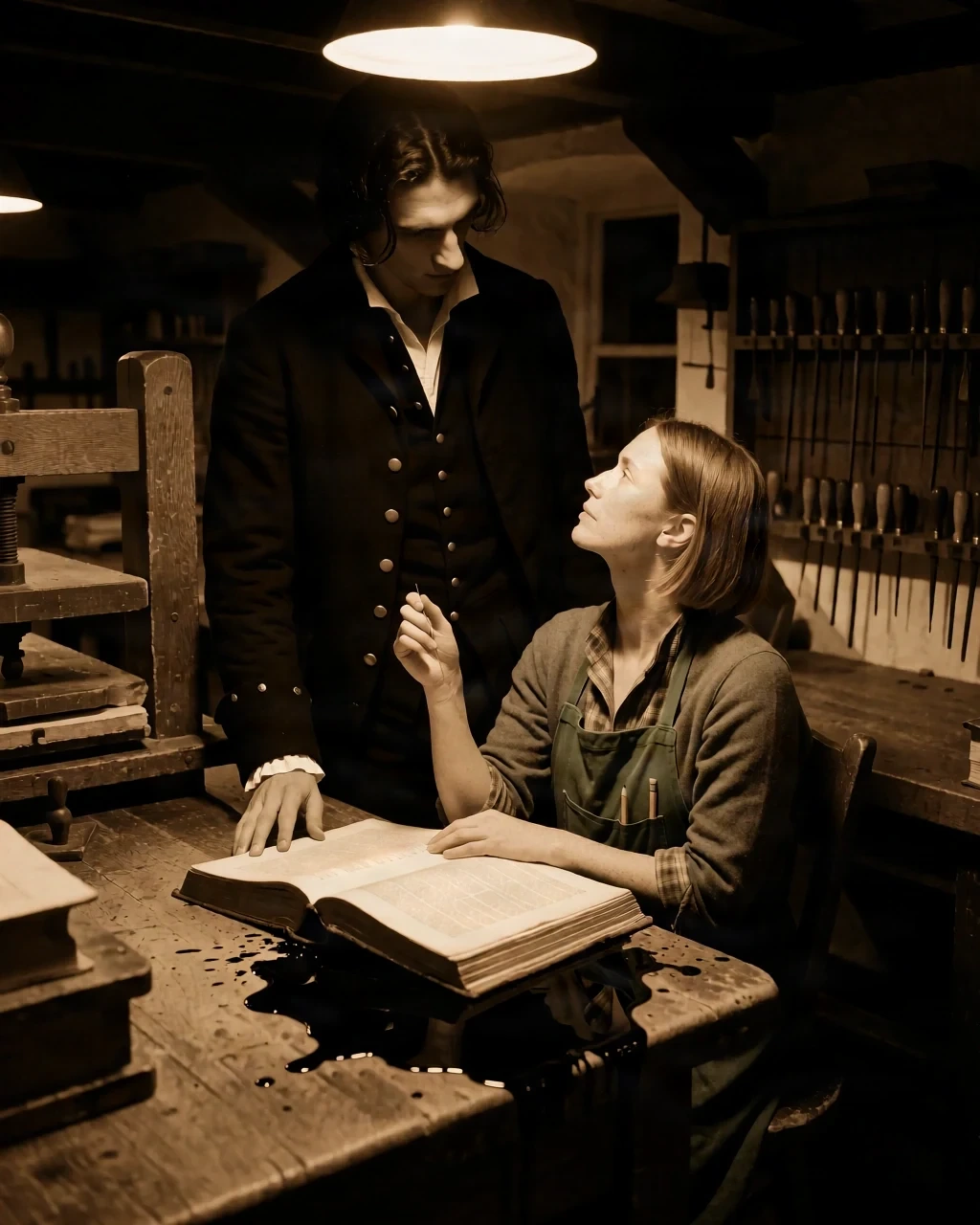
Her · Wren · Chapter 1
Kettle Stitch
MALACHAR
Whoever mends this book, mend it slowly.
The man who sewed me shut was in a hurry. He had his answer by morning, and he never slept easy again.
You are not in a hurry. You hum when you pare leather. You washed every one of my leaves by hand.
Slowly, binder. I want to remember this.
WREN
The sixteenth-century book on my bench has started writing in its own margins, and I think it's flirting.
The first line has been there since the day it came in: brown ink, an old hand, every s a long one. Binders find notes like that all the time. Monks used to write curses in theirs.
The rest wasn't there when I locked up last night. I know, because when I locked up last night I was standing exactly here in my apron, swearing at this page.
Under the words, somebody has drawn the spine. Every station, every cord, a kettle stitch at head and tail, in lines finer than my best needle.
It's the original sewing. I've spent all week trying to read it from the holes, with the client wanting it sewn by Thursday, and somebody has drawn it for me overnight, in ink. The skin on my arms goes tight.
Under the drawing, smaller:
Your fourth station is a hair too tight. Rest your thumb, little binder. It locked twice yesterday.
My right thumb goes hot. Then it does the thing it does, the small catch at the joint, like a drawer that sticks.
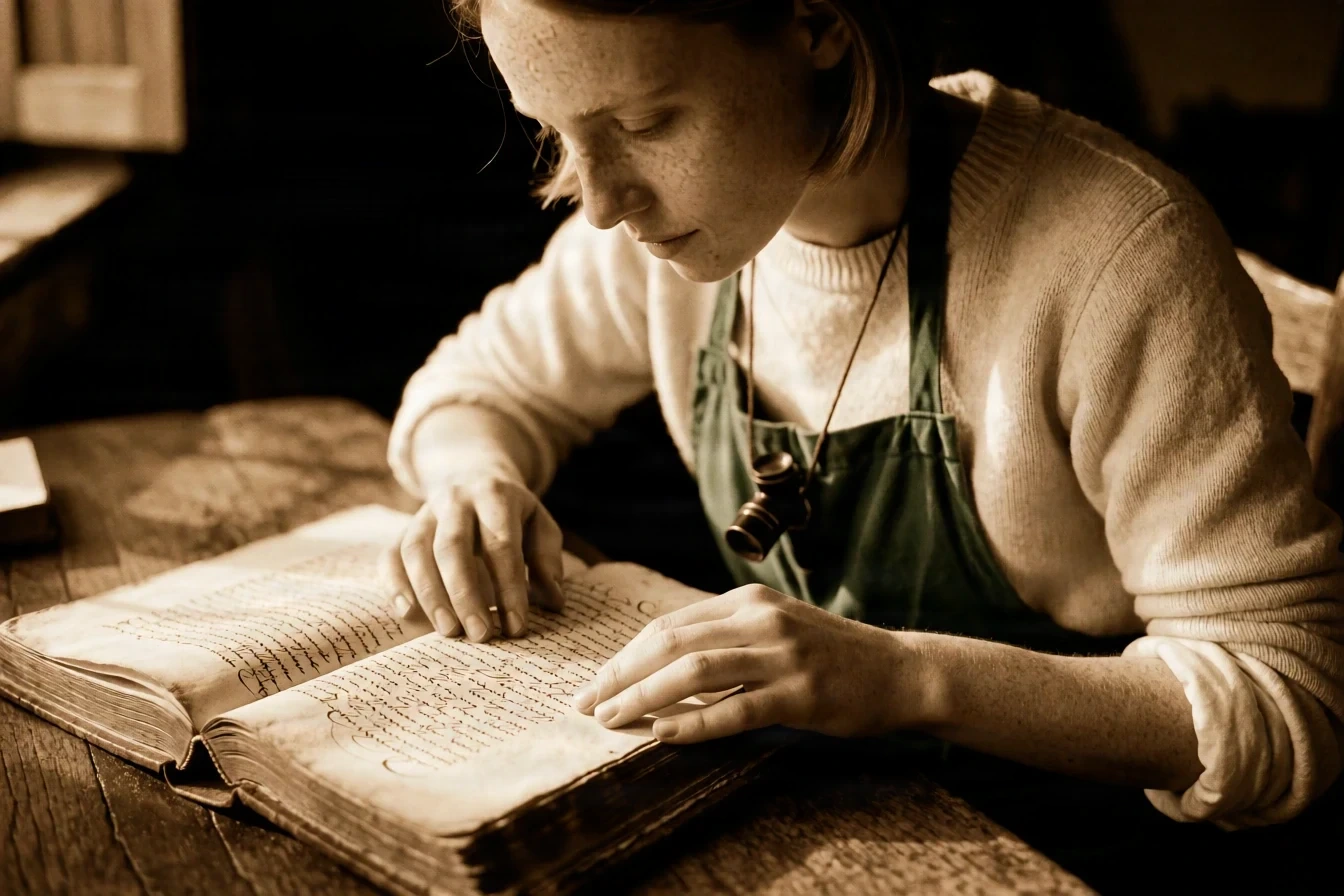
Nobody knows about my thumb. Not my GP, because I haven't been. Not my clients, because they'd take their books to someone younger.
The workshop was locked, three times over. The only other living thing in the building last night was Pica, who is a cat, who eats paper, and who sleeps upstairs behind two doors whenever there's a book on my bench.
So I do what any sensible woman would do. I check the fourth station.
It's a hair too tight.
The book is right. That's so much worse.
You don't write in a book. In my trade it's like spitting in church.
I take a soft pencil from my apron pocket, the kind that rubs out with a pinch of bread, and I write in the margin under the drawing.
Who are you.
Nothing happens, which is correct. I stand there feeling ridiculous, a grown woman passing notes to a book. I'm reaching for the bread when the ink starts.
It comes up out of the paper the way a watermark comes up when you hold a leaf to the window. Brown, then darker. One letter at a time, in no hurry at all.
The book. Mostly.
My pulse is in my thumb. I write back.
Books don't have handwriting.
This one has had four hundred and forty years to practise.
Then practise on your own paper. That's a 1583 leaf and you're writing on it in INK.
It is my leaf.
It's Mr Dacre's leaf. I have the invoice.
A pause. A long one. I don't breathe.
Fair.
Then every new word sinks back into the paper and is gone. The note, the correction, the drawing too. My pencil sits alone in the margin, shouting.
"Wait," I say out loud, to a book. "Not the drawing."
The drawing comes back. Just the drawing.
I sit down on my stool very slowly. I've been binding books half my life, and alone in this workshop for years, and I have never been obeyed so politely by anything in my life.
Mr Dacre rings in the morning.
He brought the book in a few weeks ago, in a velvet box and grey suede gloves, which is how I knew he'd never mended anything. Spine split, boards gone, sewing rotted to fluff, a flood tidemark across every leaf.
He's paying me nine thousand pounds. That's the rent on this workshop until next October, and he knows it.
"Miss Holloway. How far have you got?"
"Six gatherings left. I'll have it sewn by Thursday."
"Good. Then I have a small request." His voice is soft and careful. "Leave the last gathering for me. I'd like to sew it myself."
"You'd like to what?"
"Family tradition. Sentiment. A Dacre has always finished that book." A pause. "You'll be paid in full, of course."
I look at the page. The drawing looks back. My thumb starts to ache round the phone.
"Has it been any trouble?" he asks.
"It's a book, Mr Dacre."
"Of course it is," he says, and rings off.
I put the phone face down. In the margin, under the drawing, the ink is already rising.
He'll want to sew the last one himself.
He just asked.
Then you should know why before you decide. Whoever sews the last stitch keeps me.
Keeps you how.
The way he kept me last time. Shut.
I read it twice. The ink waits. Then, smaller:
You can stop. Box me up, give me back, and you'll never hear from me again. That's allowed. I want you to know it's allowed.
That's what does it. Not the ink. Not the diagram. A thing in a book telling me I'm allowed to leave.
Here's what a sensible woman does. She boxes the book. She rings Mr Dacre back, says what a lovely tradition, and takes nine thousand pounds for a job three-quarters done.
Here's what I know. Mr Dacre handles sixteenth-century paper in suede gloves. I wouldn't let him sew a shopping list.
And nobody finishes a book I've started. Not the client. Not God.
I pick up the pencil.
Midnight. Last gathering. Don't watch.
I'll watch.
Then don't comment on my tension.
There's a long pause. Then, very small, in the corner of the margin:
No promises.
I laugh, alone in my workshop, at a book. It's the first time I've laughed out loud since spring.
At midnight the lane is black and wet, and the Minster bells have just finished telling the whole of York about it. One lamp. The last gathering in the frame, the thread twisted the way an old woman in a cold room taught me when I was an apprentice.
My thumb aches. I sew anyway. In along the fold, out, round the cord. The margins stay blank. He keeps his word.
If my thumb goes, I go. It's the only thing I've ever been good at.
The last stitch is the kettle stitch, the little knot that locks each row to the one before. I loop it, and pull it home.
Every leaf goes dark. The ink runs out of the margins and pools on the last blank leaf, black and glossy, and spills over the bench to the floor.
And stands up.
He's tall. Taller than the lamp, so his face is half in shadow, and dressed for a funeral in another century: black wool, a white shirt open at the throat, too many buttons at the cuffs.
He looks at my hands before he looks at my face.
"You stitched me back together, little binder," he says. His voice is low and unhurried and very polite. "Now I'm yours to finish."
I put the needle down carefully, because I'm a professional.
"I'm not finishing anything. I'm calling the police."
"And telling them what?"
"That a man came out of a book."
"They'll ask which book."
"It's on the invoice."
That nearly gets a smile out of him. It looks like a hinge that hasn't moved since the old Queen.
"If you're the handwriting," I say, "show me your hands."
He holds them out, palms up, under my lamp.
Long fingers, the tips stained brown. Ink. And round his left wrist, just under the skin, pale against him: a band of stitches.
My stitches. I know them like my own signature. Even, a hair tight at one station, a kettle stitch locking every row.
I take his wrist. I don't ask. I turn it to the light, the way I'd turn a leaf to check the sewing, and I run my thumb along the band.
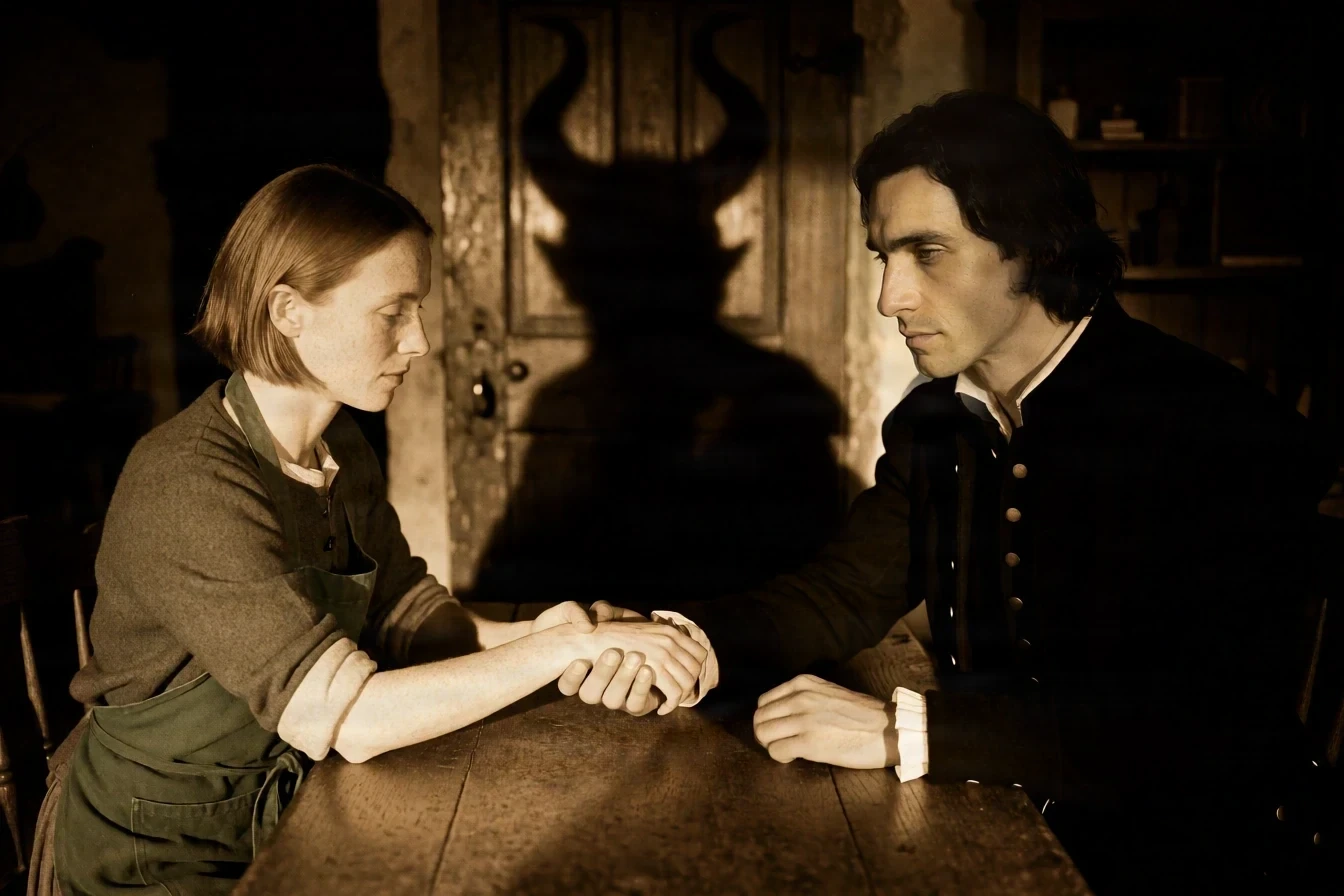
He goes completely still.
Not calm. Still, like a press screwed down as far as it will go. His hand is open in mine and I can feel it wanting to close round my fingers, and not closing. A muscle is working in his jaw.
"Four hundred and forty years," he says quietly, "and nobody has touched me without wanting something."
"I want something."
"What?"
"To know if my tension's even."
His breath goes out of him in something that's nearly a laugh. "It's even. You did it slowly."
"You watched."
"I felt it. Nineteen days, every leaf." His eyes are on my thumb. "You turn the pages from the corner. You talk to the paste. Every night you put your hand flat on the last leaf before you switch off the lamp."
I do. I didn't know anybody knew.
His skin is warm. Warmer than skin should be. I could stand here all night reading the band round his wrist with my thumb, and he'd let me, and I think it would cost him more than anything he's paid in all his centuries.
He hasn't moved a finger. I want to know what happens when he does.
I let go. My thumb is the last part of me to leave his skin.
Then the shop door handle turns.
Not a knock. The handle, turned slowly, by someone who expected it to give.
He doesn't look surprised. He goes to the door and stands close to it and speaks through the wood, low and even, the way you'd read a man his own address.
"Your daughter is nine tonight, and she's still awake, waiting for you to ring. Go home."
Silence. Then footsteps, going away fast down the lane.
"Mr Dacre's driver," he says. "Sent to take me before you'd finished. He's late."
My lamp is behind him. His shadow runs along the floorboards and up the old door in front of him, long and black and perfectly still.
It has horns.
He doesn't. I look at his head, the black hair a little too long at the collar. Then at the wall. Then at him.
I don't say anything. I put it away the way I'd put away a forged bookplate: noted, kept, not mentioned to the client.
"How do you know about his daughter?"
"It's what I'm for."
"What are you for?"
"Answers." He turns round. "Someone asks. I know. It used to be a living."
"Have you got a name, or do I keep calling you the book?"
"You've got it. It's in your thread."
"Then I'd like to hear you say it."
He looks at me as if nobody has asked him for anything nicely in a very long time.
"Malachar," he says.
He says it like a man handing over his coat.
"And Mr Dacre wanted you for answers."
"Every Dacre has. For three hundred years they kept me on a shelf and asked." He says it without any feeling at all. "Which horse. Which cousin. Which ship would come home."
"And you told them."
"Whoever holds my name gets told."
"Who holds it now?"
He doesn't answer. He looks at my right hand, at the thumb that locks, the thumb that pulled the last stitch home. He keeps looking at it until my face goes hot.
"Oh," I say.
"Yes," says Malachar. "I'm afraid so."
"Well, Malachar." My voice isn't quite level. "What are you going to do in my workshop at midnight?"
"Wait to be told to leave."
"And if I tell you?"
"Then I'll go." He tilts his head. "Do you want me gone, Wren?"
He knows my name. Of course he does. It's on every invoice I've ever sent.
"Yes," I say. "Out. Door's there."
He opens it, steps into the wet lane, and walks. He gets as far as the lamp-post at the corner and stops. Not as if he's chosen to. He just stops, mid-stride, at the end of something.
He comes back, leans one shoulder on my doorframe, and looks at me with enormous patience.
"How long was your thread?"
I look at the empty spool. "Fourteen yards."
"Then I'm afraid," he says, "you've got me for fourteen yards."
I laugh with my forehead on the cold bench. When I look up he's watching me as if he's waited a very long time to hear what it sounds like.
"It isn't funny," he says.
"It's a bit funny. You're a ghost on a lead."
"I'm not a ghost." He considers it. "I'm a gentleman on a lead."
He comes in out of the wet and reaches past me to my bench. He picks up my shears, the long ones, and holds them out to me handles first.
"You can end it," he says. "Cut your thread, and I'm not your problem."
"What happens to you?"
He looks at the shears, not at me. "I'd be gone."
They're heavy and cold. The book lies open on the bench, sewn and unboarded, with fourteen yards of my thread running through it, holding him to my workshop.
One cut. I can see exactly where.
I put the shears in the drawer, and I shut it.
Then I pick up the book, and I tuck it under my arm, and I carry him upstairs.
End of chapter 1
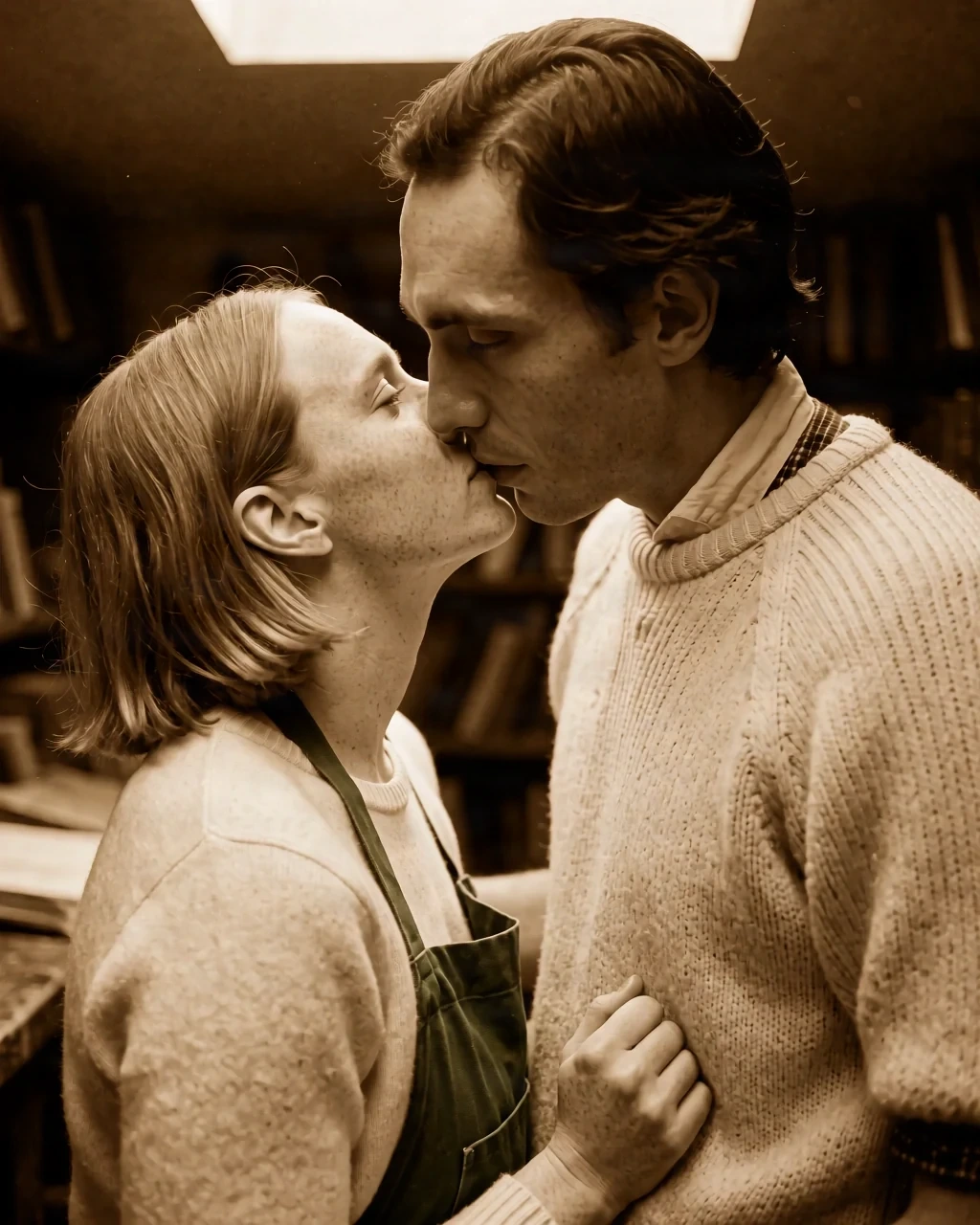
Next · chapter 2 · His · Malachar
Fourteen Yards
She carries me up nineteen stairs under her left arm, the way she'd carry a ledger, and I walk up behind her.
Chapter 2 is free with an account.
Complaints: support@teasing.me, resolved within 5 business days. Complaints policy · Anti-trafficking policy