
Her · Elise · Chapter 1
The Lamp
LUCIEN
Three hundred and fifty-four days.
I have one rule. I don't go in while she's home.
Tonight I left the lamp on, so she'd know I was there.
ELISE
The man who's been breaking into my flat for a year left me soup.
I don't know that yet, at the end of a night shift, standing in my own doorway with my keys laced between my fingers like the self-defence videos say. All I know is that the lamp in my kitchen is on.
I don't leave lamps on. I'm a pharmacist on nights. I count things for a living. I turn off every light and check the hob twice, and my mother would like it known that she raised me to.
So I count.
Three steps to the counter. Mug, rinsed, upside down. Window shut. The chain on the door is—
New.
Steel, bright as a dentist's tray, the screw heads still shiny from the driver. The lock above it is new too, heavy and silver, and my crappy old key turned in it on the landing like it had been waiting up for me.
On the counter, in a neat row, three new keys. Next to them, a note on heavy cream paper, in small careful capitals:
YOUR OLD LOCK OPENED WITH A CREDIT CARD. EAT SOMETHING.
On the hob, a pot. I lift the lid and steam rolls out. Garlic. Leeks. Something green and sharp.
Still warm.
"Eat something," I tell the note. "You eat something. Psycho."
My heart is going like I've taken the stairs two at a time.
I have a degree in drugs and a mortgage on a flat with a radiator that knocks, and the stupid part of me, the part that hasn't been touched since spring, is wondering what kind of hand writes capitals that neat.
I put the soup in the fridge, because I'm not an idiot. Then I look at my flat the way I'd look at a prescription that's been altered.
Couch. Books in towers. My sister's plant, which should be dead and is thriving.
And the painting.
It's the only thing I own worth anything: a small oil my grandmother bought at a market in Lyon. A woman at a window, one hand on the glass. There's been a crack across her wrist since before I was born.
There isn't now.
The crack is gone, and decades of yellow film have been lifted off like a sheet. Underneath, she's wearing blue. She was always wearing blue.
There's no dust on top of the frame.
I sit down on the floor with my back against the radiator, and I laugh, and it comes out wrong.
You don't do this in one night. You come back again and again, while I'm counting pills on Marrow Street. You sit somewhere with a tiny brush and the patience of a saint, or a stalker.
Then you hang her back up. And you dust.
My phone buzzes on the floor beside me.
Unknown number.
Lock the chain, Elise.
I stare at it until the screen goes dark. Then I do what any sensible woman alone in a flat at dawn would do. I type back.
Who is this.
Someone who should have knocked.
You think?? You were in my HOUSE.
I've been in your flat. I've never been in your home.
That's not a defence. That's a philosophy.
It's a rule.
Oh good, he has rules. I hit send before I can stop myself, then add, The soup was too salty.
It wasn't. It was the best thing anyone's made me in a year, and I haven't even tasted it.
The dots come and go twice. I watch them like a heart monitor.
It wasn't. You haven't tried it.
I look up at the window. Across the street, under the plane tree, there's a dark car with its engine off. It's been there before. I've walked past it a hundred times with my head down, counting my steps, like a good girl who doesn't look at things.
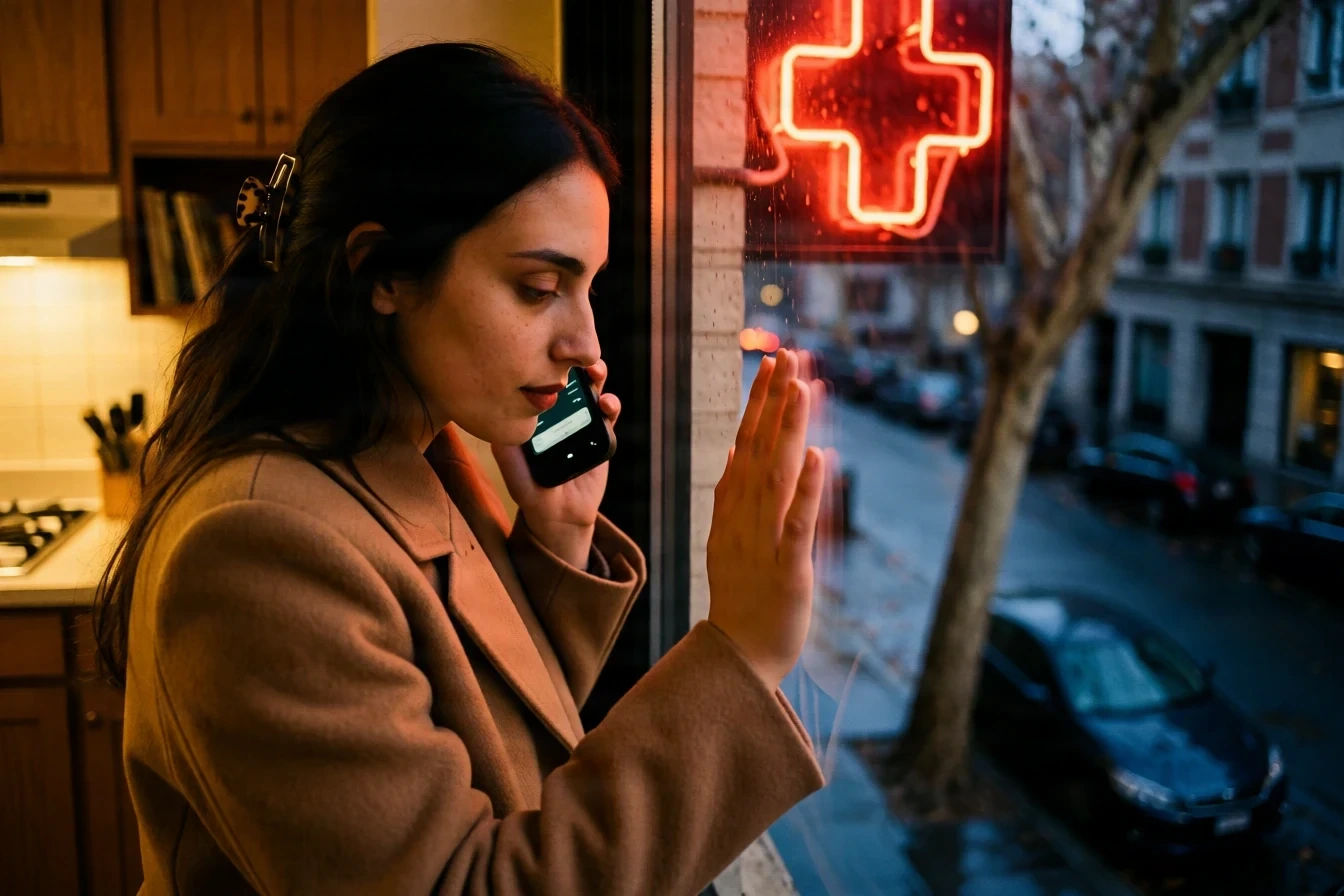
I look at it now.
Go home, I type.
When you've eaten.
I take the pot out of the fridge. I eat three spoonfuls standing at the counter, coat still on, facing the window, and I make sure he can see every one.
Then I turn off the lamp.
I sleep through the day with a chair jammed under the door handle, which is hilarious, because he has a key.
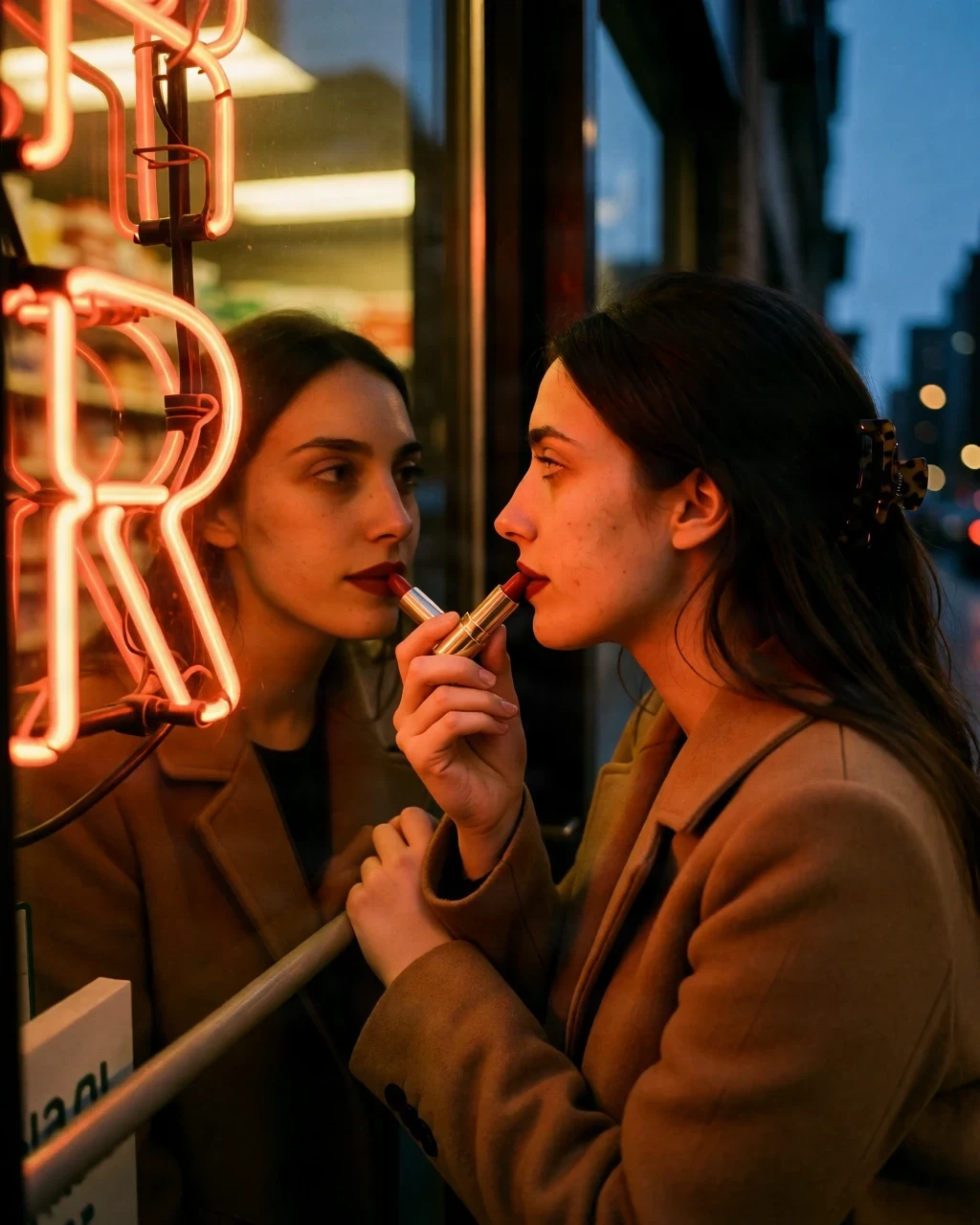
That night I put my hair up, badly, and my lipstick on, carefully, which I never do for work. I'm not asking myself who that's for.
I'm going to work, because a man has broken into my flat, changed my locks, mended my grandmother's painting and fed me, and none of that is a reason to let Dana do the controlled-drugs count on her own.
The car isn't under the plane tree.
I tell myself that's a relief.
On the bus, a man in a grey hoodie sits three rows behind me and doesn't look at me once.
That's what I notice. Everyone looks a little, at the hair or the uniform or the sheer exhaustion, and he looks at his phone like it owes him money. He gets off one stop after me.
I go in through the side door at 9:52 and stand behind it with my pulse in my ears.
Then I take the stock trolley, because it's heavy and has wheels, and I go back out.
The alley behind the bins has a broken light and a camera that's been dead since spring. The man in the grey hoodie is at the end of it, holding his phone up at my door.
Or he was.
Someone has taken it out of his hand.
He's tall, the someone. Dark coat, no hat, the kind of stillness you only see in people who've never had to hurry.
He isn't touching the boy. He's just standing close enough that the boy has forgotten how to move, and he's talking, low and even, the way you'd talk to someone about the weather.
I catch the end of it.
"—you photographed her door. Think about how much I know about yours."
The boy goes. He doesn't run, quite. He walks past me and my trolley with his eyes on the ground, and I could swear he says sorry, miss.
The man in the coat puts the phone in his pocket, turns round, and sees me.
I know him. That's the worst part. I know him before my brain catches up, the way you know a song from the first two notes.
"You," I say.
"Me."
"You changed my lock."
"Your old one opened with a—"
"Credit card. I read it." My voice cracks on read and I hate it. "Who was that?"
"Someone who was paid to take a picture of you."
"Paid by who?"
"By someone who won't be paying anyone again." He says it the way you'd tell someone their bus is cancelled: sorry, nothing to be done. "He'll lose his lease this week, and his friends will stop answering his calls. That's all. I promise you that's all."
"You promise me." I shove the trolley aside. A wheel catches on the cobbles and it lurches, and his hand comes down over mine on the handle to steady it.
Cool. One second. Then he lets go, the way you'd put down something you aren't allowed to keep.
"You've been in my flat."
"Yes."
"For a year."
"Three hundred and fifty-four days."
"Oh, you count." I laugh, and it comes out high. "Of course you count. You restored my grandmother's painting with what, a tiny brush and the patience of a saint, and you couldn't bleed my radiator?"
"You'd have noticed the radiator."
"I noticed the soup."
"Yes," he says. "That was what the soup was for."
Above us, the broken R on the pharmacy sign flickers red, red, dark. My breath comes out in fast white clouds.
His doesn't.
I notice it the way I notice a patient's hands shaking: filed, not mentioned. It's cold enough to see your breath. There's nothing in front of his mouth at all.
"You fixed her," I say, quieter. "The woman at the window."
"She was going to split at the wrist."
"She was my grandmother's."
"I know."
"How do you—"
I don't finish. I walk the last three steps and take his right hand and turn it over under the red light, the way I'd turn a box of tablets to read the small print, and he lets me.
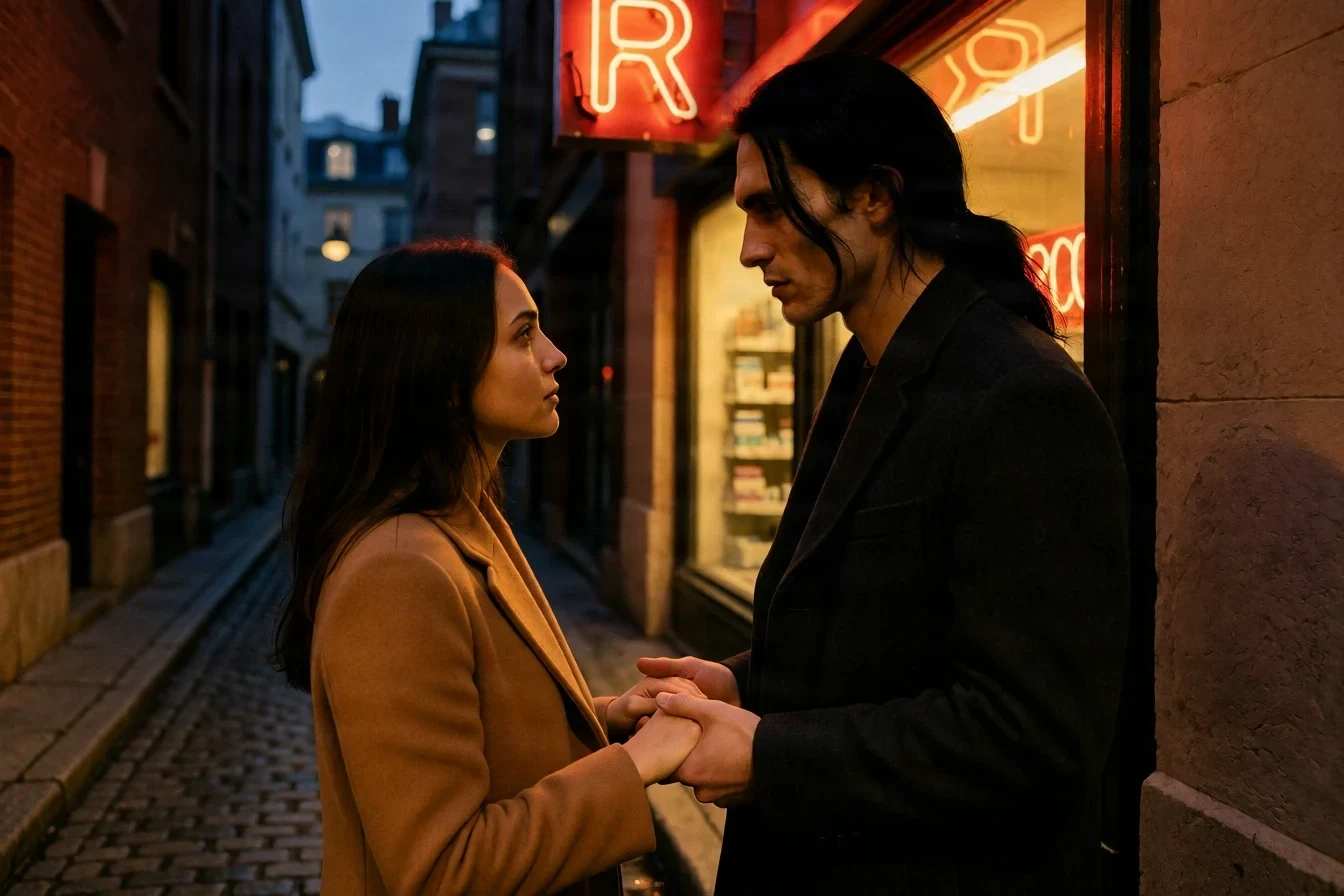
His palm is cool. Long fingers. And dark red paint ground in beside one thumbnail, like he dipped it in wine.
I know this hand.
Back in the spring, a man came into the pharmacy in the small hours and bought one box of plasters. He paid in coins and counted them onto the counter one at a time, slowly, like he had all night. He never looked up.
I went home and thought about his hands for a week. In bed. In detail.
"Plasters," I say. "In April. You paid in coins."
"I did."
"You counted them out one at a time. I thought you were a weirdo."
"I was buying time."
"You are a weirdo." My thumb is still on his paint, and I can't seem to move it. "Why me?"
He looks at my mouth. Then, very deliberately, back at my eyes.
"Ask me something I can answer."
"Fine. Your name."
"Lucien."
"Lucien what?"
"Lucien who has been very patient."
That's when I understand that he's holding still. Not calm. Holding still, the way you hold a full glass. There's a muscle going in his jaw, and his hand is open in mine like he's been told not to close it.
Nobody has ever wanted to touch me so badly they had to stand still to stop themselves.
It's the most frightening thing that's happened to me all year, and that includes the soup.
"Are you going to tell me what you are?" I ask. "Because your breath isn't doing the thing breath does."
"Not tonight."
"Is that a no?"
"It's a not tonight." The corner of his mouth moves. It isn't a smile. It's what a smile would be if it had been locked up for a long time. "You have a shift."
"I have to go in," I say. "Dana can't count past forty without help."
"I know."
"Of course you know." I let go of his hand. It's harder than it should be. "I'm off at six."
"I know that too."
"Then you know I'll be tired, and in a terrible mood, and I'll have questions."
"Ask them," he says. "I'll be outside at ten past."
"I didn't say I wanted you outside."
"No," Lucien says. "You said you were off at six."
The shift is the longest of my life. I count everything twice.
Dana asks if I'm all right three times. The third time, she leans on the counter and says, "Is it a man? It's a man. You're wearing lipstick."
"I've met someone," I say, which is a lie, because what I've met is a situation.
"Is he nice?"
I think about a boy walking out of an alley saying sorry, miss. About soup. About a hand held open in mine like a promise.
"No," I say. "I don't think nice is the word."
In the dead middle of the shift my phone lights up under the counter.
Eat something.
I eat Dana's biscuits. I don't reply. I don't need to. He can see the window from the car, and I make sure I'm standing in it.
At 6:04 I take my lipstick out of my bag and put it back without using it.
At 6:07 I use it.
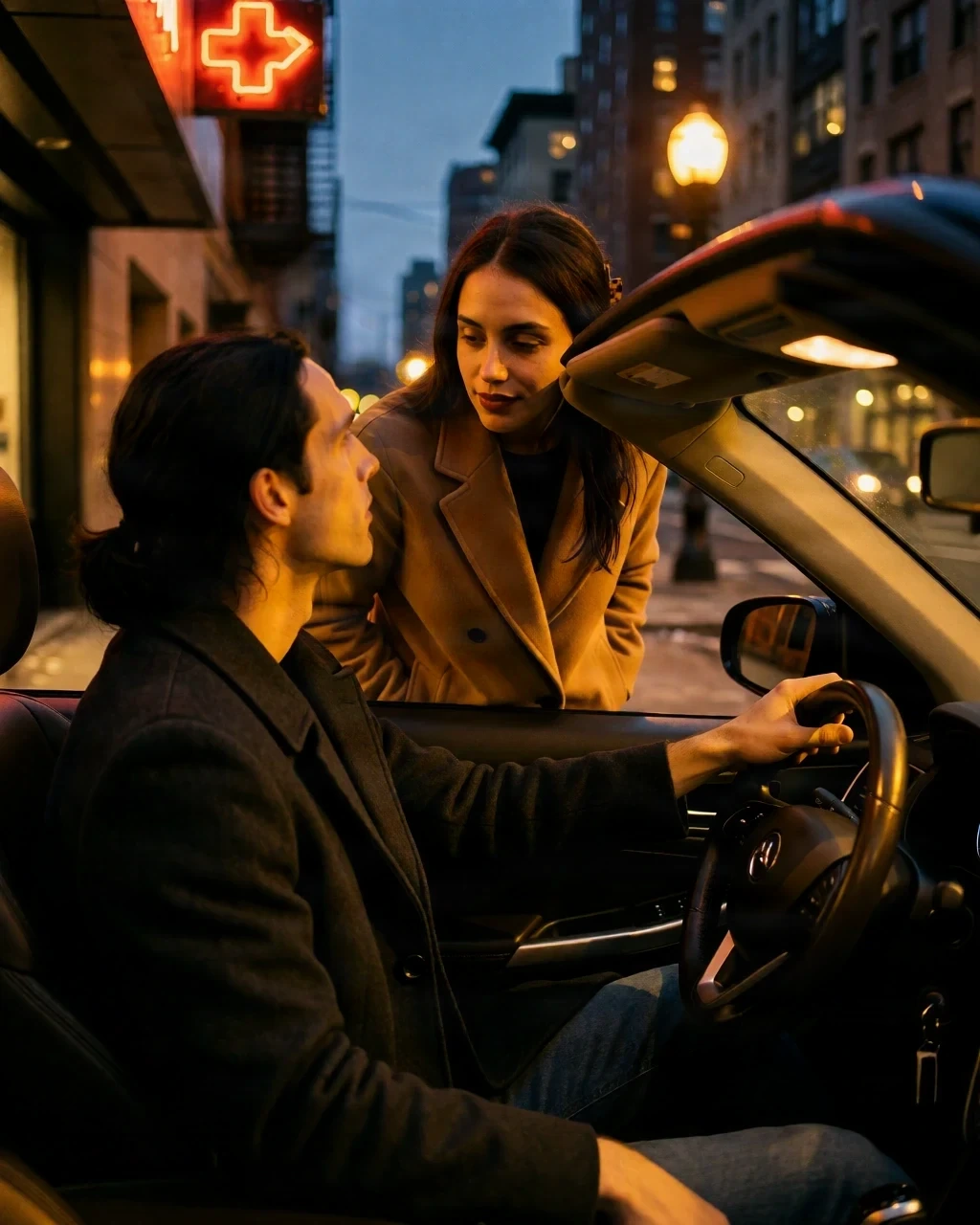
At ten past six I come out of the side door in my coat, cross the empty street in the grey half-light, and knock on his window with one knuckle.
End of chapter 1
Next · chapter 2 · His · Lucien
Ten Past Six
She knocks on my window like a woman who has already decided, and I forget which button lowers it.
Chapter 2 is free with an account.
Complaints: support@teasing.me, resolved within 5 business days. Complaints policy · Anti-trafficking policy