
Her · Ivy · Chapter 1
Room Tone
AUGUST
Last page. Pencil, under the notes, where the words would go:
For the wo- man who lis- tens.
Three owners before her. I played each of them out of this house inside a month.
This one sits on the third stair from the top and hugs her knees until I stop.
Tonight she left a microphone on my bench. Good.
IVY
The piano in my back parlor plays itself at three every morning, and he's rushing the left hand.
I've listened every night since I moved in. Every night from the third stair from the top, in my robe, knees up, heart going, telling myself that old houses settle, and that settling can sound like a nocturne if you're tired enough.
Last night I stopped telling myself things and left a microphone on the bench.
Now it's morning. Coffee, kitchen table, my good headphones. Mono is on the chair across from me with her back turned, which is how my cat says she isn't involved.
I spent my whole career in Nashville making other people's records, and every dollar I made went into this house on Jones Street, in Savannah. I have eleven days to turn that parlor into a room people will pay to sing in.
I press play.
Room tone first: the hiss of a quiet room, which is never quiet. And under it the hum, low and stubborn, the one I've hunted for three weeks.
At 3:00 exactly, the piano.
It's good. That's the problem. I've recorded people who sell out arenas, and they don't play like this. Slow, dark, private, the left hand rolling under the right, and it doesn't sound like anything I know. I know a lot.
A few minutes in, it stops in the middle of a bar. Not an ending. A lift, as if someone took the needle off.
A long stretch of hiss. I reach for the mouse.
"Ivy."
A man's voice. Low, unhurried, so close to the microphone I can hear the shape of his mouth on the vowel. Right in the middle of my head, where only good headphones put things.
I take them off. I put them on the table very gently, the way you'd put down a snake.
"Mono," I say. "Did you hear that."
Mono is deaf in her left ear and doesn't use the right one for anything she doesn't want to. She washes a paw.
I play it again, zoomed in, because I'm a professional and my hands need a job that isn't shaking. There it is. Ivy. A neat little island in a sea of hiss.
And nothing in front of it.
Every voice I've ever edited starts with a breath. I've cut more of them out of vocals than I could count. You can't say a word without drawing air first. It's the one thing nobody fakes.
He didn't.
The back of my neck goes cold and tight. Lower down, somewhere I'm not going to examine, it goes warm, because of how he said my name. Patiently.

A sensible woman would call the realtor. She said the house had "a reputation" in the same voice she used for "original heart pine," and knocked a chunk off the price.
I take the recorder down to the parlor instead.
In daylight it's just a room. High ceilings, tall shutters, the oaks outside. And the piano, black and enormous. It conveyed with the house because nobody in a hundred years has managed to get it out.
I sit on the floor with my back against the wall and press record.
"Okay," I tell the room. "If you're going to say my name, you could at least say good morning."
A stretch of nothing. I stop, rewind, play it back on the little speaker.
Hiss. My own breathing. Then, close:
"Good morning, Ivy."
My heart stops being polite. It's texting somebody on the moon: a thirty-second delay, and no proof he's real except the reply.
Record. "Who are you?"
Rewind. "August. I live here."
"I live here," I tell the room. "I have a mortgage that says so."
"I have a piano that says so."
"The piano conveyed. Page nine of the contract." I lean my head back against the plaster. "So legally, you're a fixture."
The playback is silent so long I think I've lost him. Then I hear it under the hiss, small and rusty. A laugh. The sound a man makes when he's forgotten where it goes.
"You can hear me, Ivy." Quieter. "No one has heard me in a hundred years."
I sit with the speaker in my lap and the sun on my bare feet.
"Hearing people is my whole job," I say, when I can.
Rewind.
"Then come down at three. Turn the house off. All of it."
"Houses don't have an off switch."
"This one does. It's in the hall, and it hums."
I spend the day on the parlor floor with a meter on my chest. The hum is everywhere and nowhere, in the walls, in my back teeth.
A singer is booked in eleven days, my first paying session. Under her voice this room has to be dead quiet.
I don't have another plan. I've never needed one this badly.
At ten to three I'm in the hall in my robe and socks, with a flashlight in my teeth, in front of a gray metal box.
Every horror movie I've ever seen is screaming at me. I've seen a lot of them. I have opinions about the ones where she goes into the basement.
I pull the main breaker anyway.
The house dies around me. The fridge cuts out mid-shudder. The vents sigh and stop. And the hum, the hum I've chased since I moved in, goes out with it.
Silence. Real silence, the kind I've only ever heard in one room in Nashville that cost a million dollars to build.
I walk into the parlor by the streetlight through the shutters and sit on the floor.
At three o'clock, the piano begins.
Not from a speaker this time. From the room. Every note lands on my skin before it reaches my ears.
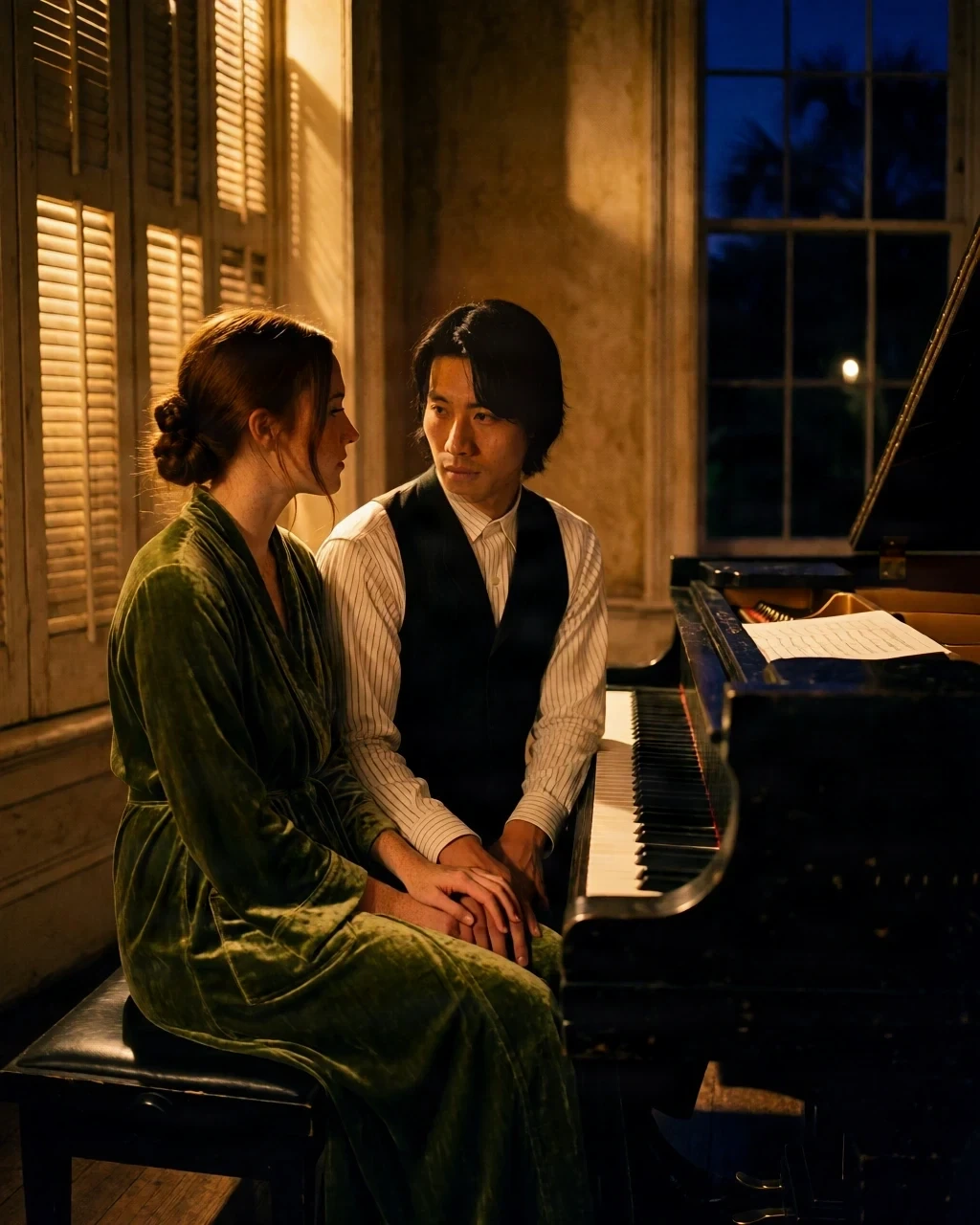
And there's a man at the bench.
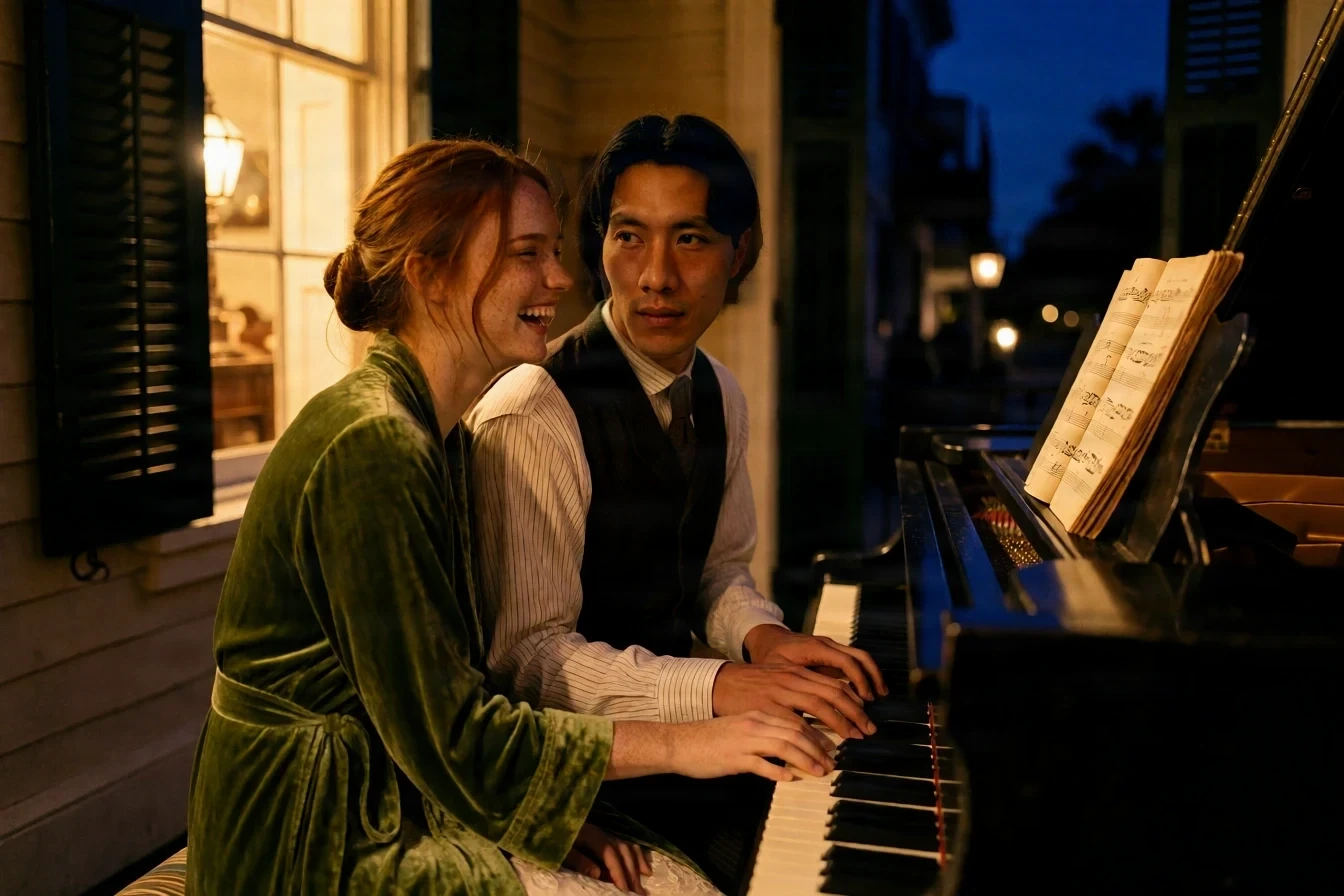
Shirtsleeves, dark waistcoat, collar undone at the throat. Black hair that falls forward when he plays. A long back, long hands, eyes shut. The streetlight lies across him in bars, and he doesn't throw a shadow on the keys.
He plays to the bar where it always stops. His hands lift and hang there.
Then he turns his head and looks straight at me.
"You turned it off," he says.
"You told me to."
"I've told a lot of people a lot of things." The voice from the tape, without the hiss. "You're the first one who listened."
"You're rushing the left hand."
His eyebrows go up. Dark eyes, a face younger than his voice. "I've been playing that left hand since 1924."
"How old are you?"
"Thirty-four." A pause. "For a while now."
"Then you've had a while to fix it."
"I came down here because of a hum." I get up off the floor. "Sixty cycles. Two electricians. If it's still here in eleven days, I lose the house."
"It's the bell wire."
"The what?"
"My mother had a bell put in every room, to ring for coffee." He nods at the wall left of the mantel. "Third panel. Behind it."
"Behind it is plaster."
"Behind the plaster. Before you were born, a man in a red cap ran your new cable down the old bell run, to save himself a hole. I watched him. He whistled the whole time. Flat."
Three weeks. Two electricians. One dead man who noticed the whistling.
I cross to him. Close up there's a smear of ink along the side of his right hand, blue-black, a writer's smear.
Before I can think better of it, I put two fingers on his sleeve. Cotton. Cool. There.
He looks down at my fingers as if they've said something to him in a language he used to speak.
"Can you touch things?" I ask. I take my fingers back. They're shaking.
"The piano. Only what reaches for me." A rule of the house, said plainly. "Nothing in this house has reached for me in a very long time."
I hold my hand out, palm up, in the bars of light between us.
He goes very still.
"Ivy," he says. "Are you asking?"
"I'm reaching. Isn't that the rule?"
He lifts his hand off his knee. It takes a long time. It hovers over mine, and I feel it before it lands: a coolness, the air over a lake at night.
Then his palm settles into mine.
It has weight. That's what undoes me. Not cold. Cool like a piano key at dawn, and real, and a whole hand's worth of heavy.
I can feel everything. The long bones. The ridge on his middle finger where a pen sat for years. And a stillness in it that isn't peace at all.
His fingers don't close. He lets his hand lie open in mine, and his jaw works, and his eyes shut. He's holding still the way a singer holds a note she can't afford to crack.
"How long," I say. My voice comes out wrong. "How long have you wanted to do that?"
"Since the first night you sat on the stairs." He opens his eyes. "Twenty-three nights."
Nobody has stayed up for me in years.
I don't say it. I close my fingers around his instead, slowly, so he can watch me do it, and his breath would catch if he had any.
"You've been listening to me," I say. "Not just me to you."
"I can't help where I am." He looks down at our hands. "You hum in the kitchen. A B-flat that wants to be a B. You talk to the cat in two voices, and hers is ruder."
"Hers is accurate."
"You sat on the stairs on Tuesday with the window open in the rain, and caught cold, and told her it was allergies."
"That's three things. You're keeping a list."
"I've had a hundred years with nobody to keep one about." His thumb moves, once, across my knuckles. Then it stops, as if he's caught himself stealing. "You can leave, Ivy. The door works. The last ones found it."
"Found it, or got shown it?"
"I played. Every night at three, a little louder. The last week, badly, on purpose." He says it simply. "They were gone in twenty-six days."
"That's evil."
"It was effective."
"Are you going to play me out too?"
He turns my hand over in his, palm down, and studies the back of it.
"That depends," he says, "on whether you stay up."
Mono comes in out of the dark hall, jumps onto the end of the bench, walks the length of it, and sits down against his hip.
"Traitor," I tell her.
"Every night," August says. "She likes the low notes."
I look past him at the stand. There's a manuscript on it, the paper brown at the edges, open to the last page. The notes are in the same hurried blue-black as the smear on his hand. At the top, in careful script: 1924.
"Is this what you play?"
"Yes."
"Why do you stop there?"
"Because that's where it stops." He doesn't look at the page. "I can't play past it. I've tried every night."
"For a hundred years."
"Give or take a leap year."
I laugh. It comes out of me too loud for the room, and he shuts his eyes again while it lasts.
The last bar is half written. The final note has a stem and no head.
I reach past him with my free hand and touch it, one finger, where the ink runs out.
When I take my finger away, it's blue-black. Wet.
All this time, and it hasn't dried.
I wipe it on my robe and say nothing. I file it, a click on a vocal take, something to come back to with the volume up.
Under the bass line, where the words would go if it had words, there's one line in pencil. New pencil. It still shines.
For the wo- man who lis- tens.
I don't ask who it's for. My face asks for me, and goes hot doing it. When I look at him, he's watching my mouth. He looks away from it, a century too late to fool anyone.
"You should turn the house back on," August says quietly. "Your milk will spoil. You have a session to save. You should go to bed."
"You first."
"I don't have one." The corner of his mouth again. "I've had a long time to notice."
Out in the hall the breaker waits in the dark, my flashlight on top of the box where I left it. One switch, and the fridge shudders back to life, and the hum comes home, and he goes wherever he goes.
He's right about the milk. I have a wire to find and eleven days to save my life.
I sit down on the bench beside him and hold out my other hand.
End of chapter 1
Next · chapter 2 · His · August
Dead Air
Nobody has sat on this bench with me since my mother taught me scales on it. She sat on the left.
Chapter 2 is free with an account.
Complaints: support@teasing.me, resolved within 5 business days. Complaints policy · Anti-trafficking policy