Her · Cass · Chapter 1
The Cue Light
JUDE
My setlist, in my own hand, gaffer-taped to her desk before she's in the building.
Seventeen songs. A line through Don't Wait. I'm done with that one.
Encore: Cass.
Under it, in red, for the crew: Do not cut. If she cuts it, let her.
CASS
My ex has gone platinum singing about me, and his encore breaks curfew by four minutes.
It's taped to my desk at stage left, in handwriting I'd know in the dark. A line through Don't Wait. Then the encore, one word, in capitals that lean forward like they're late for something.
CASS.
The building pulls the power at eleven and fines the promoter for every minute after, and the promoter takes it out of me in ways that never show up on paper.
I've called shows on every continent that has a stage, and I have never once run over.
Today I want one thing: to open the biggest tour in the world without a single late cue. I have until doors to do it, and my mouth has gone dry over a piece of paper.
"Don't," I tell the show clock.
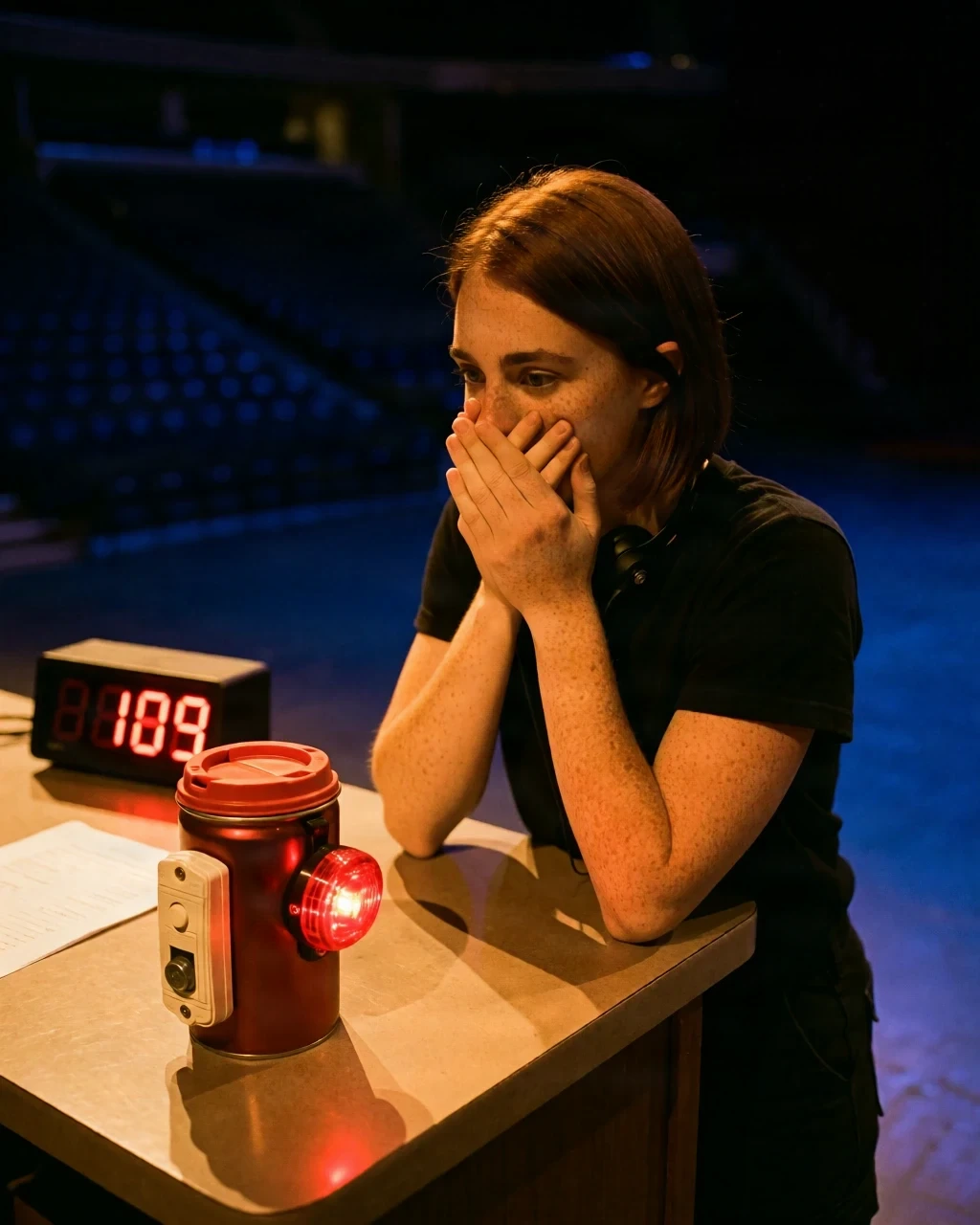
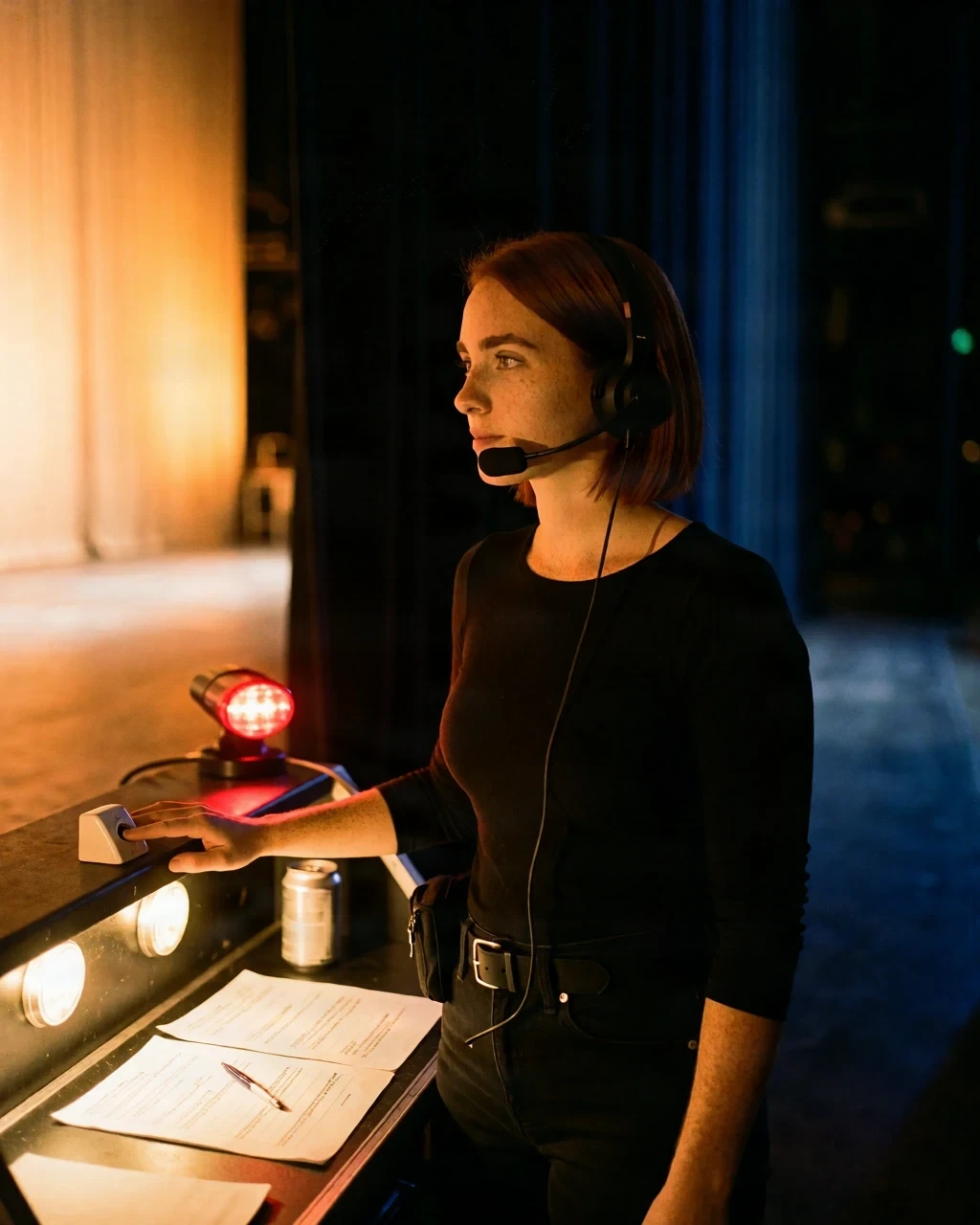
It's bolted to the corner of my desk, big red digits counting down to doors. It is the only man in my life who has never lied to me. It says 07:58:14, and it keeps its opinions to itself.
Then I see what's beside the setlist, and I stop being funny.
Wired into my brand-new desk, which cost more than my car, between the god mic and the comms panel, is a coffee can.
Red, dented, the label half gone. A bicycle light is bolted through the lid. On the side is a white plastic doorbell, the four-dollar kind from a hardware store, and someone has run its cable into my desk and labeled it with a strip of tape.
CASS. LAST SONG.
My hands go cold, then hot. My body knows before I do, the way your foot knows a stair in the dark.
He built this. In a van in Ohio, the summer I was nineteen, so I could tell him from the back of a screaming bar that it was time for the last song. I pressed the doorbell. A red light came on at his feet. He looked for me.
I left him in a parking lot with a note on the dashboard. I didn't take the can.
He did.
"Cass." Tash, in my left ear, from somewhere up in the rig. "You've been staring at a coffee can for a full minute. Is it a bomb? Tell me if it's a bomb."
"It's not a bomb."
"Is it his?"
Tash is my assistant stage manager, and she has a gift for asking the one question I've decided not to hear.
"It's a cue light," I say. "Leave it."
The comms panel clicks. Channel two lights up amber.
Nobody uses channel two. Channel two is me and the artist's talkback mic, for emergencies, and the artist isn't due for hours. The artist's people sent an email about it. It had a font.
"It still works," says a voice in my right ear. "I checked."
Low. Rough at the bottom, the way it gets after a long night of singing. I've heard it in taxis and grocery stores and at my own sister's wedding, where the band played him for the first dance.
I haven't heard it this close in eleven years. It's inside my head, and my whole body has turned toward it.
"This is a closed channel," I say.
"I know. I asked for it."
"You can't ask for a channel. It's not a song request."
"I asked nicely." A pause. "You cut your hair."
I look out. The house is black and empty, and the work lights are in my eyes. He could be at front of house. He could be in the cheap seats. He could be up in the rig with Tash, who would sell me for a sandwich.
"Where are you?"
"Somewhere with a view of stage left."
"Here's how channel two works," I say. "If the stage is on fire, you may call me. If the stage is not on fire, you may not."
"And curfew?"
"Curfew means curfew. When I say it, everything stops. The band. The lights. You."
"I remember."
He would. Back then I wrote 11:00 on the inside of his wrist in Sharpie every night, because the bar owner cut the power at eleven, and Jude Ransom would have played until sunrise if nobody stopped him.
"Then remember this," I say, and I kill his talkback.
The amber light goes out. My heart doesn't.
"Oh my God," says Tash. "Did you just mute Jude Ransom?"
"I muted the talent."
"I'm going to say that at your funeral."
My boss calls at noon, which means somebody has already told him.
"He's in the building," he says. "Since four this morning, apparently. Cass, say the word and I'll swap you onto the ballet in Lisbon. Nobody will blink."
The sensible answer is yes. Lisbon is quiet. The ballet doesn't write songs.
"Don't you dare."
"I'm offering you an exit."
"You're offering me a headline." I'm walking while I talk, past the dimmer racks, past forty road cases with my handwriting on them.
"I'm the best stage manager you have, on the biggest show you have. If you pull me off it in week one, every person on that crew will know why."
"Which is?"
"That I'm the girl in the song."
He doesn't argue, which is how I know he'd thought it too.
I hang up. Then I go back to my desk, put my hand on the cable from the coffee can, and leave it exactly where it is.
At half past three I go to find him, because rules should be set face to face.
Under the stage it's all black drapes and blue work lights, the tunnel to the B-stage, the quick-change booth, the hydraulic lift that will push him up through the floor tonight.
He's sitting on the edge of the lift with an acoustic guitar across his knees, not playing it.
He stands up when he sees me.
He's bigger than he was in the van. Not taller. Just more of him, in the shoulders, in the stillness. Black T-shirt, black jeans, hair in his eyes, silver rings. His face has been on the side of a bus. It looks better without the bus.
"Hi, Cass."
"The building pulls the power at eleven," I say. "Your encore runs to eleven-oh-two. I'm cutting it."
"The building doesn't pull the power any more."
"Excuse me?"
"I bought their four minutes. Every city, every night. The fine, the union's overtime, the neighbors' parking." He says it like he's reading me the weather. "Curfew's still yours. I just took away the excuse."
"You can't buy curfew."
"I can buy most of it."
For a second I can't speak, which has never happened to me on a headset or off it.
"Did you buy me?"
"No."
"Did you ask for me?"
"Yes." He doesn't blink. "I didn't need to. Yours was the best name on the list."
That should make me angrier than it does. It's the first compliment anyone has paid me in years that's about my work and not my face, and it's from the one man who knows what my face looks like at four in the morning.
"Fine," I say. "Then I'll cut it because I want to."
"Then cut it."
"Just like that."
"Just like that. You were always the one who called time." He says it without any edge, and it cuts anyway. "I'm only the one who sings till somebody stops him."
"You wrote let her on my setlist."
"I meant it." He sets the guitar down against the lift. "Every song I've written in nine years is about you. Tonight I'm singing them to your face. The last one's yours to cut."
"Nine," I say. "You've been famous for nine."
"I didn't write anything for two."
That lands somewhere I don't have a word for. I look at the guitar instead.
"I've heard all of them," I tell him. "I've never made it to the end of one."
He doesn't say anything. He just looks at me like I've handed him something heavy and he's deciding where to put it down.
"Your headset's twisted," he says.
It is. The band has slipped behind my ear and the mic is pointing at my collarbone. He lifts his hand toward my temple to fix it, and stops, an inch from my hair, and leaves it there.
I take his wrist.
To move it away. That's the plan. My fingers close round it and the plan goes somewhere else.
He goes still all over, the way ninety crew go still in the half-second before I call a cue, every muscle waiting on one word. His eyes close. His other hand is a fist against his thigh.
Under my thumb his pulse is running at about a hundred and forty. I count songs in for a living. That's not a heartbeat. That's a tempo.
"You're shaking," I say.
"I've been standing still for eleven years." His voice is very quiet. "I can manage another minute."
He has forty million records and a face on the side of a bus, and he's shaking because I'm holding his wrist.
I let go before I do something about it.
"Don't touch my desk again," I say.
"I didn't touch your desk. I touched the can." The corner of his mouth moves. "The can was mine."
I laugh. I don't mean to. It comes straight out of my chest, the way it used to in the van, and his eyes open and land on me like he's been waiting all this time to hear it.
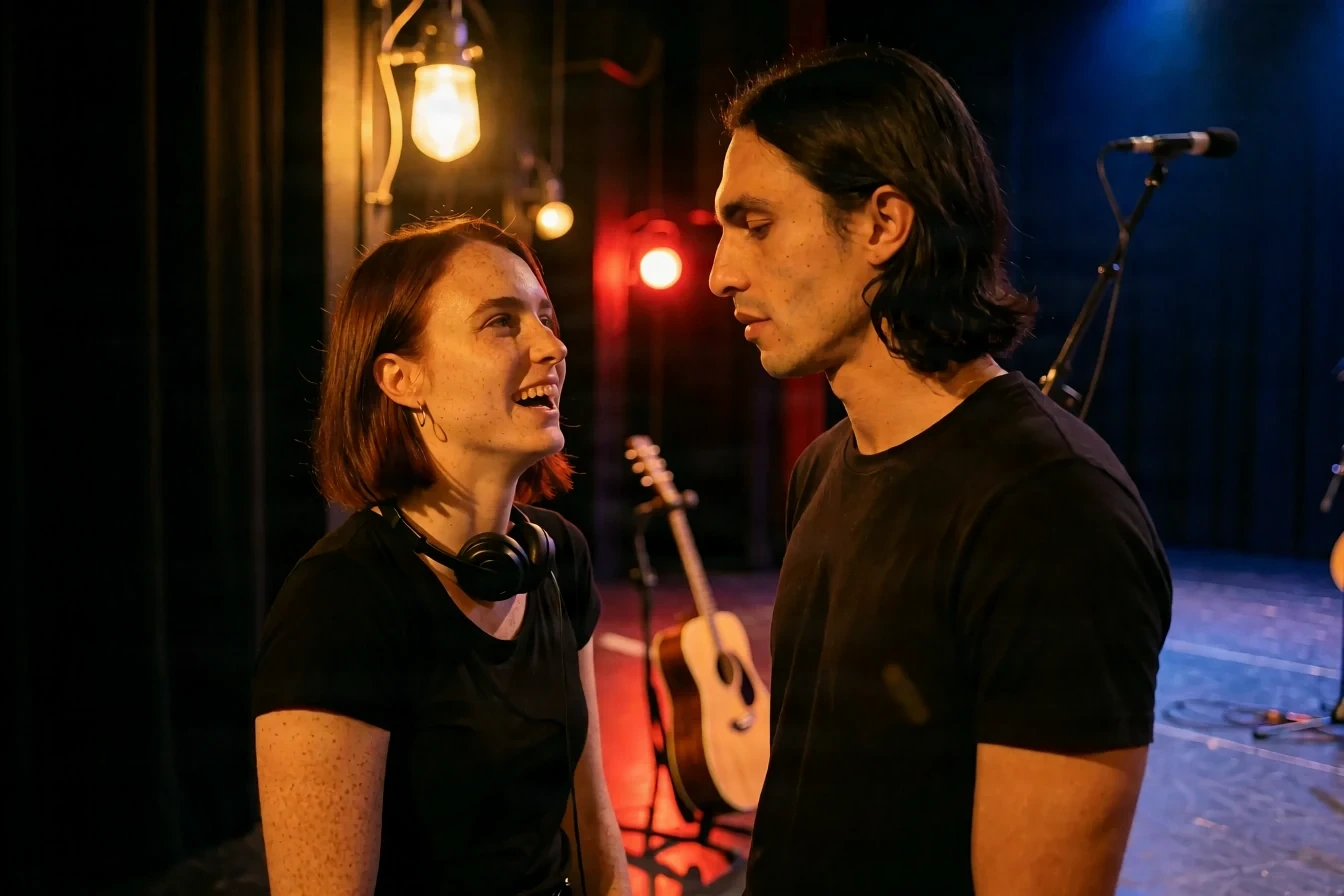
"You were in my building at four this morning."
"It's my building until eleven," Jude says. "After that it's yours."
I call the show.
Every cue on the beat. When the lift pushes him up through the floor into a white wall of light, and the noise comes up through my desk into my elbows.
He doesn't look at stage left once. I know, because I'm watching for it.
Song nine is the one with the line through it. The band skips it. The crowd doesn't.
Somebody in the upper bowl starts it, then a whole section, then the building: eighteen thousand people singing Don't Wait into the dark with no band at all. He stands at the mic with his hands at his sides and lets them.
Two words I wrote on the back of a setlist and left on a dashboard. A whole arena of strangers is singing my note back to me.
On the big screens, the camera finds his hand on the mic stand and pushes in, the way directors always do. A wall of knuckles and silver rings and the soft inside of his wrist.
There's a tattoo there. Small, faded, black. Four numbers and a colon.
11:00.
In my handwriting. The lopsided one, with the slash through the zeros, that's been on every cue sheet I've ever written. Forty feet high, in front of a crowd who think it's a lyric.
I don't say anything. Not to Tash, not to the god mic. I put it where I put a cable that's warm when it shouldn't be, and I call the next cue on time.
The band walks off and the crowd loses its mind.
The house is a black sea of phone lights. The floor is shaking under my desk.
Up in the rig, the follow-spot operators are waiting on my word, and down in monitor world somebody is holding a towel and a bottle of water for a man who isn't coming off.
He's standing in the dark at center stage with his back to the crowd. Looking at stage left.
The building's house manager arrives at my elbow with his radio held up like a warrant. He's been waiting all night for this.
"Eleven's eleven, ma'am. I've got a man on the main breaker."
"Check your email," I say.
He checks it. I watch him read it twice. His face does the thing people's faces do when a number has more zeroes than they were expecting.
"Somebody paid us for four minutes," he says. "Every night. For the whole tour."
"I know."
"Who pays for four minutes?"
I don't answer that. I'm looking at the man in the dark.
"Cass." Tash, very calm, which means she isn't. "Do we cut the encore?"
The clock says 10:58:41. It keeps its opinions to itself.
The coffee can sits next to my hand, dented and red, a lifetime older than the last time I touched it. Out there, the whole building is chanting his name.
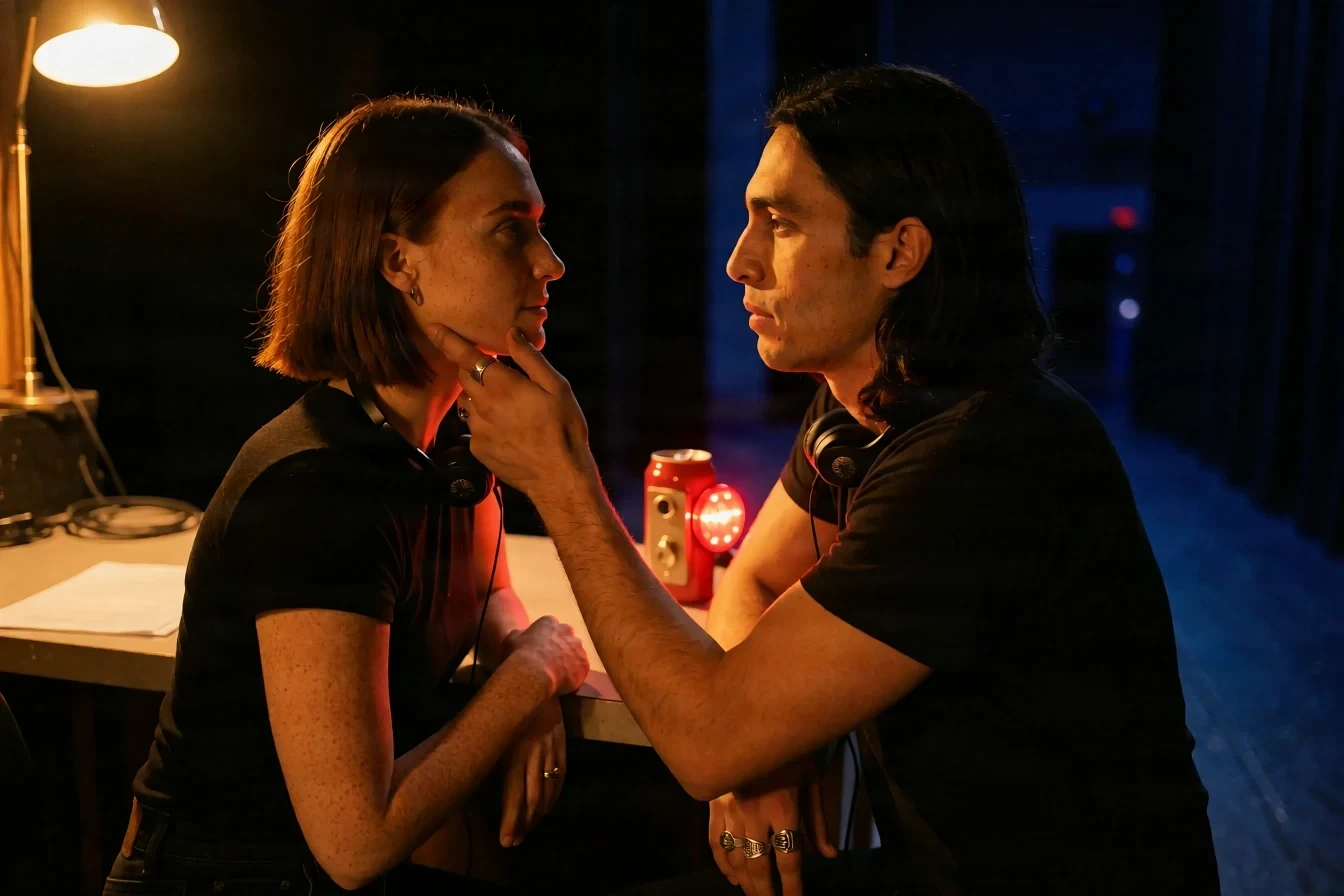
I put my thumb on the doorbell.
Then I press it.
End of chapter 1
Next · chapter 2 · His · Jude
Channel Two
The light comes on at my feet.
Chapter 2 is free with an account.
Complaints: support@teasing.me, resolved within 5 business days. Complaints policy · Anti-trafficking policy