
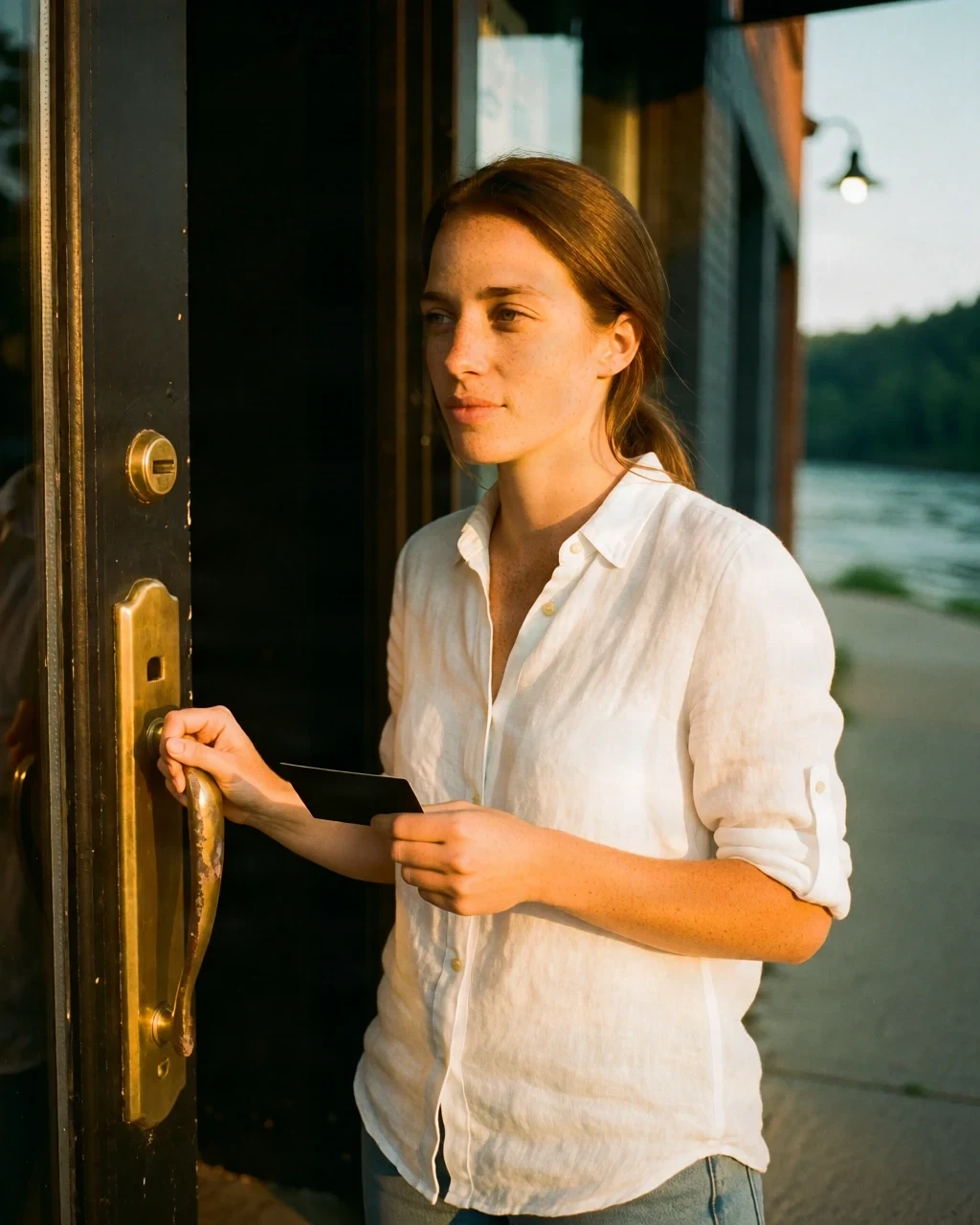
Her · Tessa · Chapter 1
The Stencil
KADE
I draw her left collarbone from memory. The line runs along the bone and forks where a wing's veins would split.
She walks her brother's bridge after midnight with a flashlight, buttoned to the throat in a heat wave. Tonight she's booked my last slot under her mother's maiden name.
I fill another page. I still don't draw her face.
TESSA
My family has two rules, and I broke both at a single red light, which is my personal best.
Nobody drives Theo's car. Nobody touches Kade Miller.
Which is how I come to be outside Kade Miller's tattoo shop on a Thursday evening, buttoned to the throat in the worst heat of the summer, sweat under my collar, here to get the evidence inked over. In my hand is the card he left under my windshield wiper.
Black card, gold letters. K. MILLER, TATTOO, BY APPOINTMENT. Under that, in pen: Thursday. Pemberton.
Pemberton is my mother's maiden name. I booked online at midnight so nobody in this town would know it was me until I walked in.
He knew by sunrise. The card was waiting at the bridge site before my coffee was.
On the back, in pencil, in small careful capitals:
4.2 CM. IT FORKS AT THE END. NO RECTANGLES.
I read it again. Under the third button of my shirt, right on the line he's describing, my pulse starts going like a pile driver.
Here's what I typed into his booking form: Cover-up. Left collarbone. Scar, approx. 4 cm. Solid black rectangle. Any artist.
Here's who has seen that scar since it healed. Me, in hotel mirrors, quickly. Not my mother. Not the man in Rotterdam who lasted two winters and thought I just really liked turtlenecks.
It is four point two centimeters. I measured it once, years ago, with a steel rule. Then I put the rule away and never looked again.
"I've been home eleven days," I tell the card, "and the only man in this town who uses metric is the tattoo guy."
The card doesn't argue. It's right.
I was twenty-four. He was twenty-two. It was December and raining, and I was driving my brother's car with my brother's best friend beside me, and then, at the bend by the ferry landing, I wasn't driving anything.
Now I'm home for one summer to sign off my brother's new bridge, and at the end of it I'm back on a plane. I'd like to get on it without the line.
"Be normal," I tell the door.
The door has a brass handle worn pale by years of nervous people. It makes no promises.
Inside it smells of green soap and coffee. Leather couch, framed flash on the walls, and a woman at the front desk with a shaved head and a septum ring, who looks at me, then at her screen, then at me.
"Pemberton," she says.
"Yes."
"Sure you are." She tips her head at the cactus by the register. It's wearing a tiny yellow hard hat. "He put that on it this morning. I asked why. He said, 'Site visit.' I've worked here forever. That cactus has never had a hat."
The cactus looks back at me with the calm of a thing that's passed its safety orientation.
Behind a folding screen at the back of the room, a machine is buzzing, low and steady. It stops.
"You're early," says the screen.
I know the voice before I know I know it. Lower than it was. Patient, as if he has all night.
"You left a card on my car," I tell the screen.
"You left a rectangle on my website."
"It said 'any artist.'"
"Small town, Tess."
Nobody calls me Tess. Theo says Tessa. Mom says honey. My team in Rotterdam calls me Hart, like a firm. Kade Miller said Tess exactly once, at a red light, and from the way he says it now, he's kept it folded up somewhere for nine years.
"Pemberton," I correct him.
"Pemberton," he agrees, and the buzz starts again. "Sit down. I've got a few minutes of somebody's grandmother left."
"She was a saint," says a man's voice behind the screen, thickly.
"She's coming out beautiful," Kade tells him.
I don't sit. "How did you know it forks?"
"You wrote 'approx.'"
"That's not an answer."
"You've never written 'approx' in your life. You wrote it because you didn't want to look."
That lands somewhere under the third button. So I go looking for his soft spot, the way I'd look for one in a weld.
"And you wrote centimeters," I say. "You've never used a centimeter in your life, Miller. Who'd you ask?"
The buzz stops dead.
The woman at the desk makes a noise into her coffee. Behind the screen, the grieving grandson laughs, wetly, and says sorry.
"Hold still," Kade tells him. Then, after a pause you could drive a truck through: "I looked it up."
"When?"
He doesn't answer that one. The buzz starts again.
"Point to Pemberton," says the woman at the desk, and slides me a clipboard. "I'm Jas. I do the books, the walk-ins and the screaming."
It's a release form: name, date of birth, a box to tick that I'm over eighteen and sober. I'm well past it and stone sober, so that part's easy.
The line that says LEGAL NAME is not easy.
"Back door's there if you want it," Jas says, without looking up. "People bolt. No shame. It's usually the ones getting a name."
"I'm not getting a name."
"Then you're getting a cover-up." She glances at my collar. "Those are worse."
I hold the pen over the line, and the crash comes back the way it always does. In facts.
I know he kissed me at the red light by the old mill, and I kissed him back, and when the light went green I was still thinking about it.
I know I woke up in the ER with my mother holding my hand. I know that through the curtain I heard my brother say three words to his best friend, in a voice I'd never heard him use. "Not my sister." Then a door.
I know nobody ever asked me about the car. Not the police, not the insurance company, not Theo.
I mailed him a check from Rotterdam that spring for every dollar I had. It came back torn in half, with two words on the envelope in his blocky capitals: IT'S HANDLED.
Harts don't discuss things. We handle them. So I didn't ask. I got on a plane a week after the crash and stayed gone.
I've been handling it for nine years. I'm tired.
I write TESSA HART, in full, in capitals my brother would recognize, and hand the clipboard back.
Jas reads it. Her eyebrows go up into where her hair would be.
"Huh," she says.
"Problem?"
"Your brother brings me a flat white every Tuesday. He's never looked at me once while he does it." She turns the clipboard face down on the desk. "I'm not going to tell him. I'm just going to think about telling him, very loudly, all night."
The grandson comes out with his grandmother on his forearm under clear film, red-eyed and grinning. Somewhere in the back a tap runs, and stops.
Then Kade comes out drying his hands.
I'd like to say I looked at his face first. I looked at his forearms. I'm a structural engineer. I check the supports.
They're very good supports. Brown from the summer, black ink from wrist to elbow, ferns and something that might be a river. A paper towel going slowly over every finger.
He's broader than he was. There's a line between his eyebrows that wasn't there at twenty-two.
He throws the towel away. Then he looks at me, and I'm twenty-four, and the light is red.
"Miller," I say, and put out my hand like we're at a site meeting.
He looks at it for a second. Then he takes it. Warm, dry, a hard ridge on the side of his middle finger. He lets go exactly on time, which is somehow worse than if he hadn't.
"Tess."
"It's Pemberton tonight."
He holds up the clipboard. "It says Hart."
"I changed my mind about lying."
"Good. You're bad at it."
"I'm excellent at it. Ask my family."
Something crosses his face and is gone. "I know," he says.
I sit on the edge of the black leather bench. "So. Black. Solid. Like a redaction."
"No."
"I'm the customer."
"You're the customer. I'm the one who has to look at it."
"There's a man out by the interstate who'll do a black rectangle for eighty dollars and a sandwich."
"There is. He'll do it crooked, and you'll measure it every morning for the rest of your life."
I open my mouth. I shut it. He's right, and he doesn't have the decency to look pleased.
My phone buzzes in my pocket. My site superintendent.
Bearings held at the weigh station. Permit says 5 axles, rig has 6. Monday earliest.
I say a word my mother would ground me for.
"Bearings," Kade says. Not a question.
"The bridge sits on them. Without them it's a very expensive diving board, and my brother has a stroke on the courthouse steps."
"Which scale?"
"The one on the interstate, south of town. Why?"
He takes out his phone and types with one thumb, a few words. He puts it away.
"Your gate, seven tomorrow," he says.
"That's not how permits work."
"It's how this town works. The man on the permit office night desk has his daughter's name on his back." He shrugs. "I spelled it right."
I laugh before I can stop it. My phone buzzes again.
??? Permit reissued. Truck moving. WHO DID YOU CALL
I look up. He isn't looking at the phone. He's looking at my collar.
"Do you do that for all your clients?"
"No," he says. Just that.
He wheels a stool over and pulls on black gloves, and the snap at each wrist goes straight through me.
"I clean it. I look at it. I put a stencil on, you look in the mirror and tell me if you hate it."
Snap.
"And the rule, same as everybody. You raise your hand, I stop. Mid-line. I don't finish the stroke, I don't ask why. Hand up, needle up."
"There's no needle tonight."
"It's still the rule."
"What if I raise it for no reason?"
"Then I stop for no reason." He holds out a gloved hand, palm up. "Shirt, Tess."
I unbutton it myself. Top button, second, third, fingers not quite steady. Underneath is a black tank top I chose this morning with more care than I gave my thesis. The air conditioning finds my bare collarbone.
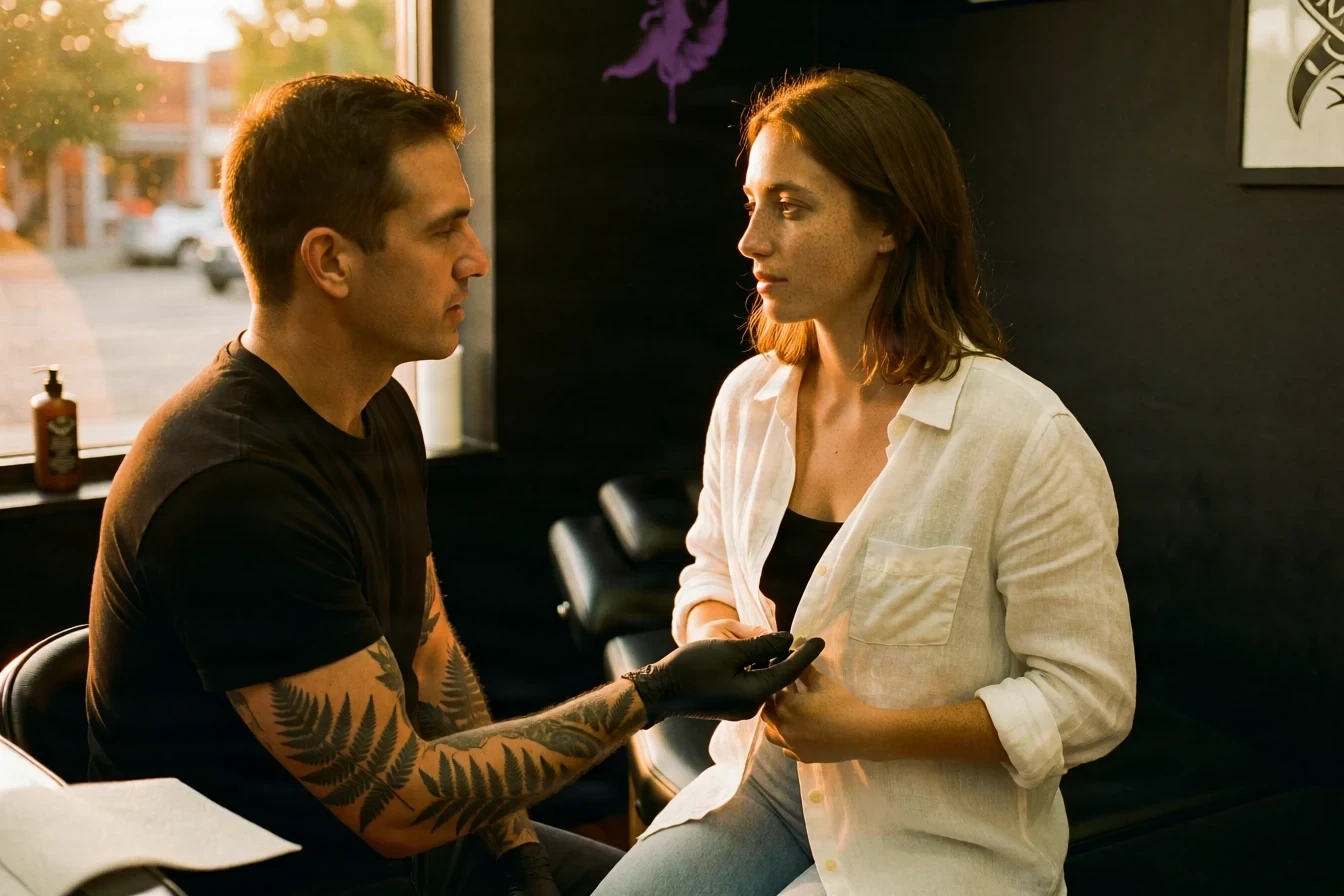
He doesn't look away from the scar. Nine years of me not looking at it, and he looks at it like it's the only thing in the room.
Then he touches it.
Green soap, cold, on a square of paper towel. One wipe. Two. His gloved thumb rests just under the line, not on it, the way you'd steady a drawing.
I can feel the heat of his hand through the nitrile, and my pulse in the exact place he's touching. So can he. His thumb goes still.
"Breathe," he says, very quietly.
"I'm fine."
"You're holding it like you're under a load."
"I'm an engineer. I'm always under a load."
His thumb stays where it is, a careful hair below the line, and I understand that he's going to keep it there all night unless somebody stops him.
"You can touch it," I say. "It doesn't hurt. It hasn't for years."
He doesn't move.
So I put my hand over his gloved one, and I press his thumb flat onto the line. On it. Not next to it.
Kade Miller goes completely still.
Not calm. Still, the way a crane holds at the top of a lift with the whole load swinging under it.
A muscle jumps in his jaw. His other hand closes on his own knee until the knuckles go pale. Under my palm his thumb, which has held steady through years of other people's grandmothers, shakes once.
"Nine years," he says. That's all. His voice does the rest.
"Nobody has touched it since the hospital," I tell him.
He takes his thumb back slowly, like it's costing him something he'll be paying off for weeks. "Give me a minute," he says, and goes into the back room.
He's gone less than a minute. No pencil, no sketching. I hear a drawer open and shut, and the thermal printer hum once.
"Forty seconds," Jas says to nobody. "He took three weeks over a sparrow for a pastor."
He comes back with a sheet of purple transfer paper and doesn't show it to me. That's when I see the back of his left hand.
In blue ballpoint, no bigger than a thumbnail, there's a moth. Half rubbed away, the way a drawing goes when somebody keeps washing it off and drawing it back.
I don't ask. I file it, with the card and the hard hat and the centimeters, under things I'll think about later, in the dark.
He lines the paper up with both hands, presses it flat with the heel of his palm, holds it for what takes a geological age, and peels it away. Then he wheels back and nods at the mirror.
I stand up. My legs are not entirely mine.
It's a moth. Wings spread, the left one lifting toward my shoulder as if it's about to go. Every vein drawn as fine as a river on a survey map.
It's beautiful. It's also wrong for a cover-up, far too delicate. You'd see straight through it to what's underneath.
Except what's underneath is part of it.
My scar runs along the leading edge of the left wing. The fork at the end, the part I've hated for nine years because it looks like a crack in a weld, is where the wing's two main veins split. He hasn't hidden it. He's built on it.
I lean in, and I measure, because I can't not.
The line of the wing meets the line of my skin and doesn't miss by a hair.
In the mirror, behind my shoulder, he's on the stool with his gloved hands on his knees, watching my face and nothing else.
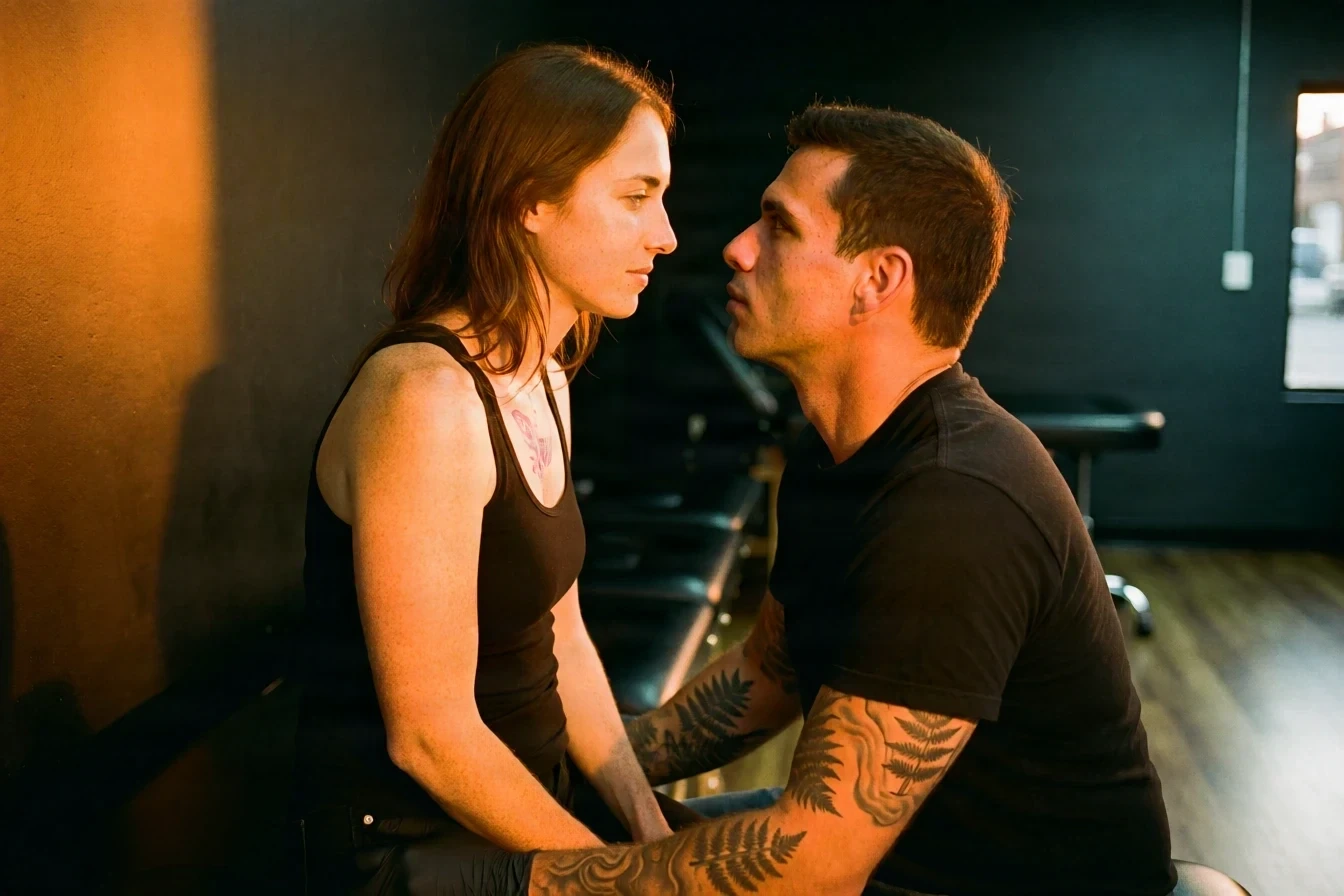
He was in the car. He was in the hospital hallway. Then I got on a plane and wore turtlenecks to every Christmas since. He has never seen it healed. The stencil fits to the millimeter.
"How," I say.
"Practice."
"It washes off," he adds, when I don't move. "Couple of days. If you want it to stay, it's six hours. Saturday."
"You've already booked me."
"I've cleared the day. You book it."
I take the pen off Jas's desk. In the big appointment book, under Saturday, I write HART.
Then I leave my shirt folded on his bench, walk out into the July evening with my collar open and his moth on my skin, and turn left, toward my brother's office.
End of chapter 1
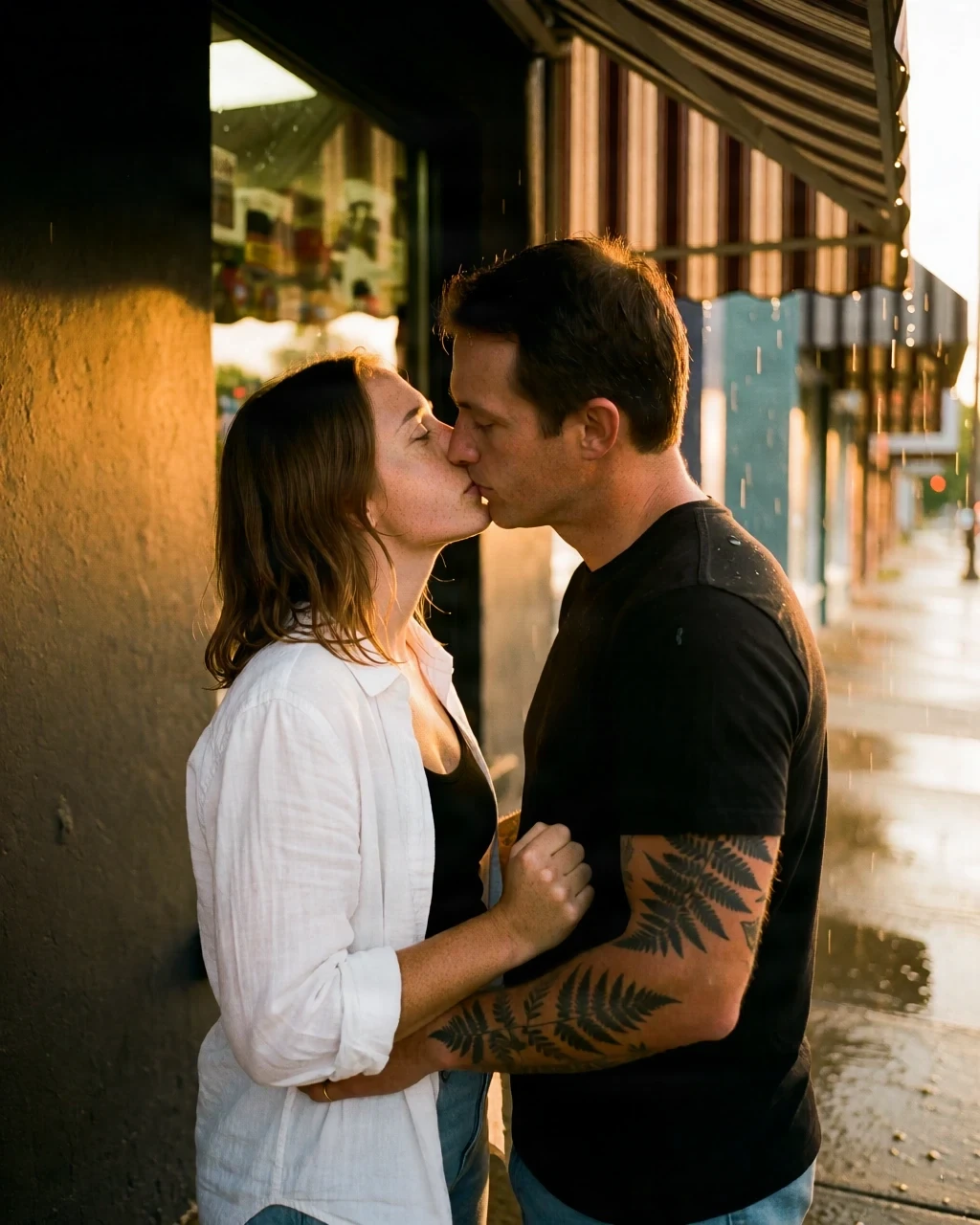
Next · chapter 2 · His · Kade
Nine Years
Theo asks me to keep an eye on his sister, which is like asking a fire to watch a barn.
Chapter 2 is free with an account.
Complaints: support@teasing.me, resolved within 5 business days. Complaints policy · Anti-trafficking policy