
Her · Lou · Chapter 1
Dead Money
SOL
Delgado, L. — Due.
— Deferred.
— Deferred.
— Deferred.
— Deferred.
Every other name on this page I collected. On time, gently, by hand.
Hers I put on my tab. Every night I sit at her bar and run it a little higher.
LOU
The man on my last stool tips in dead money, and I've started looking forward to it.
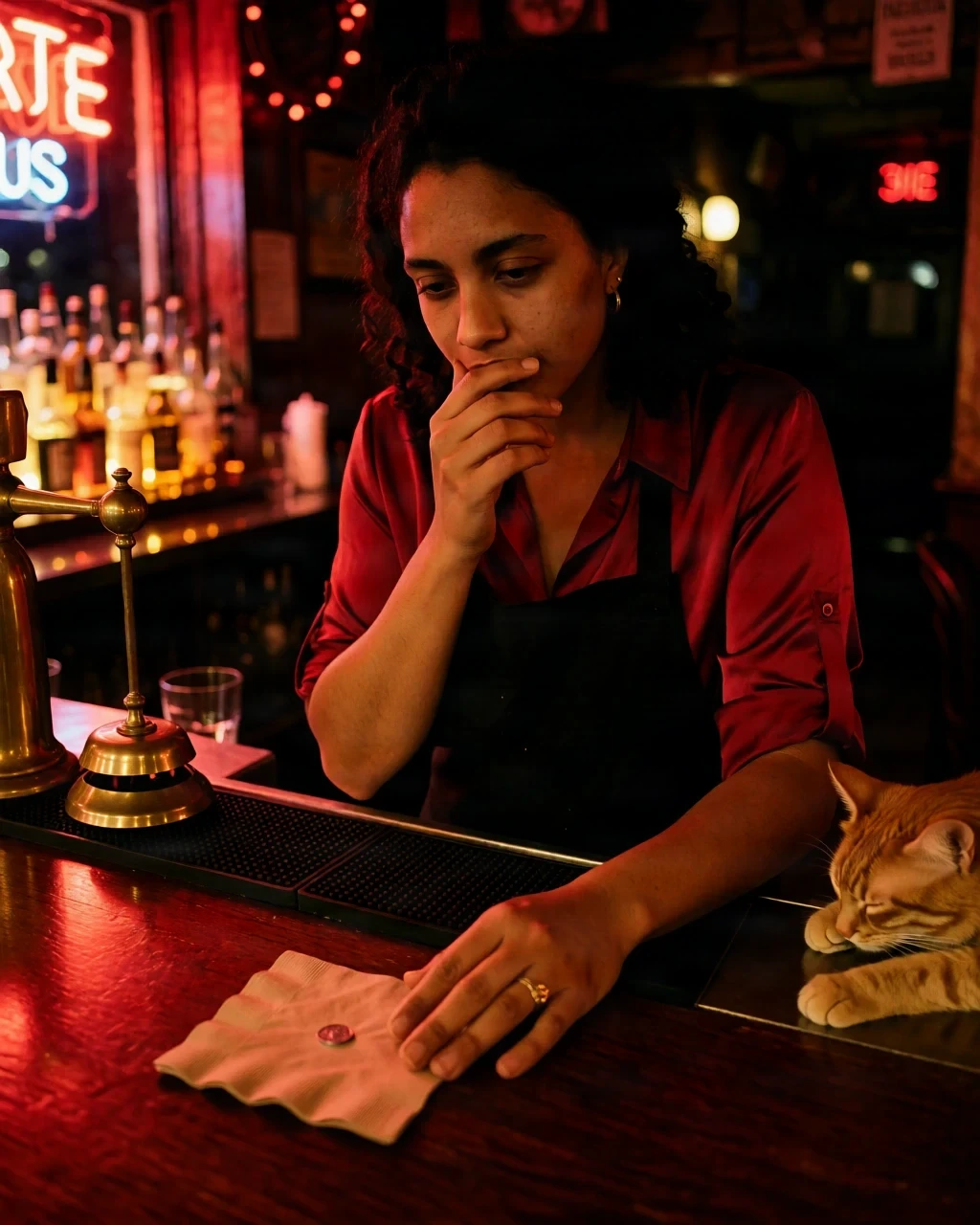
Mercury dimes. Silver, smaller than my fingernail, a woman in a winged cap on the front. Nobody has minted one since my grandmother was a girl. Every night for weeks he's left one under his glass, beside a rye he orders neat and never drinks.
Tonight the dime is sitting on a napkin, and the back of my neck goes cold.
It's nearly three. The Second Line is empty, the chairs are up, and all I want is to count the drawer and be upstairs before the garbage trucks start.
Mister Fontenot, a great slab of orange tomcat, is asleep on the last stool, warm from the man who just left it.
He went at my bell, like always. "Goodnight, Lou." All this time, and that's still the longest thing he's ever said to me. Tall, black suit, no tie. Eyes the color of an old dime. A face you'd put on a coin.
I lift the dime. Under it, in fountain pen, in a hand nobody has been taught since my grandmother's day, are four dates.
June 14, 2016.
August 29, 2021.
March 3, 2023.
December 9, 2025.
My hands understand before I do. The bar towel is on the floor and I don't remember dropping it. My heart is going so hard I can feel it in the roof of my mouth.
In the back hall, the payphone starts to ring.
At nineteen, a truck jackknifed across the interstate ahead of me, and my car stopped eleven inches from its side.
It rings again.
At twenty-four, in the storm, a live oak came through my bedroom ceiling onto the pillow I'd just got up from to answer a knock at the door.
Again.
At twenty-six, I went down all fourteen storeroom stairs of this very bar, the fast way, and stood up at the bottom without a mark on me.
Again.
At twenty-eight, the stranger downstairs left his gas on and drove to his mother's for the weekend, and somebody who never gave a name called it in.
Nobody alive knows all four. Nobody at all knows the date of the last one, because I never told a soul.
That payphone has been disconnected since before I was hired. Odile keeps it because it's historic, which in Odile means she can't be bothered.
Mister Fontenot opens one yellow eye, looks toward the hall, looks at me, and goes back to sleep. It's the face he makes when I'm being dramatic about rent.
Before it can ring again I'm in the hall with the napkin in my fist, picking it up, because apparently I'm the girl in the movie now.
"This phone doesn't work," I say.
"It works for me."
I know the voice. I've heard it forty-one times say rye, neat and goodnight, Lou. Low and unhurried, Southern in a way nobody has been Southern for a hundred years.
"Everything works for you," I say. "You've had the same rye in front of you for six weeks."
"It's a good rye."
"You wouldn't know."
A pause. I think I've scored. I lean my shoulder on the wall, because my knees have opinions.
"Did you read it?" he asks.
"Four dates and no return address. Most men send flowers."
"Most men weren't there."
The hall is warm. Every hair on my arms stands up anyway.
"Who are you?"
"I'd rather tell you in person. If you'll let me in."
"We're closed."
"I know."
"Then you know I don't serve after three." I look at the napkin. The ink hasn't even smudged in my sweaty hand. "And you're broke in here, by the way. I've been spending your dimes at the laundromat."
"They're silver," he says. "About four dollars each. You've been washing your sheets at a loss."
I laugh. I don't mean to. It comes out of me loud in the empty hall, and down the line I hear something I've never heard from him: a breath that might be a smile.
"Then you can afford the cover charge," I say, and I hang up on him.
A sensible woman would call somebody. Her mother. The police. The priest on the corner who still owes Odile money.
I've been nearly dead four times, and I don't drink, because I've never needed the help. Sensible never kept me alive. Something else did, four times, and it just called me on a dead phone.
I put the napkin in my apron. I set the cat on the floor, where he files a complaint, and take two stools down off the bar. I pour a club soda with lime for me and a rye, neat, for the last stool.
Then I walk to the front door and turn the deadbolt back.
"Okay," I tell the empty room. "Come say it to my face."
This block at this hour is not nothing. I know that. I stand behind my bar with the door unlocked and my pulse going in my wrists.
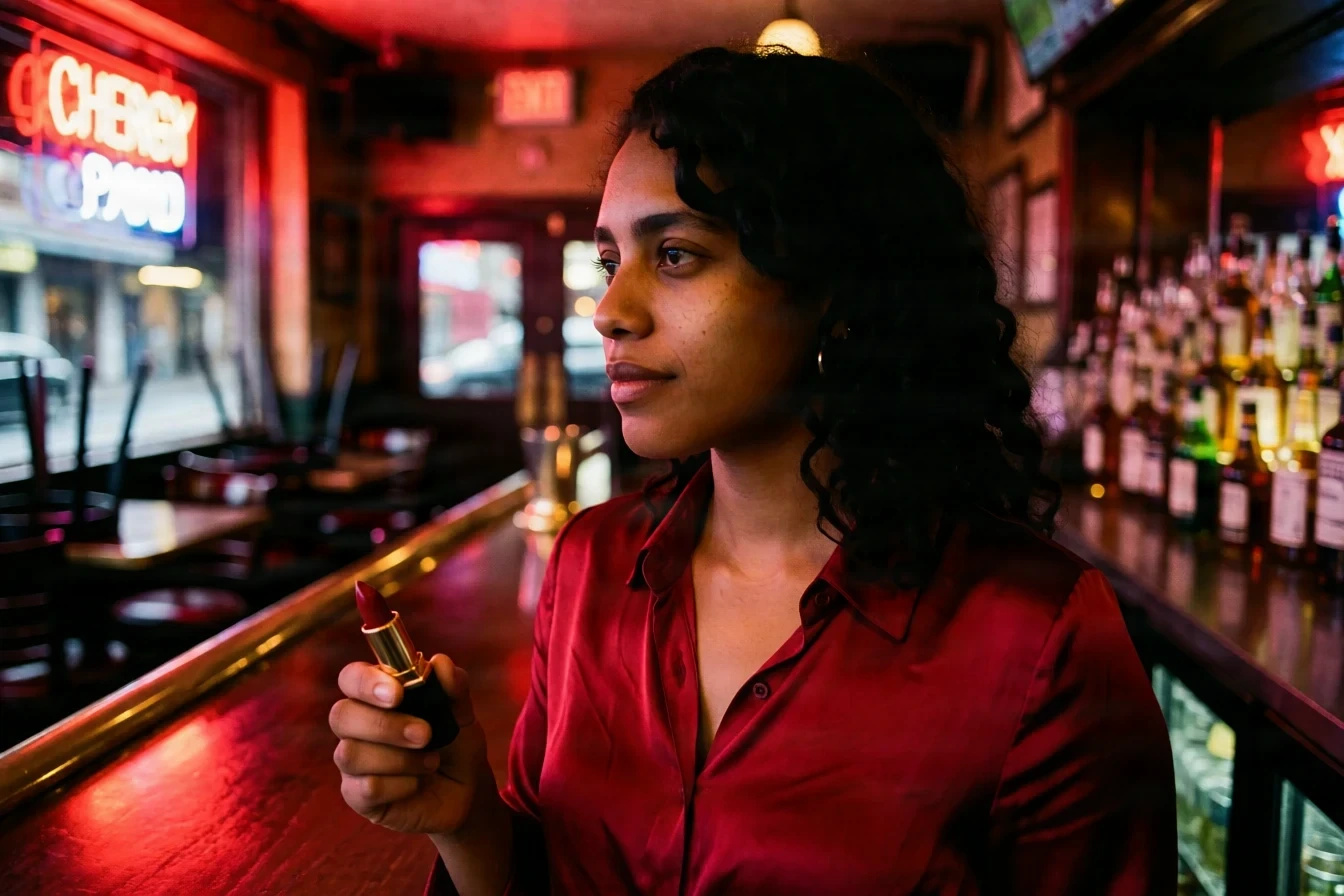
I wait for a man who knows the four worst days of my life. I put on lipstick while I do it, by feel, which tells you everything about my judgment.
The door opens a few minutes later, and it isn't him.
It's the hotel man. Gray suit, good teeth, leather folder. He's been in all autumn trying to buy this building out from under Odile, and every time, he's called me sweetheart.
He isn't drunk. Men like him never are. They just walk into rooms as if the room has been expecting them.
"Saw your light," he says, and drops the folder on my bar. "For the old lady." He looks at the two glasses, then at me, slowly. "Waiting on somebody?"
"We're closed. It's a word that means leave."
"Door was open, sweetheart." He smiles with all his teeth. "When I own this place, I'm keeping you, you know. You're the only original fixture."
I put both hands flat on the bar, because the alternative is a decision I'd have to explain to Odile.
"You have a long life ahead of you," says a voice from the last stool.
Neither of us heard the door. He's just there, in the black suit, the rye in front of him. Mister Fontenot, who hates men, the vet and me before noon, is in his lap.
"I've read it," he tells the hotel man, quite kindly. "It's long. Spend it on another street."
The hotel man doesn't argue. That's what I'll remember. This is a man who argues with waiters about lemons, and he picks up his folder and goes. He leaves the door open behind him. He doesn't look back.
I shut the door. I don't lock it. On the way back to my side of the bar my bare arm brushes his sleeve, and every hair on it stands up. I keep walking.
I stand across from him, and for the first time I look at him as long as I want.
"You didn't use the door," I say.
"You weren't looking at it."
"What did you say to him?"
"That he has a long life ahead of him."
"That's a nice thing to tell somebody."
"Not the way I told it."
I laugh again, and he watches me do it like it's something he paid for. The cat purrs on his knee, loud as a fridge.
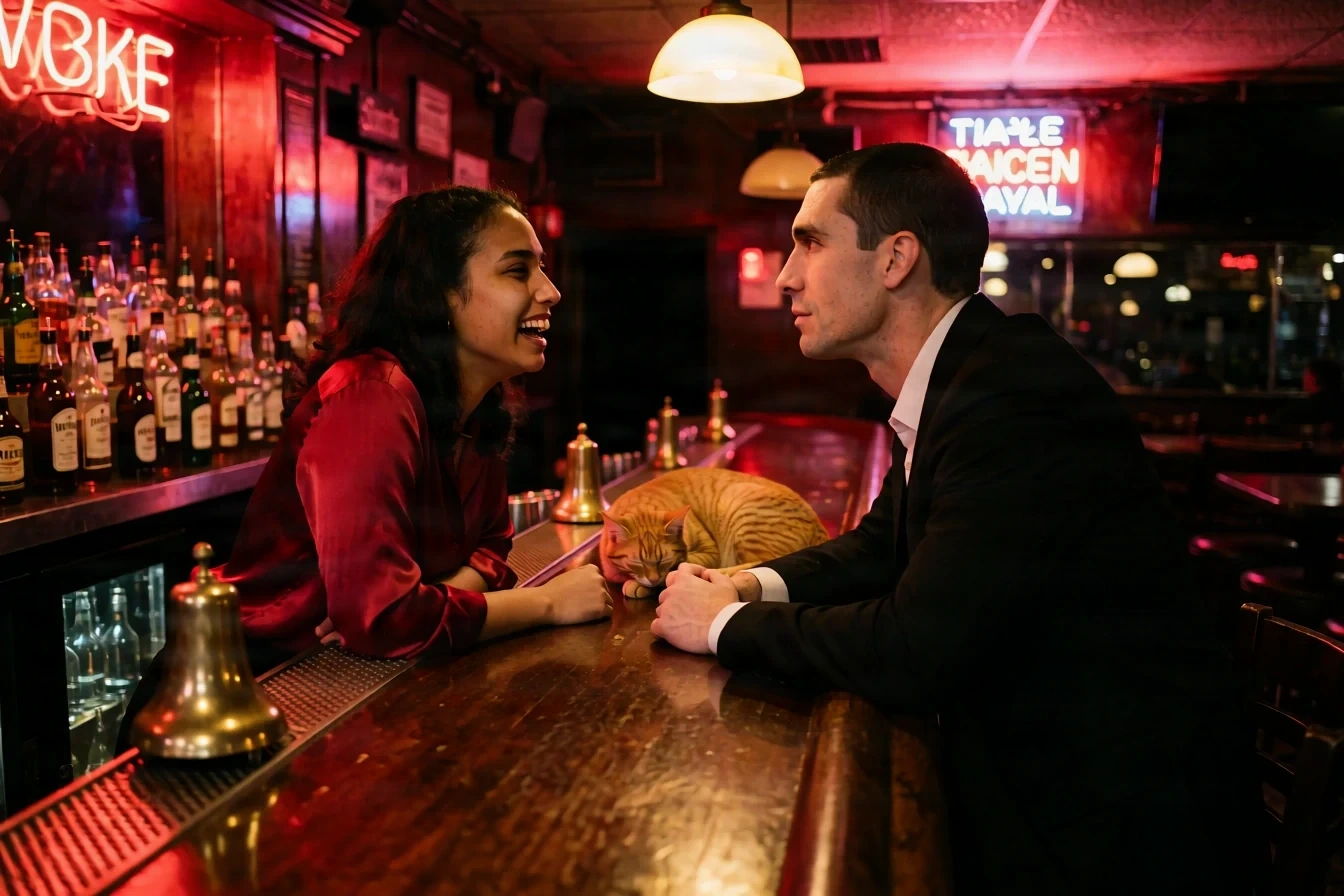
"See that?" I point up at the brass bell over the register. "When I ring it, everybody goes."
"I know. I always go."
"Even you."
"Especially me." He doesn't say it as a joke. "Your bar, Lou. Your bell."
"And I don't come out from behind it. Not for regulars, not for fights, not for Odile's birthday." I push the rye an inch toward him. "What's your name?"
"Nothing you'd like."
"Then you're Sol."
His eyebrows go up a sixteenth of an inch, which on him is a parade. "Why?"
"Because you're the least sunny man I've ever met, and I'm contrary."
The corner of his mouth moves. It's not quite a smile. It's a smile that hasn't been allowed out in a while.
"Sol," he says, testing it. "Yes. All right."
"Now tell me how you know the dates."
"I was there."
"No. I'd remember you."
"You did, each time. You just didn't keep it." He looks at the napkin sticking out of my apron. "Nobody keeps me, Lou. It's the job."
I should ask what the job is. Instead I put my hand out across the bar and lay my palm flat on his chest, over his heart, over the white shirt.
"Sit still," I say.
He does.
He goes so still the cat stops purring. His shirt is cool, like a bottle just out of the walk-in, and under it he's built like the doors of a church.
His hands are flat on my bar, fingers spread, as if the wood is the only thing keeping him on his side of it. He closes his eyes.
"Lou." Just my name. It sounds like it's being taken out of him.
"How long have you wanted that?"
He opens his eyes. They're silver all the way through.
"Since the interstate," he says. "You were nineteen and furious, and you told me you had a shift at four."
"I said that? Out loud?"
"You said it to me. Nobody says anything to me." He hasn't moved. I can see what that costs him in his hands. "So I laughed."
"Is that bad?"
"I hadn't since the river ran somewhere else."
I don't remember any of it. But I believe him, which is worse.
"Every time," I say, and my voice does something I don't let it do at work. "Every time, I went back to work the next day. Because I didn't know what else you do with extra."
He doesn't answer that. He doesn't move his hands. That's how I know it landed. Men who want something from you always have an answer ready.
I take my palm back, slowly, and that's when I see the bar.
Where his fingers were, small blooms of frost, one for each fingertip, are fading off the varnish. White, feathered, like breath on a window. It's October in New Orleans. It's eighty degrees in here with the fans going.
I watch them disappear. I don't say a word about them. I file it, the way I file a fake ID: later.
And then the rest comes up, all at once.
A tall man in black in the median of the interstate, one hand raised. A knock at my door just before the oak, and nobody there. A low voice at the bottom of the storeroom stairs, telling me to stand up. A caller who never gave a name.
Him. Every time, at the edge of it. Every time, gone by morning.
"You weren't saving me," I say slowly. "Were you? You were there for something else."
"Yes."
"Then why the napkin? Six weeks of goodnight, Lou, and tonight you write me a letter."
"Because tonight someone else started reading your page." He says it quietly, to the dime, not to me. "You should know who wrote on it first."
"Who's reading it now?"
"Someone who doesn't tip."
I almost laugh. I don't, because his hands still haven't moved, and I'm doing arithmetic I don't like. Four dates. Four times a man in black. A bar stool he has kept warm every night for six weeks, facing my door.
He looks at me for a long moment. Then he turns the dime over on the napkin with one finger.
"I've come for you four times, Lou," Sol says. "I keep leaving with nothing but your tab."
Somewhere under my ribs, the part of me that has been counting since I was nineteen gets to four and says a word I am not going to say out loud in my own bar.
He doesn't look sorry. He looks like a man who has been waiting a long time to be found out, and would like a drink he can't have.
The clock over the register says 3:19. Last call was nineteen minutes ago.
I don't ring the bell. I lift the flap in my bar and come around to his side.
End of chapter 1
Next · chapter 2 · His · Sol
Not Today
She has never come out from behind the bar. Not in six weeks. Not for a fight, not for a fainting tourist, not when the ice machine flooded.
Chapter 2 is free with an account.
Complaints: support@teasing.me, resolved within 5 business days. Complaints policy · Anti-trafficking policy