她的视角 · Nora · 第1章
The Tracks
ROWAN
Search log, Burnt Pine Road. Night four.
The ring is walked. I don't knock.
She checks latches left to right. She eats an orange standing up when sleep won't come. She sleeps in her socks.
Subject: not lost. Hiding.
Coffee's out. The switchback below the widow's place glazes before dawn, and she'll drive it anyway.
I'll still be behind her.
NORA
The wolf came at first light, and I measured it before I let myself want coffee, because a yellow tape measure is what we have instead of nerves.
Thirty-four inches, paw to paw. I knelt in the new snow and laid the tape along the line, and the numbers sat there as even as a payroll run: out of the pines, past the woodpile, under my bedroom window, where something heavy had sat long enough to melt itself a bed. Then the pattern broke. Where the next paw should have landed, the heel of a boot. Size thirteen. Both boots, side by side on my top step, close enough to the door that the snow had gone to ice.
A ring in the morning, and boots on the step. Never a knock.
The coffee tin gave me nothing but the bright smell of a habit I refuse to surrender. That is the whole of my courage these days, and it is not much. I took the car anyway. The widow's place was still dark when I passed it, one lamp in a kitchen, and the switchback below her fence shone as if someone had varnished it in the night.
The ditch is quick. The rear goes light, the front slides past the guardrail, and I am nose-down in the bank with the wipers painting the glass white and my heart knocking hard enough to find the fillings.
Hands, neck, breath. All of them answer when I ask.
Someone knocks on the window.
I say a word my mother would have soaped out of a child's mouth. He opens the door. I didn't lock it. I turn on the seat and sit sideways on the edge of it, feet out in the snow, my small car nose-down in the bank and the white coming in over the sill.
He kneels in the snow in front of me. Tan canvas jacket, sheepskin at the collar, red flannel undone at the throat. Hair that has lost an argument with a comb. A short dark beard. Clipped to the zipper, of all the things a man might carry, a child's red mitten, the clip worn dull.
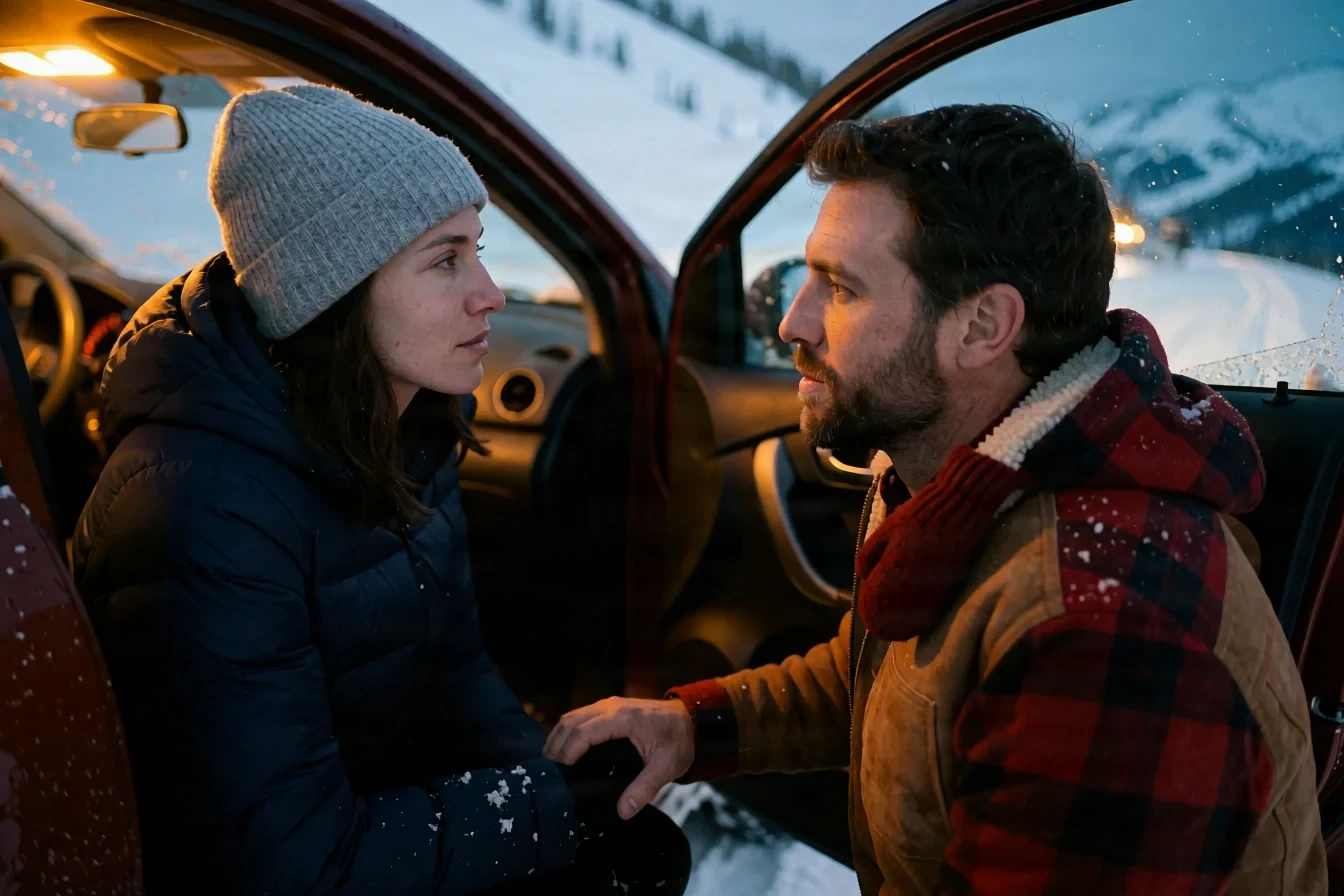
"Don't move your neck. Look at me."
"Are you a doctor?"
"Search and rescue."
"Is that a yes?"
"It's a look at me."
I look. His eyes are whiskey held to a fire.
He reads them left, then right, the way you'd true a picture on a wall. Then he takes his gloves off with his teeth. One cuff. The other. No hurry in it. I watch his mouth on the leather and forget the sentence I had ready.
His bare fingers touch the side of my neck. Light. Warm.
Warm in a way that does not match the snow he is kneeling in.
"Feel your feet?"
"Yes."
"Wiggle them."
I wiggle them. The order is ridiculous. I obey it anyway, which I will be thinking about at a bad hour.
"Good," he says.
One word, and it lands under my ribs and stays. I look at the mitten so I have somewhere safer to put my eyes than his mouth.
"You got here fast."
"I was behind you."
"There's no one on this road but me and the wolf."
"Then you didn't check your mirror." His fingers stay where they are. He is counting. I know the count from the inside, because I would be doing it too.
"You took your gloves off with your teeth."
"Hands were cold."
"Your hands are the warmest thing on this mountain. That was showing off."
He doesn't argue. He takes the fingers away. A dull red comes up under the beard. He sees me notice. The red gets no better.
He puts me in his truck to wait out the winch, on the grounds that his has a heater and mine has a snowbank. I accept the grounds. I do not enjoy accepting them.
The cab smells of coffee and wet wool and the cold off his clothes, and under that the warm salt of his skin, woodsmoke caught in it. He shuts the door. The smell stays. A thermos on the seat. "Drink that," he says, and the coffee is so much better than mine that I resent it on the first swallow and take a second.
Under the thermos, a clipboard. I am a woman who reads what is left in reach. The top sheet is last week's search, closed in a blunt half-print: subject found, handed to the family, no further action. Under it, newer, the ink not yet settled into the paper.
Greaves, R. Burnt Pine Road. Night four. Perimeter. No contact. Subject checks latches. Subject is not lost.
I look at my name not being on it, and at the fact of me being on it anyway. I drink his coffee and watch him through the glass.
Bare hands on the cable. Snow landing on the knuckles. They never go red. When he hauls, the tendon in his wrist stands up under the skin, and I think about that wrist against my mouth. I take another drink so the thought has somewhere to go that isn't my face.
When my car is a car again and not a decision, he opens the passenger door. I hold up the clipboard.
"You wrote that I'm not lost."
"You're not."
"You also wrote no contact."
"You put the car in the ditch." He takes the thermos back. His ears have gone red to match the jaw. "That's contact you started."
"There's a map on your dash with my cabin circled until the plastic gave up."
"Bad road. People get lost on it."
"I'm not lost," I say again, because I want the second answer, and I hate that I want it.
He looks at me properly then. The first time the look isn't a check for concussion. "No."
I climb down. Heat comes off his coat into the cold between us. I stand in it one second too long, and then I get my feet under me and step out of range.
"The mitten."
He glances down, surprised by his own zipper. "A girl dropped it on the high trail in November. Family's away till spring."
"So you wear it till spring."
"I carry things till I can give them back." Gloves on, one, then the other. He opens his door. "Get snow tires. Drive slow, Ms. Vance."
The door shuts.
Nobody has called me Vance since I put the name in the ground.
A sensible woman goes home, takes the bag by the door, and is over the pass before the light fails.
I go to the store. Coffee, and a bag of oranges, because a man who knows my name does not get my mornings on top of it.
The woman at the register looks at my face and smiles with every tooth she owns. "You've met Rowan."
"Is that the official term."
"Everybody meets Rowan. Mostly when they're lost." The laugh startles out of her, geese off a pond. "Three hundred and twelve, he's brought down off that mountain alive. Half the single women in this county have gotten themselves lost on purpose. Some of them twice. I keep a private list."
"I'm not joining it."
"No, honey." She bags the oranges and does not glance at the name on my card. Kindness, or a decision she made the day I arrived. "You look like the accidental kind. Those are the ones who stay for the winter and then argue about it."
On the lease and on the mailbox I am Nora Prior. My mother's maiden name. Sentimental, or the last clean name I had. I have stopped trying to decide which.
The rust-colored truck finds my mirror at the bottom of the valley and stays in it, switchback for switchback, never close enough to be a dare. I do not speed up. Speeding up is a confession.
Before Prior, firms called me when the numbers were too clean. Clean is a kind of shouting, if you've been trained to hear it.
The headlights stop where my track meets the road. He idles. He does not turn in.
The cabin is cold enough that my breath goes ahead of me. I left the stove out. The stove is out. On the boards by the wardrobe, a puddle of melt in the shape of a boot, smaller than thirteen, the edge of it not yet skinned with ice.
My hand finds the doorframe and stays. The cabin is quiet in the wrong way. No tick from the stove. No drip from the tap I never quite shut. I can hear my pulse in my ears. My shoulders go up under the navy parka and will not come down. A timber knocks in the roof and I flinch so hard my fingers slip on the wood.
I make myself step in.
The woodpile has been touched. I stack bark-out, so the snow sheds. A corner has been turned split-face forward, neat as a window display. The mug I abandoned in the sink is clean and upside down on the rack, handle aligned with the edge of the board. My laptop is open. I close it when I leave. I always close it. The screen is a headline I could recite under oath.
CAR PLUNGES FROM BRIDGE; DRIVER NOT FOUND.
Ohio. A dry road, a clear night, a guardrail that failed at the one place a car would not have chosen. I have spent the months since working at staying not found.
Linked beneath it, the bulletin. My work photo: hair scraped back, mouth refusing the camera its little victory. NORA VANCE, 31. Circulated to law enforcement and search and rescue agencies.
So the name in his mouth has a source. A desk. A list that went out to men with trucks. It is the kindest explanation I can reach, and it still means someone sat in my chair and woke that screen.
The melt is fresh. Rowan has been in my mirror since the valley floor, and he is idling at the foot of the track now. I can see the faint lift of his exhaust if I lean. He did not have the minutes to stand by my wardrobe and also be those headlights.
It wasn't him.
Someone else walked through my life and put it back tidier than I keep it.
I haul the suitcase out from under the bed. The pouch is there, a stiff square in the lining, and for one breath I am a person with a plan again.
In the fall I found the second set of books belonging to a man named Callan Rhys. Hundreds of pages, handwritten, because the careful criminals are afraid of anything a warrant can copy in an afternoon. I made two copies. One went to a federal agent who said discretion the way other people say next Tuesday. The other I sewed into this lining with motel thread, stitches I would not sign. My own boss handed my name across a table. Six months of being nobody. Nobody touches nobody. Nobody gets close enough to sell you.
Then my thumb finds the seam.
Mine were big and crooked and beige, done with the thread in my teeth and the motel fan loud enough to cover the swearing. These are small and black. Each stitch knotted off alone. Even tension, the sort of close a surgeon trusts when he means the patient to stand up afterward and walk out under her own name.
I open the pouch. The pages are in it. I cannot tell if they were slid out and slid back. The not-knowing sits in my hands like a figure that will not reconcile, no matter which way I turn it.
Whoever came in tonight knew where to cut. Whoever came second could not stand the cut. I don't know which of those is worse, and I am not going to solve it on the floor.
The bag by the door is packed. The pass is open if I leave now. I put the tape measure in my pocket, take the flashlight, leave the gloves where a stranger's boot bled water onto my boards, and walk down the track in the dark toward the only man on this mountain who has said the buried name aloud.
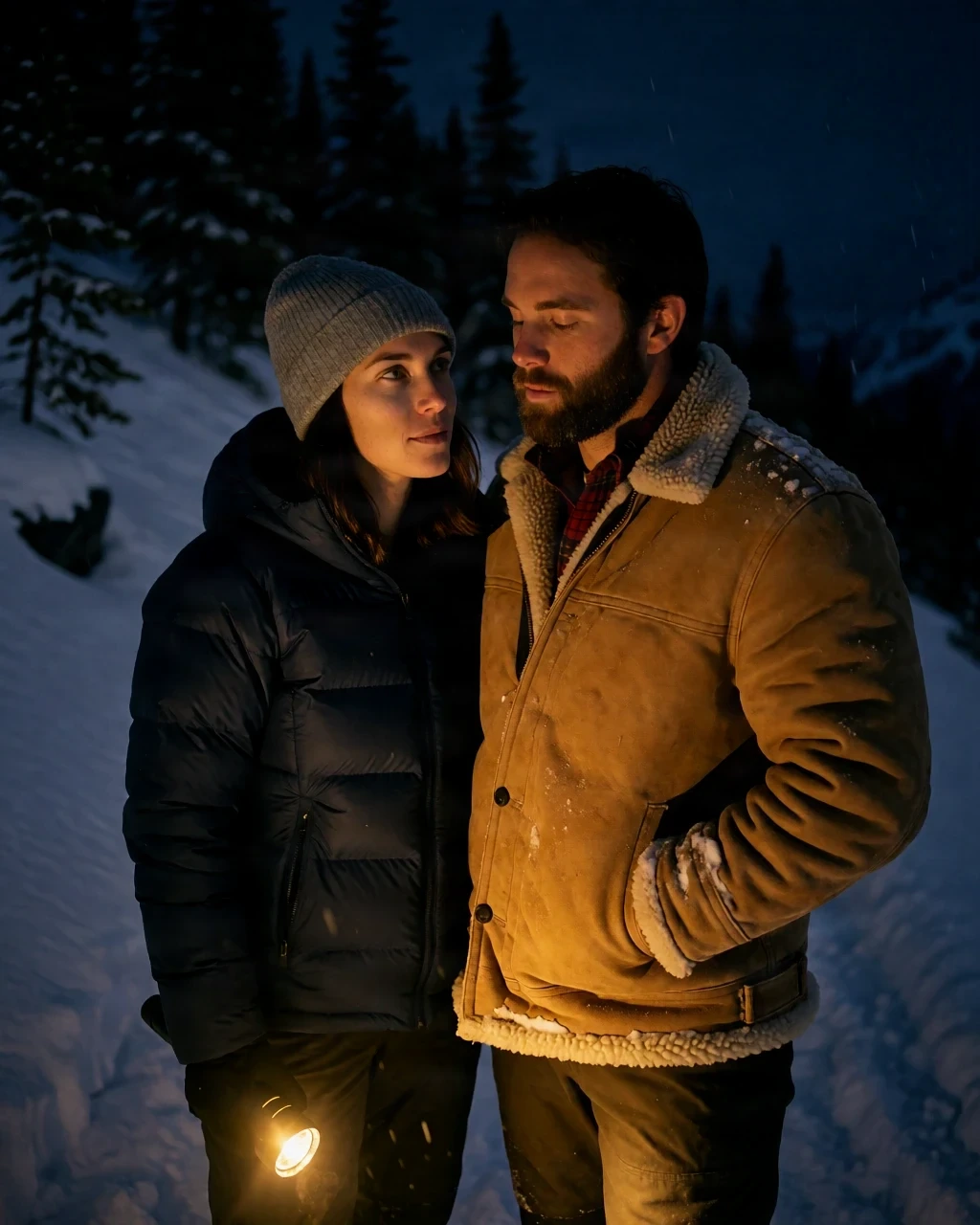
He is out of the truck before I reach the glow of his parking lights. Hood at his back, hands in the pockets of the tan canvas, sheepskin at his collar, red flannel at his throat. I stop out of arm's length and put the beam on his chest. I am not putting it on his face yet.
The navy parka is zipped to my chin. My hands are bare. The cold has them already.
"Somebody was in my house. Smaller boots than yours."
"I know."
"You know."
"Snowmobile over the back ridge, just after five. One man. Left by the front door faster than he went in."
"And you know that because."
"Somebody was on your back door."
"Who?"
"Family."
"Your family watches my back door."
"Since Tuesday."
"That's a generous use of the word family. Most people start with a wave."
"She'd bring a casserole," he says, "if you asked. She likes a reason."
"Did she sew my suitcase?"
The pause is small. I hear it anyway.
"She can't walk past an open seam."
I laugh. It comes out sharp, wrong for the dark, and he watches it happen with the patience of a man who has been standing in weather, waiting for a change in it.
"You knew my name this morning."
"Your face hit my desk in December. That bulletin went to every search and rescue unit that might trip over you in a ditch and call it a rescue."
"So call Ohio. Tell them the ditch had a driver."
"I've picked the phone up nine times."
"And set it down."
"A woman whose car leaves a bridge and doesn't leave it with her isn't missing." His breath shows, thins, shows again. "She's hiding. A call to Ohio is a call to anyone who reads what Ohio writes down."
Nine times, and then his hand back in a pocket. He has kept me hidden by refusing the one thing his job is for.
My hands are shaking. The cold is an excuse and not a good one. He sees the shake. He does not offer his pockets, or his gloves, or the thermos. He stays where I put him, which is its own answer.
I close the distance. He doesn't give ground. I have to tip my face up to his. The beam stays on his chest. My bare hand comes up to the side of his jaw, into the short beard, and down to his throat, the same place he chose on me.
"You checked my pulse this morning. My turn."
He is hot. Past wool, past the heater in the truck, past any reason I will be able to use later. The heat walks into my fingers and up my arm, and I allow it.
His pulse is slow. Heavy. A big heart doing quiet work. I watch his face, and the quiet ends. The beat picks up under my fingers. I feel it change, and I don't take my hand away.
He does not move. His head stays still. His mouth stays still. He doesn't come an inch toward me. His eyes close. Through the canvas his hands have gone to fists in the pockets, holding there the way you hold a door against a wind that wants in.
The worst part of being nobody isn't the fear. It's that nobody touches you.
"How long," I say. I don't finish. I don't know which question I spent the walk down preparing.
"Since December," he says, eyes shut.
I take my hand back. It should be nothing. It is not nothing. He lets a breath out, careful, as if the air might spook.
I don't step away. We are face to face, a hand's width of cold between his mouth and mine. I lift the beam.
His eyes throw it back. Flat gold.
He blinks. Whiskey-brown again, tired, fixed on me as if the gold had not happened and we are both going to be polite about it.
I file it. I don't have a place for it yet.
I step back and pull the tape measure and hold it between us like a form he has to sign.
"Name."
"Rowan Greaves."
"Age."
"Thirty-five."
"Occupation."
"I find people."
"Marital—"
I stop. The rest of the word sits in my mouth, and I will not help it out.
His eyebrows lift. Red at the tops of his ears. "Single."
"Hobbies."
He thinks about it with a seriousness that would get him hired. "Walking."
"Around my cabin. While honest people are asleep." I show him the tape. "Size thirteen. Thirty-four-inch stride, which I measured, because someone should. Did you knock?"
"No."
"Why not?"
"A knock is a question." He says it to the snow, not to me. "A woman alone up here at night has one answer to that question, and it isn't an invitation. I'd rather wait till there's a better one available."
The beam wavers. My wrist is tired. I let it be.
"Go inside," he says. "Lock the door. I'll sit here till it's light."
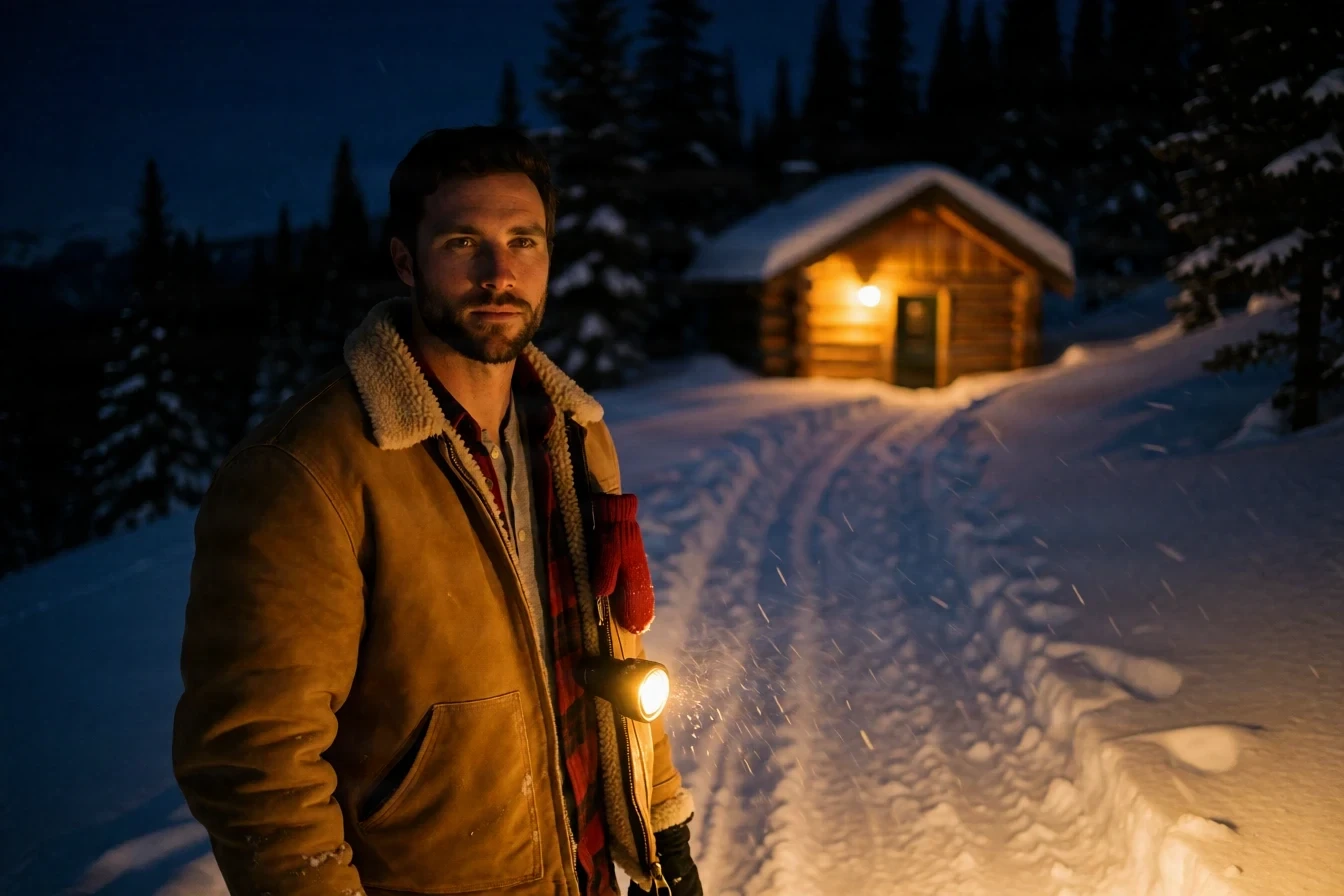
"I didn't ask you to stay."
"No. You came down a dark track with no gloves on to scold me. That's a worse ask, and you made it with your feet."
I laugh, the second time tonight, with a man I came down here not to trust.
"Goodnight, Mr. Greaves."
"Rowan."
"I haven't decided."
I turn. The beam stays on my own boots the whole way up, and his attention stays on my back like a hand I have already taken off his throat and can still feel.
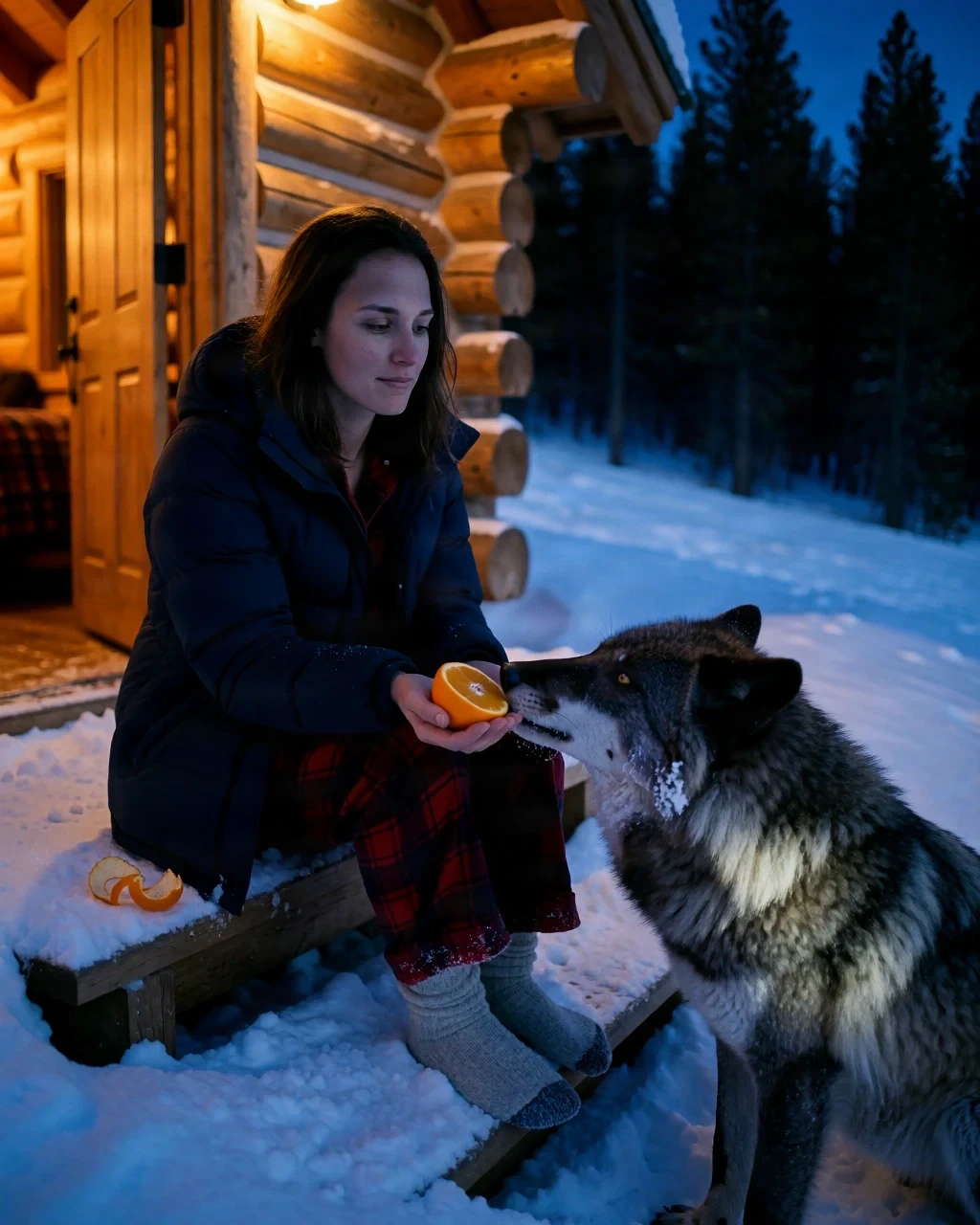
At two I am at the window with an orange, because pretending I might sleep has become a waste of a good lie.
The truck at the foot of the track is dark. Engine off. I put the flashlight on the cab once, and it was empty, and I felt like a woman checking a lock she had already turned, and I checked it again anyway.
I peel the orange in one spiral. The peel goes on the sill. The smell is sharp, and it is mine.
When I lift my head, the wolf is in the snow a few strides from the steps.
"Hi," I say, through the glass, like a fool. One ear tips toward the word.
Big. Gray the color of the smoke off the town chimneys when the cold gets serious. Frost in the ruff. It sits square in the prints the boots left, not looking at the latch, not looking at the bag by the door. Looking at me.
The porch light finds its eyes. They go flat gold.
I have seen that once already tonight, on a man's face, a hand's width from mine. I walked up the track and tried to leave it there.
The sensible sequence is the latch. Left to right. The way I do it every night. The way, I understand now, has been watched, and written down in a blunt half-print, and not used against me.
I put the navy parka on over my pajamas. I open the door. I sit on the top step in my socks, and the cold comes up through the wool and into my feet. The wolf does not rise. I don't either.
My hands are not steady. I let them shake.
"I don't know if you eat these. I don't know anything about you. That's going to be a problem."
I break the orange in half. My hand holds one half out into the dark.
第1章完
下一章 · 第2章 · 他的视角 · Rowan
The Rule
Wolves don't eat oranges. I take it out of her hand anyway, and that's the end of me.
注册账号即可免费阅读第2章。
投诉:support@teasing.me(5 个工作日内处理) 投诉政策 · 反人口贩运政策