
Ella · Signe · Capítulo 1
The Skerry
SØREN
"She is not yours to deal with," I tell the pack.
My cousins look at me across the fire and say nothing, which is how they argue.
The survey woman counted the seals twice today. She did not count me.
I don't go down to the shore. It's daylight. I stand on the rise and let her look.
SIGNE
Ulvøy has two hundred and twelve seals and one man, and the man's the one with the teeth.
I don't know about the teeth yet. This morning I only know about the seals, because I've just counted them twice from a slab of wet rock.
Same number, both times. That isn't the problem.
The problem is that none of them moved.
A colony this size should pour into the sea the moment a woman in an orange survey jacket climbs off a boat. These lift their heads, look at me, and go back to sleep. As if they've already decided what's dangerous on this island, and it isn't me.
I have nine days to find out why, and a report to write about it.
Up on the rise, a man is standing in an open doorway, watching me work.
He hasn't moved either. The back of my neck has been warm since I landed, and it isn't the sun.
The agency hut is on the south rise: one room, one bunk, one gas ring, a barometer with a cracked face, and a radio bolted to the wall. The file says the radio has been dead since March.
The radio is on. Green light. A low hiss on channel sixteen.
On the table, under a mug turned upside down, there's a strip of paper torn off a tide table. Pencil. Square, heavy capitals.
212. YOU'LL COUNT TWICE.
I sit down on the bunk with my bag still on my shoulder.
Of course I counted twice. A census you only do once is an opinion. Everyone who has ever worked with me knows that. Nobody on this rock has ever worked with me.
He counted them first, from his doorway. He got the number right. And he knew exactly what kind of woman was going to get off that boat.
My pulse is doing something it hasn't done in a long time. I tell it to sit down.
"Show-off," I tell the strip of paper.
It doesn't answer. The radio does.
"Ulvøy survey, Ulvøy survey, this is Ulvøy Light." A man's voice, low and unhurried, rough at the edges, as if he doesn't use it much. "Radio check. Over."
I look at the handset for a long moment. Then I pick it up.
"Ulvøy Light, this is survey. You've been in my hut. Over."
"The agency's hut. I mended the radio. Over."
"And left me the answer to my sum."
A pause. "You didn't say over."
"I don't say over to men who do my homework."
"Was it right? Over."
"It was right," I say. "It was also unsolicited, unscientific and in pencil. If you'd like to contribute to the survey, there's a form."
"What's on the form?"
"Name. Address. Why you haven't answered the agency's letters in years."
"I answer the ones that ask something. Out."
"Survey to Ulvøy Light," I say. "You said out. Out means you've stopped listening. Over."
Nothing. Just the hiss.
"You're still listening," I say.
Nothing at all, very loudly.
"Thought so. Out."
I hang up the handset and laugh, alone, in a hut with no heating, and it's the first time I've laughed at work since spring.
The second call comes after lunch, and it isn't him.
"Survey, this is your ferry." It's the skipper who dropped me this morning, a man with a thermos and no small talk.
"Forecast's changed. They've moved the storm up. Gyda was Saturday, now she's tonight. Nine days, they're saying, maybe more. I can be back at your landing in ninety minutes. After that, nobody's moving. Over."
I look at the barometer. It has dropped a long way since he left. I tap the glass. It drops again, out of spite.
The sensible thing is very obvious. I've done the sensible thing my whole life. I've been counting seals my whole working life, and divorced for long enough to stop counting that. My ex-husband got the flat, the car and a hydrologist. I got the fig tree.
I'm here because of a letter. My boss, Kjersti, slid it across her desk in March: a few typed paragraphs, no signature, asking someone to come and count the seals on Ulvøy while there were still seals to count.
"Last line," Kjersti said. "Send someone who counts twice. That's you, Signe."
The file had one page on the resident. Vidar, Søren. Sole occupant. Retained keeper, north light. Does not answer correspondence. And a photograph someone at the lighthouse office had snapped: oilskins, face turned from the camera, two big bare hands on a mooring rope.
I looked at those hands for longer than the agency pays me to look at anything that isn't a seal.
If I get on the boat, the survey is void. The pups will have moulted before anyone comes back, and a committee in an office on the mainland will decide this island on last year's numbers and a photograph of a man's hands.
And a whole colony will go on not being afraid of something, and I'll never know what.
"Survey? Over."
"Negative," I say. "I'm staying."
"Nine days, Dr Solheim."
"I'm booked for nine."
He breathes out down the line. "Then you've got the coastguard helicopter for emergencies, any hour, and you've got him. God help you with the second one. Out."
The hiss comes back. I'm reaching to turn it down when the other voice comes in over it, quiet.
"You should have gone, Dr Solheim."
"You were listening," I say. "On an open channel. That's very rude, Ulvøy Light."
"Channel sixteen is for everyone. The helicopter's real. If you want off this rock, any hour, you call them. Not me. Them. Over."
It's the longest thing he's said. It sounds like it cost him something.
"I'll call them when I want them," I say. "Out."
At six I read the day's count to the agency's duty officer, the way the protocol says, handset against my cheek: two hundred and twelve, nine pups in the lee cove, colony unusually habituated.
The light in the doorway goes dark.
I don't turn round. I hold up one hand, flat, without looking. "Stand by."
And behind me, he stops.
Not stops talking; he hasn't said anything. Stops moving, all of him, mid-step. I feel it the way you feel a fridge go off in a quiet kitchen. I finish the count. I spell habituated for the duty officer twice. I sign off.
Then I turn round.
I've seen bigger men. Not many, and not in a doorway this small. He has to stoop under the lintel.
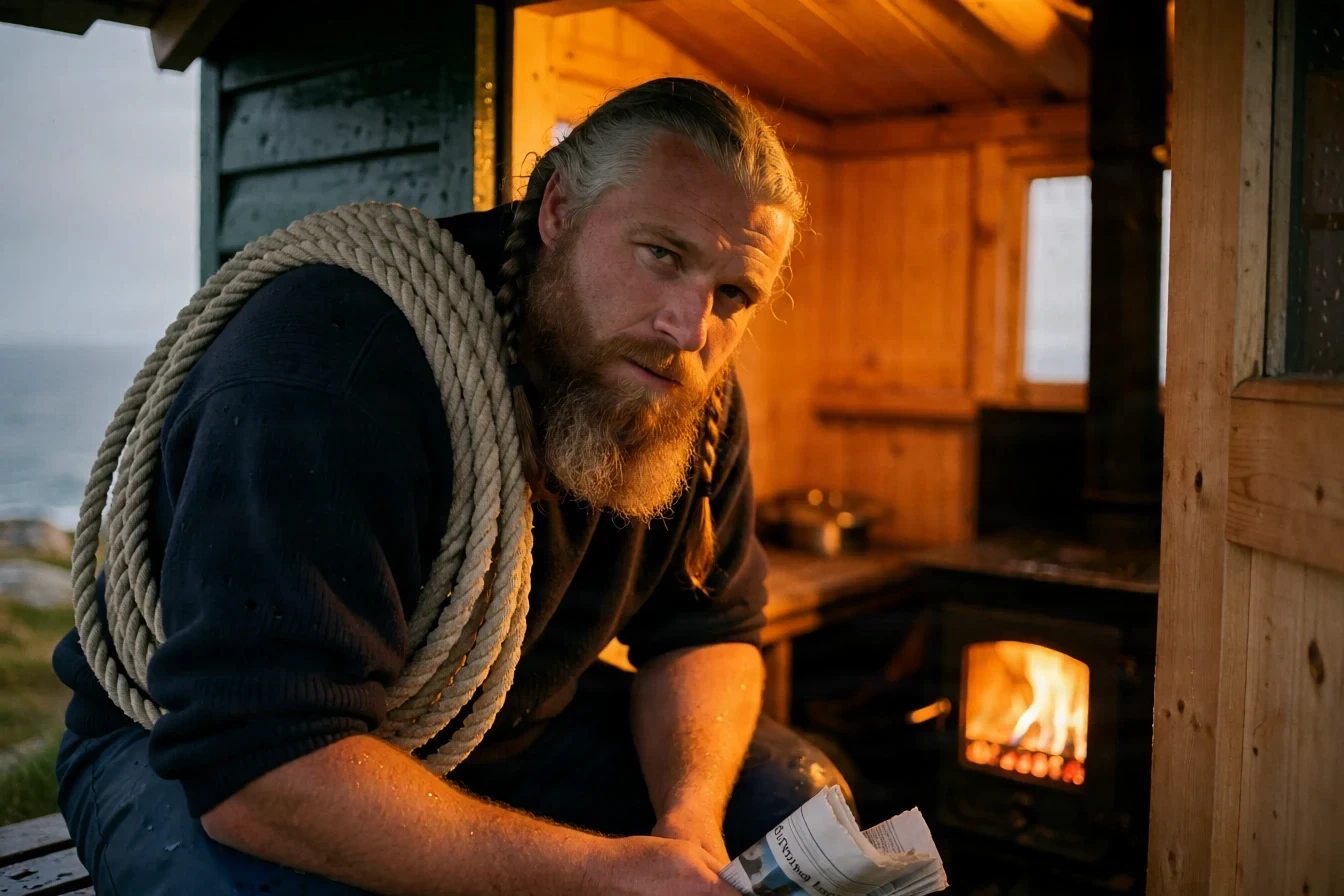
Braids, two thin ones at his temples, the rest of his hair dragged back and tied, dark blond going grey with salt. A beard that has been out in the wind all day. A fisherman's jumper with the cuffs gone to holes, sleeves shoved past the elbow.
I note, professionally, his forearms.
I note them again, less professionally. Rope-hauling forearms, weathered, with a white scar across one wrist. A woman could think about those forearms, briefly, at my age, at work. Then she could stop.
He has a newspaper parcel in one hand that smells of smoke, and a coil of rope over his shoulder.
"You said stand by," he says. "I stood by."
"I noticed."
He breathes in before he says anything else. Not a sigh. A long, slow breath through his nose, head tilted a fraction, as if the answer is somewhere in the air of my hut and he's checking it's the one he wants.
"Mackerel," he says, and holds out the parcel.
I take it. The paper's slick with rain, and for a second my fingers close over two of his instead of the parcel. His are rough and wet and very steady. He lets go first, fast, as if I've caught him at something.
"Smoked this morning. Your roof was on two straps. It's on eight now."
I didn't hear him. Not a footstep, not a knot, not one bang on the iron, and I was sitting right under it.
"That's very neighbourly."
"It isn't. It'll still go."
"When?"
"Third night." He says it the way other people give the time. "When it does, come up to the house. Mine's the one with the light."
"Let me save us both a week, Mr Vidar." I put the fish down.
"If I write that this colony needs protecting from people, there won't be any people. That's you. The house, the boathouse, the sauna I can see smoking from here. A committee gives you eighteen months and a relocation grant."
"I know what a reserve is."
"Then you know I'm the worst person on this island to be rude to."
He breathes in. "You're the only person on this island I've been rude to."
"I'm the only person on this island."
"Yes," he says, as if that settles it.
"What do you think of reports, Mr Vidar?"
"My family has kept this rock for three hundred years. You'll be here nine days, and you'll get it wrong in forty pages."
"Thirty-eight. I'm concise."
"I know," he says. "I read your census of the outer islands. Six weeks in a kayak."
That stops me. "Nobody read that. My mother didn't read that."
"I read it twice."
I don't know what to do with that, so I do what I always do with things I can't classify. I change the subject.
"Anything else, while you're critiquing my methods?"
"Stop reading your count out on sixteen."
"It's protocol."
"Everyone with a set can hear you."
"Everyone with a set out here is a seal."
He breathes in. "Not everyone."
The wind finds the gap under the door and slams the shutter against the outside wall. I need it latched. He's in the doorway.
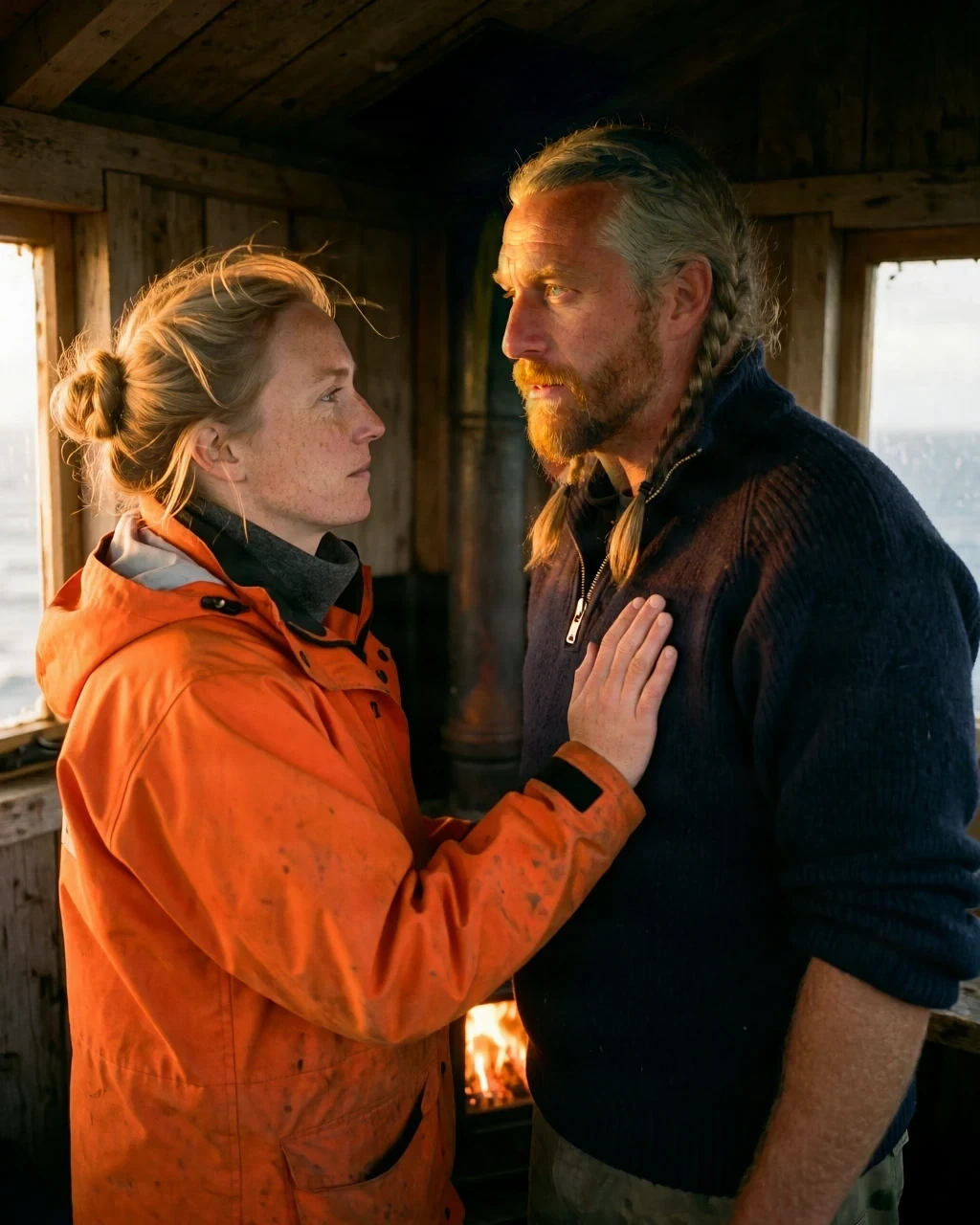
So I put my hand flat on his chest to move him.
He doesn't move. He doesn't resist me, either. He goes still under my palm, the way he did for the radio, and I feel the wool of his jumper, damp and rough and smelling of tar, and the solid wall of him behind it, and under that his heart.
It's going hard. Fast and hard and heavy, as if he's run all the way up the rise.
His face is perfectly calm. His eyes are on mine. But his hands have found the doorframe on either side of him, and I hear the old wood creak as they close.
He's been in this hut today while I was out. Now that I'm in it, he won't cross the sill. He's holding on to my door so he doesn't put his hands on me.
I haven't been touched on purpose in two years, and I'd stopped noticing.
I'm noticing now. I keep my hand where it is for one breath longer than I need to. Then another. His heart doesn't slow down at all.
"Over," I say.
He steps back into the dark, exactly one step, and lets me past.
I latch the shutter. When I turn, he's looking at me, and something happens at the corner of his mouth. It isn't a smile. It's what a smile would be if it had heard about smiles and wasn't sure it approved.
That's when I see his teeth.
They're good teeth. White, even. The canines are a millimetre longer than they ought to be. I've spent my career looking at the teeth of things that eat fish, and I notice, and I file it, and I put it down to the light.
"There'll be dogs at the north end tonight," he says. "My cousin's. Don't feed them."
"Dogs."
"Dogs."
Then he's gone down the path into the rain, and the hut is bigger and colder, and I stand in the doorway with my right palm pressed flat against my thigh, keeping whatever's on it.
The roof doesn't go. It screams.
I lie on the bunk in thermals and two jumpers, with the mackerel in my stomach, which was, I'm furious to report, the best thing I've eaten since Easter. Every gust lifts the iron and drops it again. Eight straps. I count them in my head.
I can't sleep, so I work. Headtorch. Notebook.
Resident: hostile. Brought fish. Mended the radio so I could leave him.
Stops completely when told to stand by.
I look at that last line for a long time.
Query, writes my hand, without consulting me, what else he'd do if told.
I shut the notebook. That's when I feel it. Not a sound. A change in the dark beside the bunk, the way you know someone has come into a room behind you.
I turn my head.
Outside the window, just below the sill, there's a flat shoulder of granite. On it, wet through and silver-grey in the spill of my headtorch, stands a wolf.
Not a dog. I know dogs. This country has something like a hundred wild wolves, and every one of them lives in the forests along the eastern border, nowhere near the sea. I know the shoulder height of a big male. This is bigger.
It doesn't move. Rain runs off its coat. Its breath clouds the glass.
Its eyes are pale grey, with a ring of yellow round each pupil. I looked into those eyes this evening, over a parcel of mackerel.
My hand finds the clicker on the blanket by itself.
Click.
The wolf watches me do it. Then it breathes in, long and slow, through its nose, with its head tilted a fraction, as if the answer's somewhere in the air between us and it's checking it's the one it wants.
There's a wolf at my window with Søren Vidar's eyes, and the ferry isn't coming for nine days.
The radio is on the wall above my head, green light steady, one arm's length away.
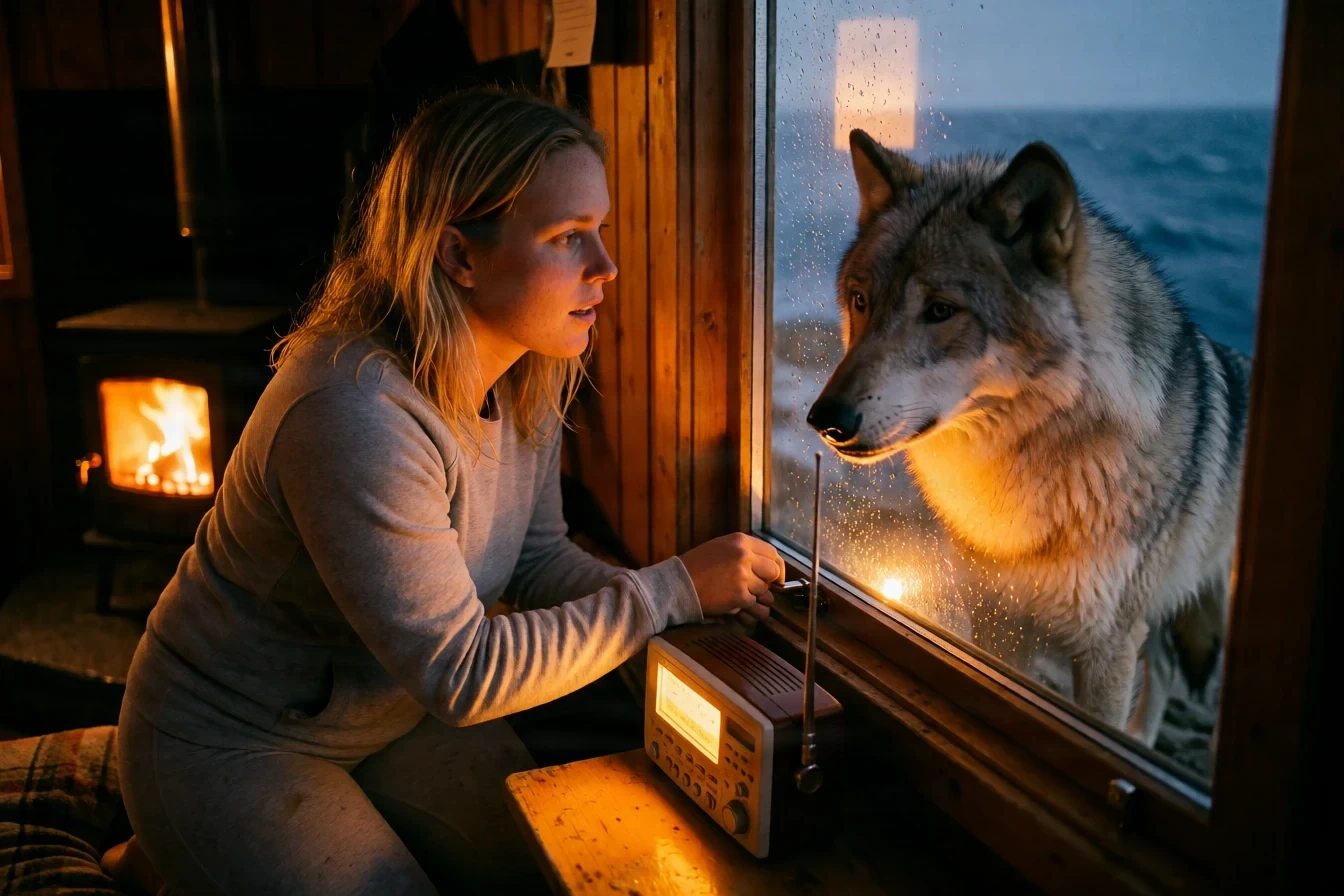
I reach past it, and I open the window.
Fin del capítulo 1
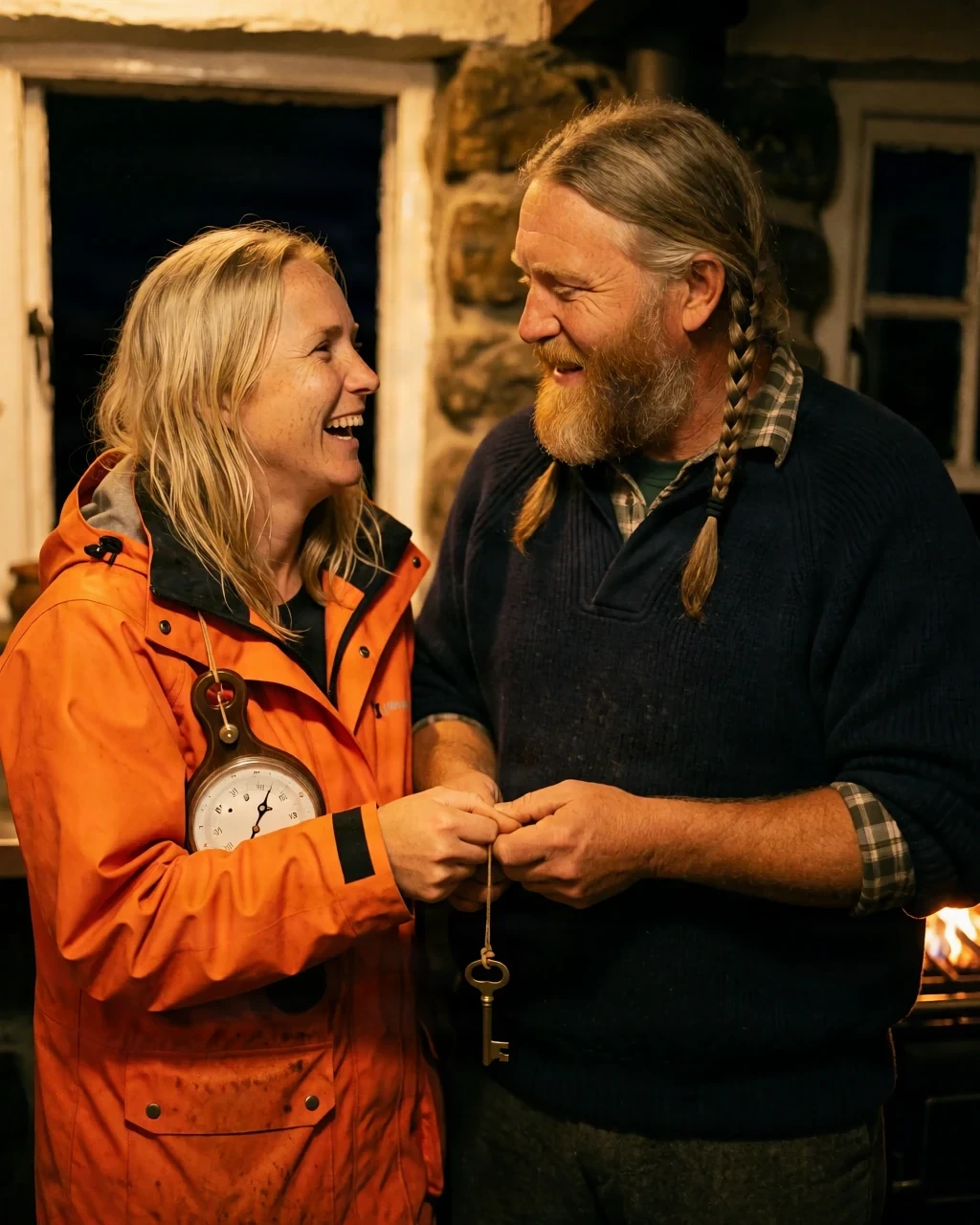
Siguiente · capítulo 2 · Él · Søren
Nine Days
She opens the window.
El capítulo 2 es gratis con una cuenta.
Reclamaciones: support@teasing.me, resueltas en 5 días hábiles. Política de reclamaciones · Política contra la trata