
Her · Mira · Chapter 1
The Proposal
CASSIAN
Leave the door open. She doesn't like a door shut behind her.
Don't search her bag.
Put one chair in front of the desk. She won't use it at first.
My uncle's car is on the quay. By four, it isn't.
And if she changes her mind on the stairs, nobody says a word to her. Ever.
MIRA
I propose to a man the port calls a murderer, and it's the best deal I've ever written.
He's peeling an orange when I walk in. Four in the afternoon, an office over the docks, diesel coming up through the floorboards, and Cassian Moreau doesn't look up. He peels with his thumbnail. The skin comes away in one long curl.
I deal blackjack for a living. I know a tell when I see one. I've never seen one that patient. My pulse is doing the opposite.
The door's been left open behind me. There's one chair on my side of his desk. I don't use it. I want this signed before my nerve runs out.
"Mademoiselle Albescu," he says, to the orange.
"You know my name."
"I know your table." He sets the fruit on a saucer, whole and bare, the peel beside it in a spiral. "Sit, if you like."
I'd planned to stand through this. Then I see the newspaper.
It's folded on his blotter, back page up. Yesterday's chess problem. White to play, mate in three, solved in blue biro, small and fast, with the second move scratched out and rewritten where the pen skipped.
My biro. My scratch. I did it on my break at half past three this morning and dropped the paper in the staff-room bin.
My skin goes hot before my brain has finished reading it.
I sit down. My knees have opinions.
"You went through the bins at the Môle," I say.
"I had them gone through. I don't do bins."
"That's a very fine distinction."
"You solved it in four minutes." He finally looks up. "It took me forty."
I laugh. I don't mean to, and it's far too loud for a room this quiet.
He's younger than the stories. Thirty-six, the port says, which in the port means thirty-six and somehow still breathing.
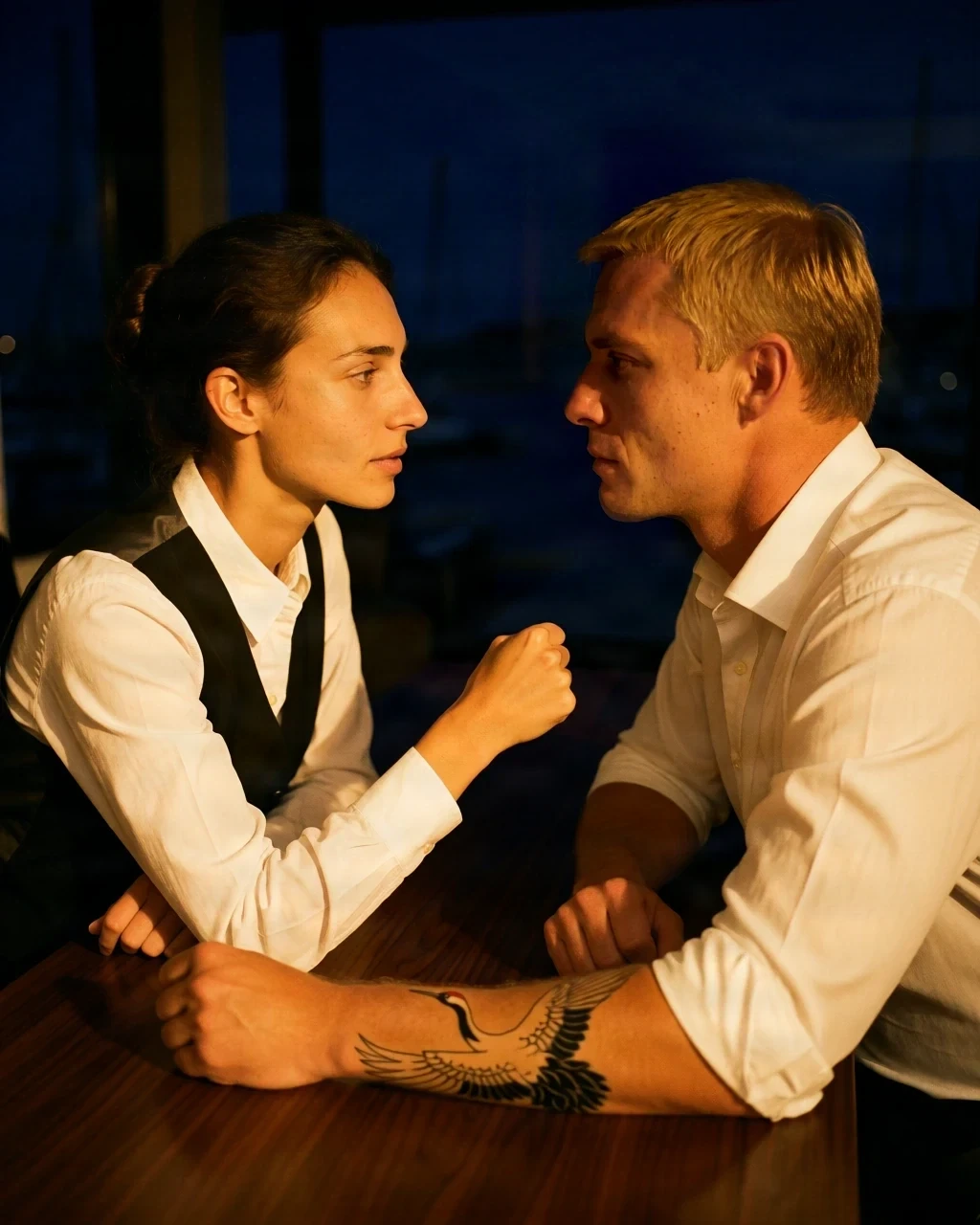
Ash-blond hair cut close. A white shirt with the sleeves rolled. And on his left forearm, wrist to elbow and on up under the cotton, birds. Cranes in black ink, wings raised. Dozens of them.
His eyes are the gold of a casino chip held up to a lamp. I'd heard that and assumed it was poetry.
It isn't poetry.
"You need a wife," I say. "In five weeks. Before you turn thirty-seven, or the docks go to your cousin, which means they go to your uncle Bastien."
"You've read my grandfather's will."
"Everyone in Marseille has read your grandfather's will. The barman at the Môle has it laminated."
"So you've come to apply."
"I've come to propose. Applying is for women who didn't bring a contract." I put the envelope on his desk, square to the edge, the way I'd square a deck. "Three pages. Eleven clauses. You'll like clause nine."
"Why would I marry a dealer?"
"Because the women in this port who aren't frightened of you want the docks." I hold his eyes. I'm good at that; it's most of my job. "And you touched your ring finger twice when I said wife. You've been thinking about it for longer than five weeks."
He goes very still.
Then he puts his left hand flat on the blotter, where I can see it, and leaves it there.
"Clause nine," he says, and opens the envelope.
He reads every word. Most men skim a page the way they skim a woman, top and bottom and a guess at the middle. Cassian Moreau reads every line, the whole way down.
"Clause one. A year, then a quiet divorce."
"You keep the docks. I keep my name."
"Clause two. Your father's debt to this family, written off on the wedding day." He doesn't look at the figure. "Two hundred and twelve thousand, four hundred."
I wrote two hundred and twelve thousand. I didn't know about the four hundred.
"All of it," I say. My voice comes out steady. Good voice.
My father's heart is bad. The Moreaus never call a debt in, the port says. They just let it grow until you're living inside it.
"Clause three. Separate rooms." He turns the page. "Clause six. No oranges at breakfast."
"Non-negotiable."
"Clause nine." He reads it aloud, slowly. "Nothing in this contract buys anything in a bed."
"I wanted that one in writing."
"It's the best clause here." He says it as if he means it, which is worse.
He unscrews a fountain pen. Fat, black, gold nib. I think he's going to sign. He doesn't. He turns to the last page, to the blank margin under clause eleven, and writes in a small upright hand, and turns the page round to me.
12. He will not touch her until she asks.
I read it twice.
"That's my clause nine with better manners."
"No." He leans back. The chair doesn't creak. Nothing in this room would dare. "Nine says what you don't owe me. Twelve says what I won't take." He caps the pen. "You can have anything in this port, Mira. I'm the only thing you'll have to ask for."
I'd like to say I have an answer to that.
I'm looking at his mouth. Years of reading men across green felt, and I'm staring at his mouth like it's the last card in the shoe.
A sensible woman would pick up her envelope and walk back down those stairs. Nobody would stop her. He made sure of that; the door's still open.
A sensible woman's father doesn't owe two hundred and twelve thousand, four hundred.
"Sign it," I say.
He signs. Then I sign under him. The last time I put my name under someone else's was on a scoresheet nine years ago, and I never finished that one.
I stand and put out my hand across the desk, because that's how you close a deal in this city: a hand, a look, and a lie about staying friends.
He looks at my hand.
He doesn't take it.
"You didn't ask," Cassian Moreau says, and goes back to his orange.
The wedding is at the mairie the next week, on a Thursday morning, because he knows a deputy mayor who owes him a favour and sweats through the whole ceremony.
I wear cream silk from a vintage shop. Two weeks of tips. He wears a dark suit and no tie, and his sleeves are down over the birds. I find I resent that, and decide not to look at why.
My father cries throughout. Happy crying, which is worse. "You look like her," he whispers, meaning my mother, and I let him have that.
His aunt, small and old in black pearls, watches me say my vows as if she's pricing me by the gram.
On the steps outside, the photographer is a nervous boy with a borrowed lens. He arranges us against the stone. "Monsieur. Your hand, maybe, at Madame's back?"
Cassian doesn't move.
It takes me a second. Then something warm and terrible goes through me, from my throat to the backs of my knees.
He's waiting for me.
"Your hand," I say, not looking at him. "At my back."
His palm settles at the base of my spine. Flat, warm through the silk, exactly where I said and nowhere else. His thumb doesn't move. His fingers don't move.
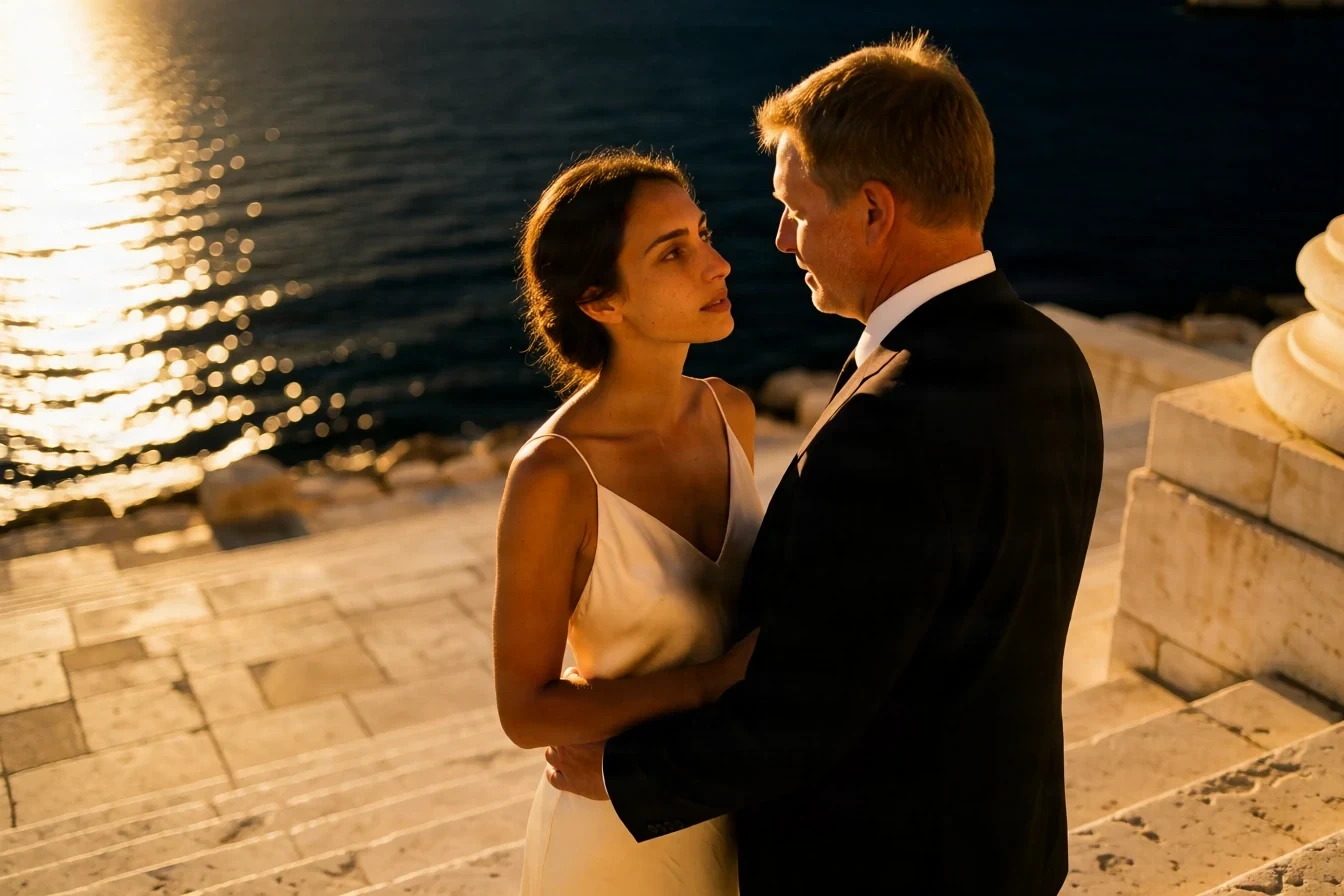
It's the most obedient hand I've ever felt, and I've never been touched so thoroughly in my life.
I look up. His jaw is tight. There's a pulse going hard in the side of his neck, and the hand on my back is so still it must hurt.
"Two years," he says, so low the photographer can't hear. "I've watched you deal from the gallery for two years. You never once looked up."
My throat closes.
"I'm looking now," I say.
He breathes out. Slowly, as if he's been holding it since the first shift.
"Now kiss the bride," the boy calls, delighted with himself.
Gold eyes, very close. I can smell the orange on him.
I don't ask.
He doesn't take it.
"We're private people," Cassian says, and the boy puts his lens cap on.
"Are we?" I ask him, under my breath.
"We are now."
His hand is still where I put it. I haven't told him to move it.
That's when a man in a camel coat comes up the steps.
Silver hair, a kind face, a good lawyer's handshake. He takes my hand in both of his.
"Bastien Moreau. The uncle. Félicitations." He doesn't let go. "I remember you, you know. The Pharo. The last round." His thumb moves across my knuckles. "Such a shame. I had money on that game."
The sea glare goes white. I was nineteen, one game from a national title, with a television camera on my face. I got up from the board and walked out, and I've never told anyone why.
I can't get my hand back without making a scene.
The hand at my back doesn't move. It goes still in a different way, and I feel that too. Cassian doesn't touch his uncle. He just speaks, at the volume you'd use to order coffee.
"Your boat's mooring comes up for renewal on Monday, Bastien. I chair the committee."
Bastien lets go of me. He smiles at his nephew, very warmly, and goes down the steps to a grey car. I've seen that car before. It was pulling off the quay at five to four, the day I climbed his stairs.
I breathe again.
"What was that?" I ask.
"Paperwork."
"You threatened your uncle with a mooring."
"I reminded him. Threats are for men without committees."
"Is that the secret? The whole port's afraid of a man with a clipboard?"
"The port's afraid of what it's heard."
"And what's true?"
"That I read everything I sign." He looks down at me. "Clause six. I've moved the oranges to lunch."
I laugh again, at a wedding, on the steps, with my hand still cold from Bastien's. It's the second time this week this man has made me do it, and I'm starting to keep count.
His house is tall and narrow, at the bottom of a tiny fishing harbour under the cliff road, where the boats are painted red and blue and yellow. It smells of floor wax and the sea.
"Is this where you bring all your wives?" I ask on the doorstep.
"Only the ones who bring their own terms." He holds the door and doesn't go through it first.
My room is at the top. White sheets, a window full of harbour, and a lock on the inside of the door, so new the brass still shines.
"Yours," he says, and puts the key in my palm without his fingers touching mine. It's a neat trick. I wonder how long he practised it.
"Do I need it?"
"No." He doesn't pretend to misunderstand. "But you should have it."
"And you?"
"Downstairs. There's a board in the study." He says it as if it's nothing. "I don't sleep much."
"Neither do I. Occupational."
"I know," he says, and goes down.
I lie on top of the sheets in my wedding dress and stare at the ceiling. I'm a married woman. I have cornicing.
My father's debt is gone. My father is alive. That's the trade.
I'm not thinking about the trade. I'm thinking about his hand. How it didn't move. How it would have, if I'd said lower.
Clause nine, Albescu. You wrote it yourself.
I take the dress off and pull on my old T-shirt. I look at the key on the nightstand for a long time.
I don't lock the door.
Some time after two, I hear it. Wood on wood, soft and deliberate. A piece being set down on a board.
Then another.
I haven't touched a chess piece in nine years. I miss it every single day.
I count the moves. I can't help it. Twelve. Twenty. Thirty. Whoever's playing isn't thinking; they know these moves by heart.
In the end I go down the stairs barefoot. The fourth one creaks. He doesn't turn round.
He's at the board in shirtsleeves, rolled again, the cranes dark in the lamplight. On the inside of his left wrist, where the skin is pale, there's a space among the birds the size of a coin. Bare. Waiting for something.
I file it. I don't say a word.
He's playing both sides. Black's queen goes deep, to b2. White's rook swings to the g-file.
I know this game.
I know it the way you know your own handwriting. The Pharo, the last round, the opening I prepared for a month. I was White. Move thirty-six. Thirty-seven. Thirty-eight.
That's where it ends. In every record in the world, the game stops at move thirty-eight, with my clock run out and my chair empty.
He doesn't stop.
He picks up my rook and takes on g7.
Check.
It's the move I sat over for four minutes and eleven seconds, with my father grey in the third row, and never played. The first move of a mate in six that nobody has ever seen. Not the arbiter. Not my mother. Not one living soul.
"Where did you get that?" My voice comes out wrong.
"From you." He doesn't look up from the board.
"I never played it. I never showed it to anyone."
"You showed me." Now he looks up, at me in my T-shirt and bare feet, and doesn't look away. "Most nights, for two years."
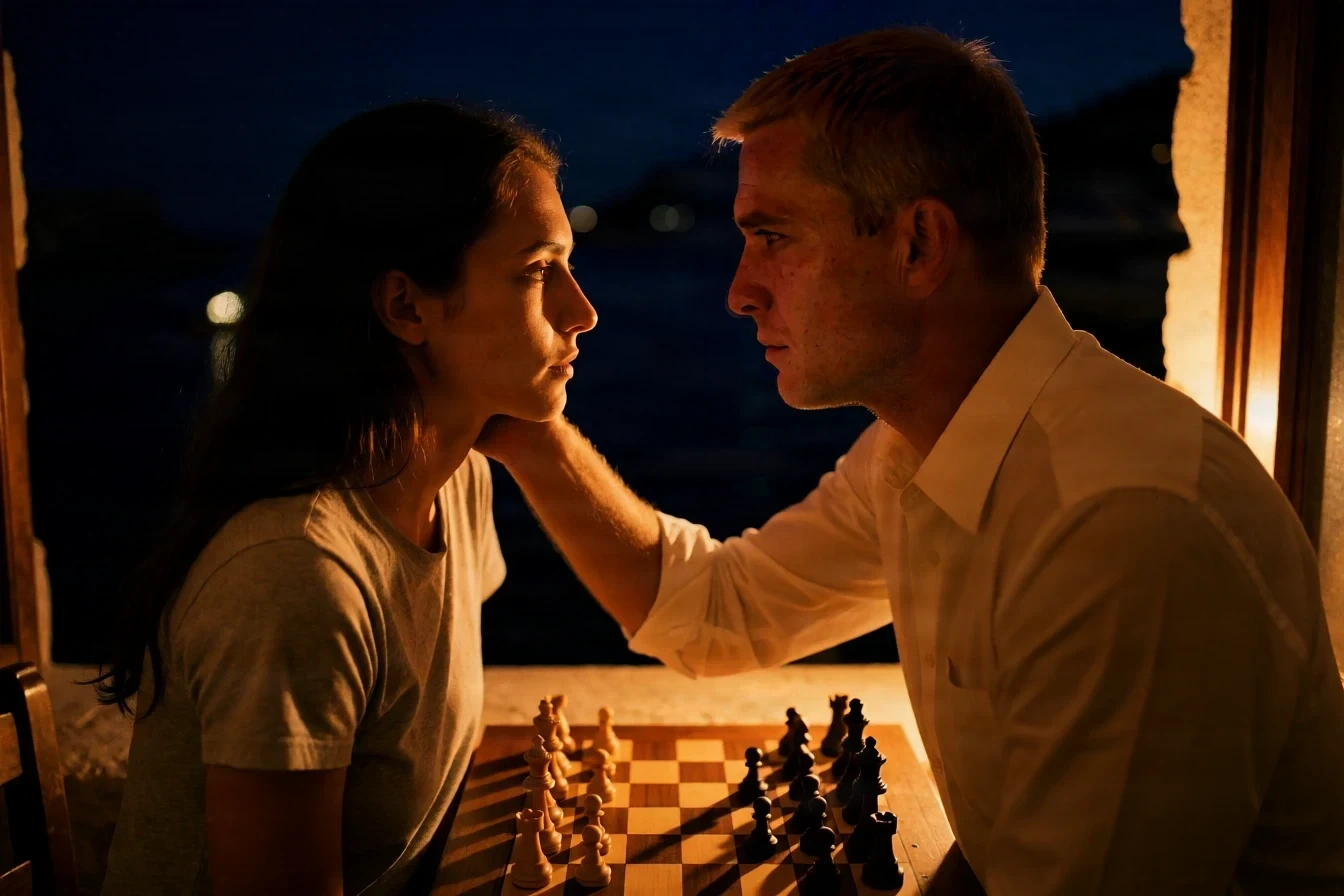
"Sit down," Cassian says, "and I'll tell you how."
I have a key upstairs, and a lock, and a clause nine in my own handwriting.
"Five minutes," I tell him.
I pull out the chair across from my husband, sit, and start his clock.
End of chapter 1

Next · chapter 2 · His · Cassian
The Rule
My wife starts my clock at three in the morning, and I have five minutes to explain two years.
Chapter 2 is free with an account.
Complaints: support@teasing.me, resolved within 5 business days. Complaints policy · Anti-trafficking policy