
Her · Livia · Chapter 1
The Inheritance
AURELIO
The old man takes all night to die, and spends it talking about money.
At dawn he asks me to seal a tablet beside the senator's wheat sheaf. I read it twice. Then I seal it.
Eighty-nine men have failed to put me on my back in the sand.
His wife could do it with one word.
LIVIA
My husband leaves me three things: a debt, a ludus, and a man who has never once lost.
The advocate reads them out in that order, which seems fair. The debt is the largest.
"Four hundred thousand sesterces," he intones, "owed to the senator Gaius Varro, and due at sunset on the last day of the Games."
I knew. I found the loan in the spring, in a drawer, under a poem my husband had written about himself.
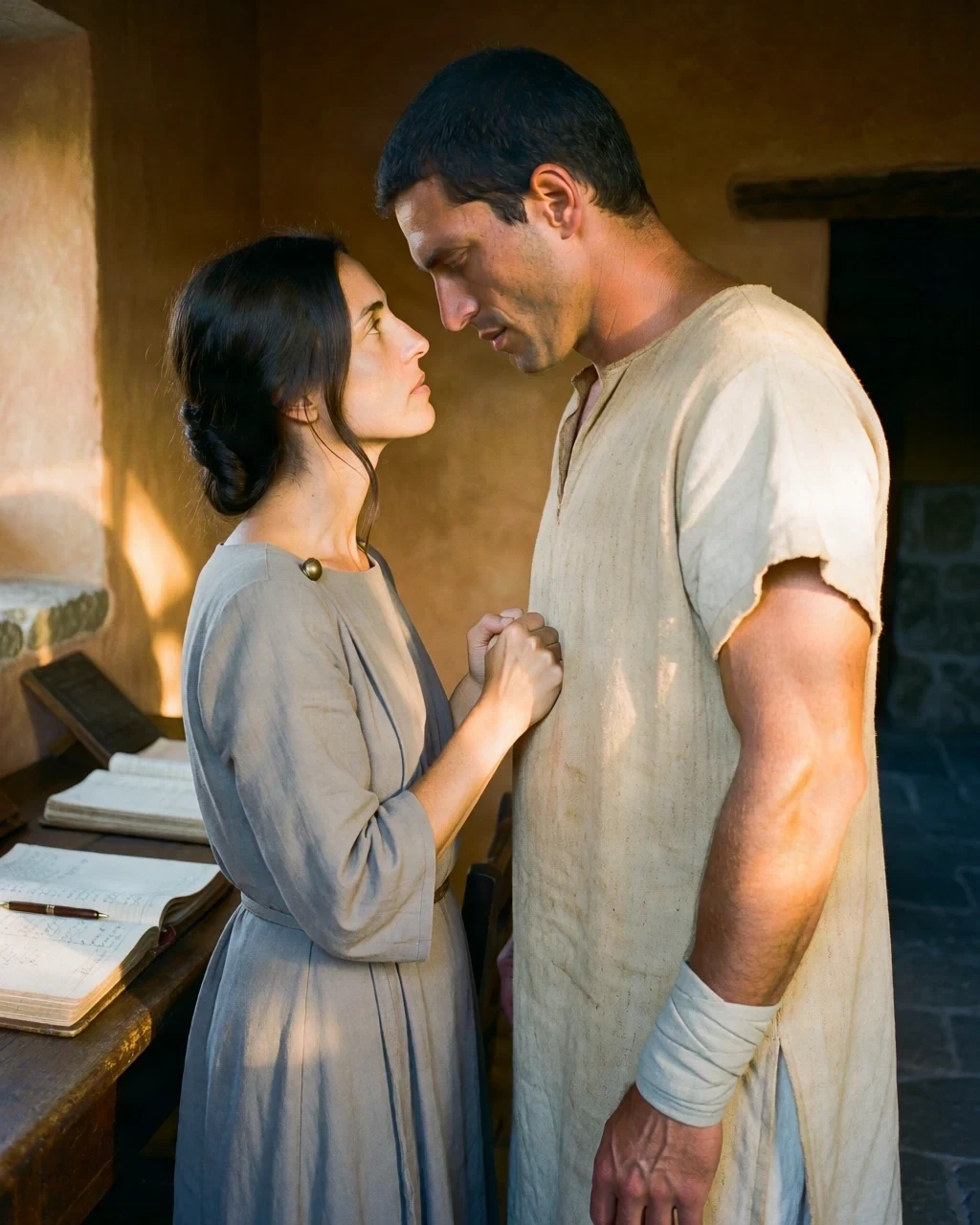
At the back of the atrium, against the last pillar, Aurelio Vale is looking at the floor. He always looks at the floor when I'm in a room. I feel it anyway, on the back of my neck, like standing too near a brazier.
What I want is simple. I want this roof over my head when the summer ends. I want to get through the next hour without anyone seeing my hands shake.
I'm in mourning grey, with ash from the family wall still on my hem. I've kept this house's accounts for years and my husband took the credit for every one. The honest total is this: he married me for my handwriting.
He never complained about it. I'll give him that.
I've been on my feet since dawn. Somewhere around the second page of obligations the floor begins to lean, and something touches the backs of my knees.
A stool. I sit down on it before I've decided to.
When I look round, every fighter is still in his place along the wall. The only one who could have crossed the atrium that fast is back at his pillar, studying the tiles with great interest.
His hands are wrapped to the wrist in clean linen. There's no training today. They're always wrapped. In seven years I've never seen them bare, and I've signed for every yard of that linen.
My pulse is doing something a widow's pulse should not.
"There is a further document," the advocate says, "for the witness."
He holds out a wax tablet, tied with cord and sealed. The seal is a wheat sheaf. I know it; it's stamped on every granary door along the river.
Aurelio comes forward and takes it. He doesn't break it. He doesn't even look at it. He slides it inside his tunic, flat against his chest, and every head in the room turns to me.
My stomach knows before I do. Something about this house has been decided, and it's been handed to him.
"What's in it?" I ask.
"Your husband's last wishes, domina."
"I've just heard his last wishes. They were mostly debt."
"These are the ones he didn't want read aloud."
"Then read them to me quietly."
A pause. "Not today."
"Then don't call me domina."
"It's what you are." His voice is low and unhurried, the voice of a man who has never needed to raise it. "It's written on a tablet."
"So is whatever you've got against your chest," I say. "And I'm not allowed to read that one either."
Somebody along the wall coughs to cover a laugh. Aurelio says nothing at all.
The tips of his ears go red.
I've seen that happen four times in seven years. This is five. I've noted every one. There are things a widow ought to confess to a priest, and I'm keeping this one.
"The witness," the cook breathes in my ear, the moment the advocate has gone. "You know what the kitchen says."
"The kitchen says the fish is fresh."
"The kitchen says he was alone with the old man the night he died. All night, door shut." She lowers her voice, which with her means the next street can still hear. "He came out at dawn and didn't speak for days."
"Then he's grieving," I say.
"For him?"
That is the question, isn't it.
The counting room is the only room in this house that's mine, and it was mine for years before anyone said so.
My father kept these books until his heart stopped over them. The next morning my husband set the ledgers in front of me and said, "You'll want something to do."
I open the big ledger and read my own house like a stranger's.
One yard, sand. One mule called Consul, who ate the trainer's hat this morning. Seven fighters under contract, every one a free man, because the Bowl of Sarnum takes no man who isn't free and willing. That law is older than the city walls.
And Aurelio, who has his own pages.
Aurelio Vale, free-born, thirty-three. Bouts: eighty-nine. Lost: none.
Victor's purse: payable to free men only. Sworn men fight for the house.
Eleven bouts left on his oath, all of them in the Games, which open tomorrow. The house's fee for him is already spent. I spent it. On the funeral.
Without him, this house is a sandpit with a mule.
Here is what a sensible woman would do.
She would send for the advocate, and a lamp, and the trainer to stand by the door. She would not send the cook to the yard for the man the kitchen thinks sat up all night with her husband for reasons of his own.
I send the cook to the yard.
When he comes, I shut the door behind him myself.
He stands just inside it, as far from me as the room allows, sand to the shins, a practice sword hanging loose in his wrapped hand as if he's forgotten it. The room gets smaller. Rooms do, round him.
"The kitchen thinks you killed him," I say.
"The kitchen thinks the fish is fresh."
My own line, in his mouth, perfectly straight. I nearly laugh. He sees me nearly laugh, and something in his face goes careful.
"You were listening."
"I always am, domina." He looks at the rushes. "He was old. He drank like a drain and he'd been dying since the spring. I didn't hurry him. I sat."
"Why you?"
"Because nobody else would have."
"And the tablet?"
"After the Games."
"That's eleven bouts away."
"Then you'll have to come and watch them." His eyes come up off the floor and find my face. They hold it, level, for exactly as long as I can stand. "I'm told the house box has a good view."
"You'd know. You've never looked at it."
That lands. I watch it land, all the way down his neck.
"Give me your hand," I say.
He goes still. "Domina?"
"I pay two denarii a month for that linen. I'd like to see what it does."
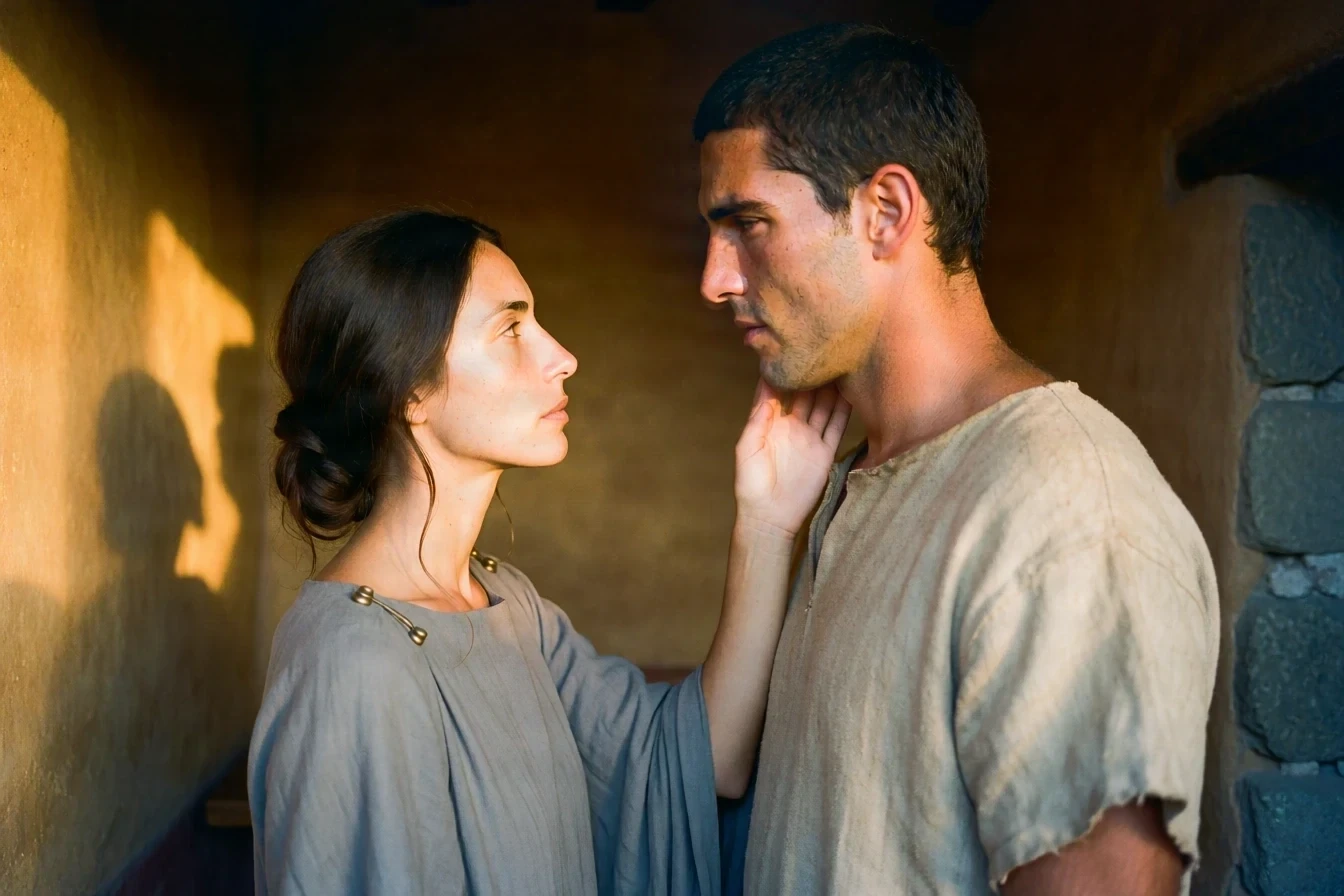
It's a ridiculous thing to say. He knows it. I know it. He comes across the room anyway, sets the sword against my desk, and holds out his right hand to me, palm up, the way you'd hold out a coin you weren't sure anyone wanted.
I take it.
It's warm through the linen. Broad. Heavier than I thought a hand could be. I turn it over under the lamp, the way I'd turn a bill to read the small print, and run my thumb along the wrap where it's tucked in at the wrist.
He holds still.
Not calm. Still, the way you hold a full cup on a stair. His breathing has gone slow and careful. A muscle works in his jaw. His fingers lie open in my palm as if he's been told that if they close, the house comes down.
His eyes shut, once, and open again slower, as if he's been waiting a long time for something and has decided not to trust it yet.
I was married for seven years. Nobody in all that time went this still because I touched him.
"Is it tight?" I ask. "The wrap."
"No."
"Then why are you shaking?"
"Because there's a litter at the bottom of the street," he says, very low, "with a purple stripe in it. He'll be at your gate before you've let go of me."
The gate bell rings.
Senator Gaius Varro arrives the way weather does. You see him coming, and you know there's nothing to be done.
He's handsome in a well-fed way, with a senator's purple stripe down his tunic and a wheat sheaf on his ring. He kisses my hand and tells me my husband was a great man, which is how I know he lies.
Then he sits in my good chair and looks at Aurelio, by the window now, the way a man looks at a racehorse he's bet against.
"I'll buy his contract," he says. "Today. I'll forgive the debt and add fifty thousand for your trouble."
The sum does itself. The debt gone. Fifty thousand clear. A little house by the river, and a counting room nobody else takes the credit for.
"Why?" I ask.
"Because the city is tired of a man who never loses." He smiles. "And because I've wagered the grain contract for the whole river that Aurelio Vale is beaten before these Games close. A man protects his investments."
His eyes travel round the room: the lamp, the dry rushes. "So should a widow. Houses are fragile things. So are litters. And grain is so very dry in summer."
I have nowhere to go if this house falls.
"No," I say.
Varro's eyebrows rise, politely. "No?"
"His contract isn't for sale. Neither is the house." My voice comes out level. My knees under the desk do not. "We'll see you at the Games, senator."
"Will you." He rises and smooths his stripe. "I do hope nothing catches fire before then."
"Senator," says the man by the window.
Just that. Quiet. Varro turns.
"The law doesn't let a man in a purple stripe trade in grain," Aurelio says. "So your steward placed that wager in his own name, at the Games clerk's table, on the second of the month. It would be a pity if the praetor heard whose money it was."
He says it the way you'd tell a man there's a stain on his cloak.
The senator's smile thins to a line. He looks at Aurelio, then at me, and goes. Aurelio opens the door for him, and steps aside exactly far enough, and not one finger's width more.
"Tomorrow, Livia," Varro calls from the yard. "The odds will never be so kind again."
The gate bangs.
It shouldn't do anything to me, watching a man make a senator leave by standing still and knowing a date. It does a great deal.
"How do you know where his steward placed a bet?" I ask.
"The clerk drinks in the tavern by the river gate."
"And you drink with him?"
"I've never had a drink in my life."
I laugh, out loud, in my mourning grey, with my husband's ash on my hem. It's the first time since the spring.
"You lied to a senator."
"I told a senator where a clerk drinks. He did the rest of the sum himself." He picks up the practice sword. "Goodnight, domina."
He turns to go, and the lamp catches his right wrist, where my thumb worried the linen loose.
Something shows in the gap. The end of something hard and narrow, bound flat along the inside of his wrist under the wrap. Carved bone, stained green at the tip, bitten flat along one side.
I bit it flat. Over my father's ledgers, then my husband's. I lost it at the midwinter feast three years ago, when it fell from my hair into the lentils and I laughed at the old man's table. When I went to fish it out, it was gone.
I don't say a word. I file it, the way you file a figure that doesn't belong in the column and might be the only true one in the book.
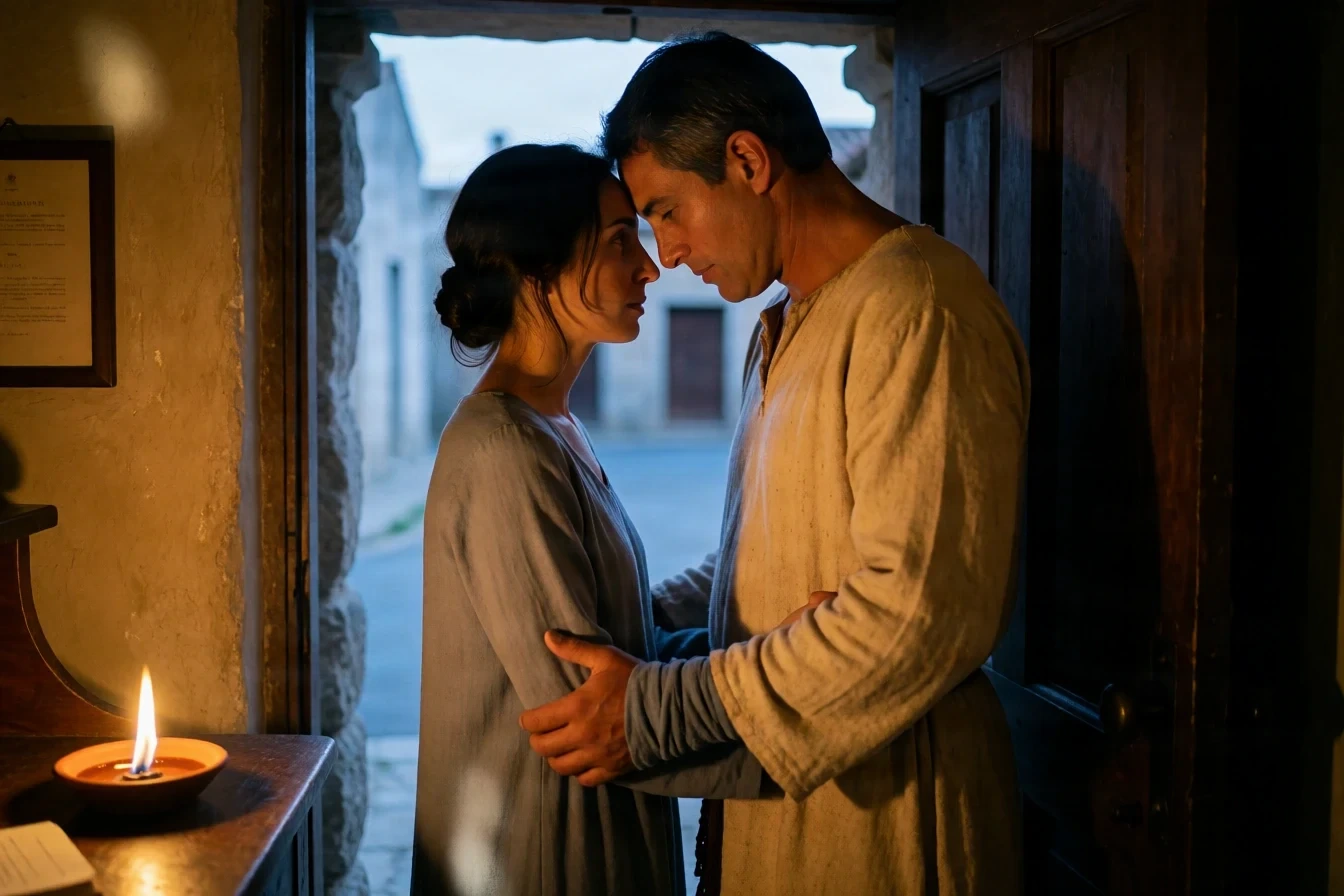
The strongbox key hung round my husband's neck for seven years. Tonight it hangs round mine, cold against my breastbone, and the counting-room lamp is the only light left in the house.
The oaths are rolled in oiled leather. Six are in the trainer's square hand, each with a fortune named: thirty thousand, forty, twenty-two. That's what a free man is paid for swearing his bouts to a house.
And that, the law says, is his way out. Twice his sum, paid back, and he walks out of the gate whenever he likes.
The seventh is older, and the hand on it is my husband's.
I, Aurelio Vale, free-born of Sarnum, swear myself to this house and its heirs for one hundred bouts upon the sand of the Bowl, and for this oath I take the sum of
Nothing.
Not a figure. Not a blot. My husband, who once sent a priest a bill for standing in our atrium, has written in his big lazy capitals: NIHIL.
I read it three times. I hold it to the lamp, as if the sum might be hiding in the grain of the vellum. Twice the sum to walk away.
Twice nothing is nothing.
He could have walked out of that gate any morning for seven years. Any morning at all, for free. And every morning he raked the sand, and wrapped his hands, and stood in my doorways instead.
I look at the date at the foot of the oath, and my hands go cold on the leather.
He swore himself to this house seven years ago, the week I married into it. The sum on his oath is nothing.
Down in the dark yard, wood knocks on wood. Small strokes, unhurried, each one landing where the last one did.
I put the oath in my sleeve, take the lamp, and go down barefoot to ask him what nothing costs.
End of chapter 1
Next · chapter 2 · His · Aurelio
Eleven
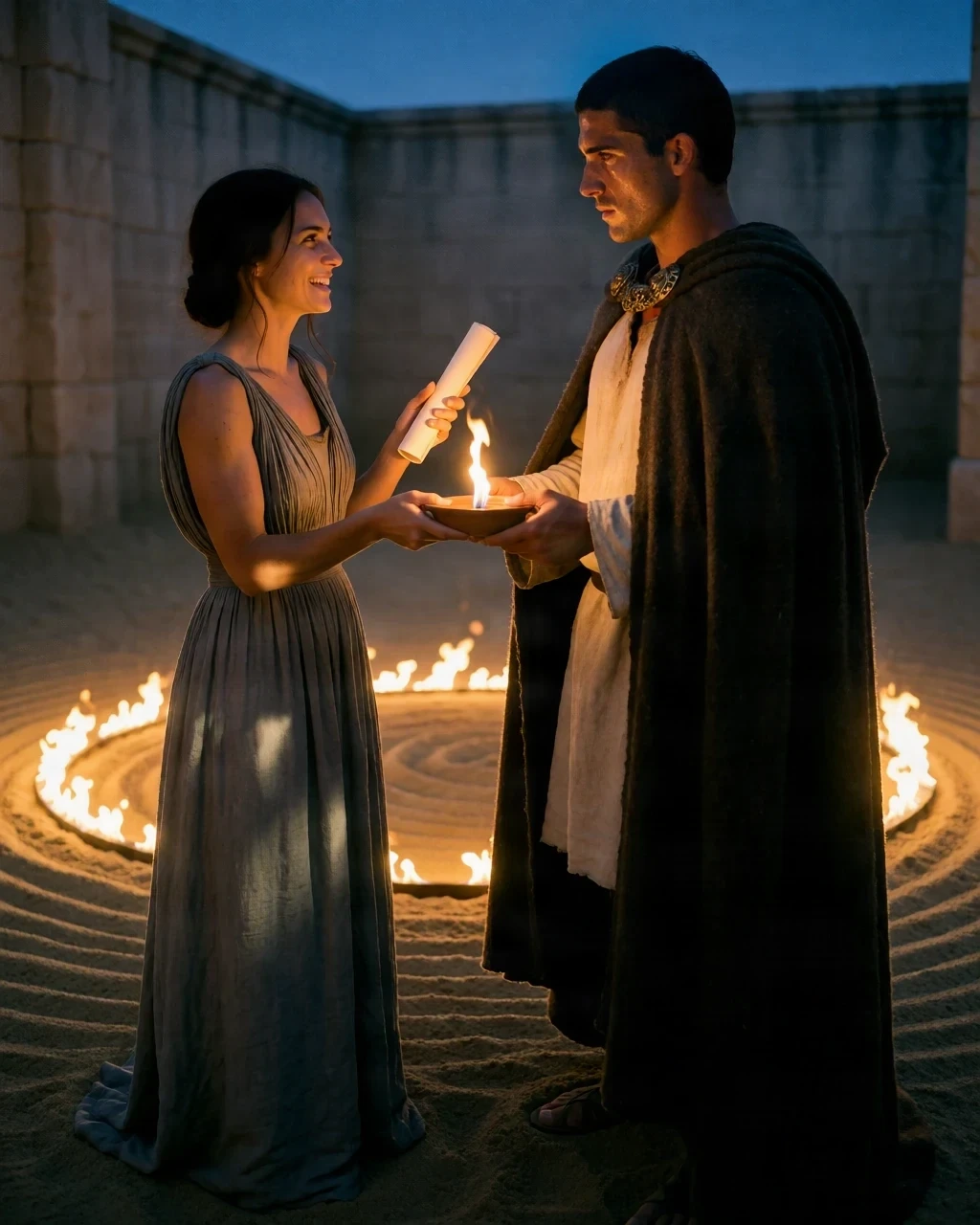
She crosses my sand barefoot at midnight, holding my oath to her lamp like a forged coin.
Chapter 2 is free with an account.
Complaints: support@teasing.me, resolved within 5 business days. Complaints policy · Anti-trafficking policy