
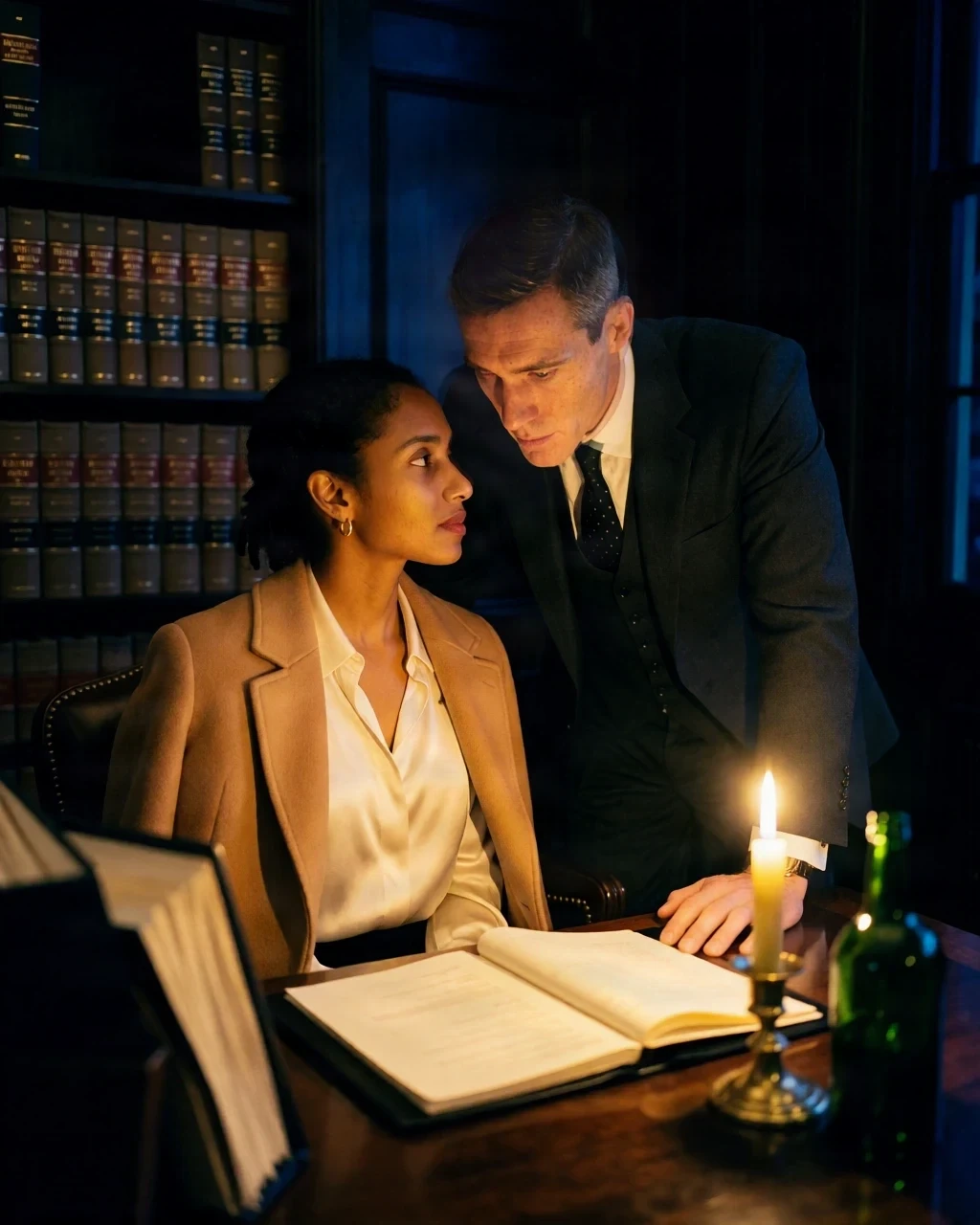
Lei · Priya · Capitolo 1
Night Three
ELLIOT
Definitions. In my hand, for nobody's file.
"Late" means a train held in a tunnel, and a woman who ran the escalator anyway.
"Mirror" means my window, which showed her the room, herself, and an empty doorway.
"Associate" means one of eleven. Each stayed a year. None remembers my name.
"Return": struck out. E.W.
PRIYA
My new boss doesn't show up in the office glass, and he still knows I'm four minutes late.
"Ms Natarajan."
His voice comes from the doorway behind me. I'm at my desk, one arm still in my coat, checking my lipstick in the window. On a November night it's a black mirror, and I'm a professional.
In the glass: me, one sleeve on. A stack of lever-arch files. The open door behind my shoulder.
Nobody in it.
I turn round. He's in it. Elliot Wren, senior partner, charcoal suit and waistcoat, a sheet of paper held between his fingertips as if it has let him down personally.
I turn back to the glass. Empty doorway.
It's night three. All I want is one shift where this man doesn't catch me at anything. The skin on the back of my neck goes cold and tight, the way it does when a contract has a clause in it I haven't found yet.
"Is something wrong with the window?" he asks.
"Anti-glare coating," I say. "Very good. Very expensive. Very selective."
"The train sat in a tunnel for nine minutes. You made five of them back on the escalator."
I didn't tell him that. I didn't tell anyone. My stomach drops a floor before my brain has finished the sentence.
"Do you have the Underground's incident log," I say, "or just me?"
"As of tonight, both."
He comes in. He comes the long way, round the far end of the desk and past the files, so that he ends up in front of me and not at my shoulder.
He did it on night one. He did it on night two. The shortest line from that door to my screen runs straight over my left shoulder, and he has never once used it.
He lays the page down. My redline of a lease, and in its margin, in a narrow slanting copperplate, in ink the faded blue of a vein:
4.2 good. 4.3 better. 4.4 is a crime.
"4.4 is a break clause," I say.
"It breaks the wrong way."
He's right. I hate that he's right. I look at his hands on the paper, because his hands are safer than his face: long, pale, a signet ring on the little finger worn almost smooth.
Then I look at his mouth, because I have never in my life done the safe thing for longer than about a second. It's the kind of mouth you describe in a witness statement and then have to withdraw.
"Fix it by midnight," he says.
"Eleven."
"Ms Natarajan, it's a crime."
"Then it'll be fixed by eleven, and reduced to a misdemeanour."
Something happens at the corner of his mouth. It isn't a smile. It's the place a smile would stand if it had been told to wait outside.
"Eleven," he concedes. At the door he stops. "And Ms Natarajan."
"Mr Wren."
"The lipstick was fine."
I watch the doorway in the glass the whole time he's walking out of it. It stays empty.
Last year I billed more hours than a sane year has in it, at a firm in the City, and then I resigned before dawn from a locked cubicle on the ninth floor. By email. Three lines, one defined term.
Soon after, I answered an advert in the back of the Gazette. Night associate. Contracts. Triple salary. No chat. It's the sexiest sentence I've ever read, and I've read a great many indemnities.
The interview was near midnight. He asked me one question. "Do you read the definitions?"
"First," I said. "Always. That's where the bodies are buried."
He said "Monday," and didn't shake my hand, and I spent the whole night bus wondering what it would have felt like.
Wren & Hale bills only after dark. Our biggest client is a river. The Fleet has been bricked up under the pavements since the eighteenth century, and it's suing a developer over a basement.
At ten to eleven I take the lease across the corridor. He's writing by hand with a black fountain pen, and he doesn't look up.
"Crime remedied," I say.
"The victim?"
"Compensated. Out of court. He's very grateful."
"He's a landlord. They're never grateful."
"This one's had a fright."
He holds out his hand for the page without looking, and I put it there without touching him, which takes more planning than it should.
"The archive wants a lawyer who enjoys a disgrace," he says. "Basement. Take your coat." He turns a page. "The shelf marked Associates is not your matter."
"Noted," I say.
That's what lawyers say when they mean no.
The archive is colder than upstairs, and under its floor the river moves, steady and unhurried, like a client who bills by the century. The shelf marked ASSOCIATES is at the far end. Eleven files.
A sensible woman on triple salary would walk past it. I was sensible all my life, and it got me a locked cubicle.
I take the first one down.
1903 to 1904. 1916 to 1917. 1947 to 1948. Eleven women, all the way up to 2018 to 2019. Each one left exactly a year after she started. Not a day over. Not one resignation.
Each file ends with the same cream card. Printed inside: With thanks for the year. I return it gladly. Under it, her signature. The first in sepia. The 1947 one in biro.
The last one is Hannah's, in green felt-tip, with a small smiley face after the k, and my chest goes tight and stays there.
Not one of them mentions him. Eleven women spent a year in this building, and on paper the senior partner never met one of them.
I look Hannah up on my phone. General counsel at a bank. Her career history skips 2018 entirely. Career break, it says.
The best-paid year of her life, and she calls it a break.
"Somebody tell me this is a coincidence," I say to the floor.
The river says nothing. It's on a retainer.
I put Hannah's card back. Then I take the 1903 file and tuck it under my arm, because I've just decided the shelf marked Associates is my matter after all, and he's going to know it, and I want him to.
Past two, the lights go out.
Under the building the Fleet makes a noise like a large dog turning over in its sleep. Force majeure, I think. Act of river.
Without the light, my window stops being a mirror and turns back into London: a white dome, cranes, an office block opposite with nobody in it.
Then a light in the corridor. Small, yellow, coming.
He's carrying a candle in a brass stick, his free hand cupped round the flame.
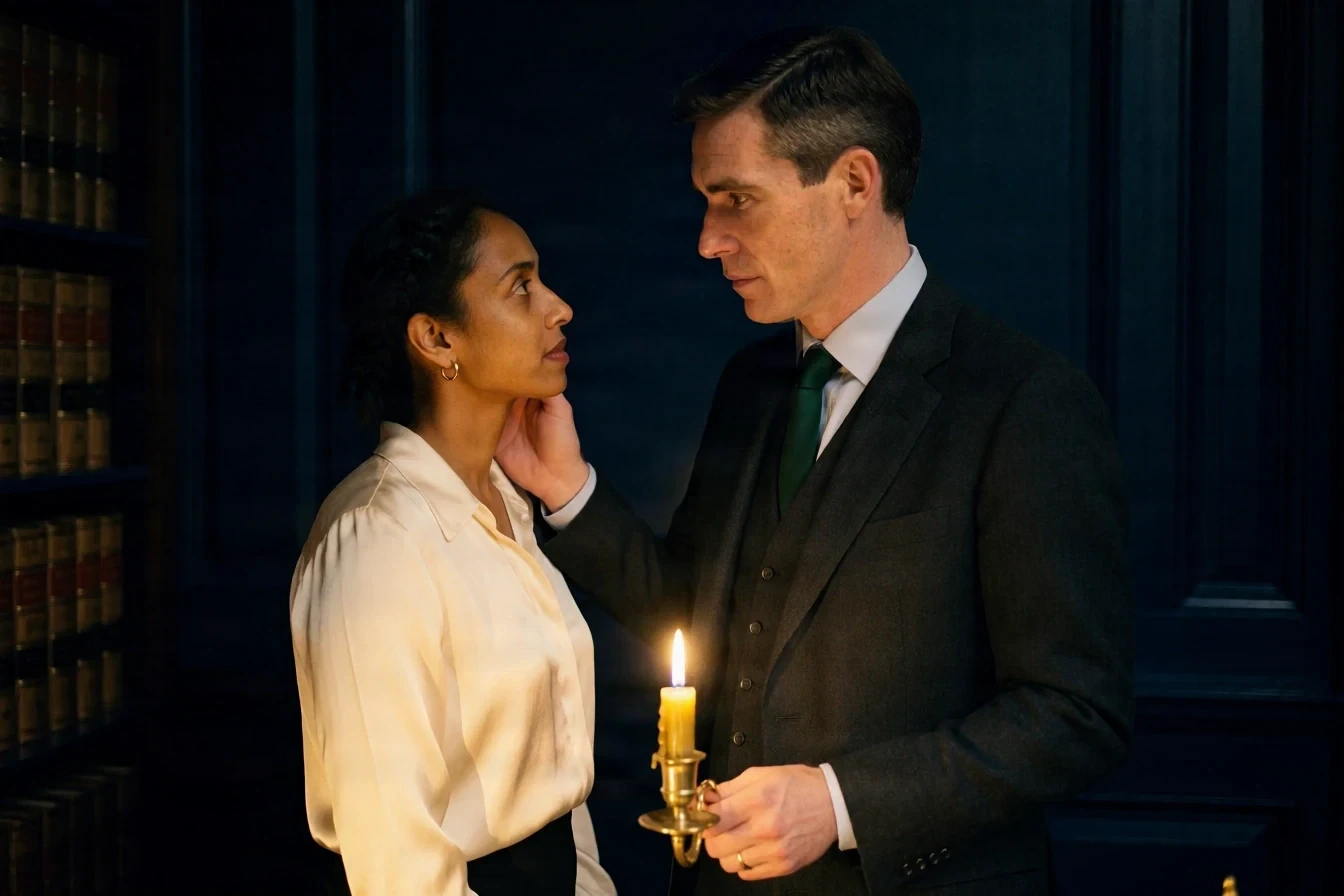
"The firm is older than the National Grid," he says, "and has never entirely trusted it."
He sets it on my desk, beside the 1903 file. He looks at the file. He doesn't mention it, which is worse than if he had.
"Is it the river?" I ask.
"The river doesn't do this. The river floods in March and sends a note first."
My phone rings.
It's the middle of the night, and the name on the screen is the managing partner of my old firm. Their letter came on Monday: they want my retention bonus back, every penny, plus costs, for leaving without notice.
My hands go cold in a way that has nothing to do with the heating.
"Answer it," Elliot says.
"It's two in the morning."
"He bills in six-minute units. He thinks the night is underused."
I laugh, and it comes out wrong, and I answer.
He doesn't say hello. He says clawback. He says proceedings. He says, "We were very disappointed in you, Priya," in the voice he used when he'd decided I could stay until four.
I can't answer him. I mean that plainly. Years of practice, and my throat just shuts.
Elliot holds out his hand. Palm up. Not reaching. Asking.
I put the phone in his palm. My fingertips brush the middle of it, and it's as cold as the glass.
"Elliot Wren. Ms Natarajan's employer." He listens, briefly. "Yes, I've read it. I've also read your time records for the March you billed sixty hours from a yacht."
A pause.
"No, I shan't be sending them anywhere. You'll withdraw your letter by Friday, and then there'll be nothing to send."
He hands the phone back. The call has ended.
"He's withdrawing it," I say.
"By Friday."
"How do you have his time records?"
"His wife sends them to me. She thinks someone ought to have them."
"That's blackmail."
"It's a reminder. Blackmail has a price. I didn't ask him for anything."
"You read up on me before you hired me."
"I read up on everyone."
"Then you knew about the ninth floor."
"Yes."
"And you hired me anyway."
"I hired you because of it," he says. "A woman who resigns in one defined term never signs anything carelessly again."
"Is that a compliment?"
"It's a reference. I don't give compliments. They can be cited."
I want to say something clever. What comes out is the truth.
"I was so tired for so long, and nobody noticed until I stopped."
He doesn't try to fix it. He lets it sit between us, like something that deserves room.
I'm shivering. The heating died with the lights, and this building was already the temperature of a wine cellar.
"You're cold," he says, and takes off his jacket.
He doesn't come round behind me to drape it, the way men do in films. He holds it up in front of me like a tailor, and I stand and put my arms back into it, facing him, and he brings the lapels together at my collarbone.
His knuckles stop just short of my throat.
The jacket isn't any warmer than the room. A jacket a man has worn all evening ought to be warm. This one is the temperature of the window.
His tie is crooked. It's been crooked since eight, it has bothered me since eight, and I've had a long night.
So I fix it.
I take the knot in both hands and slide it up and settle it, and turn his collar down over the silk. It doesn't take long. My knuckles are against his throat the whole time.
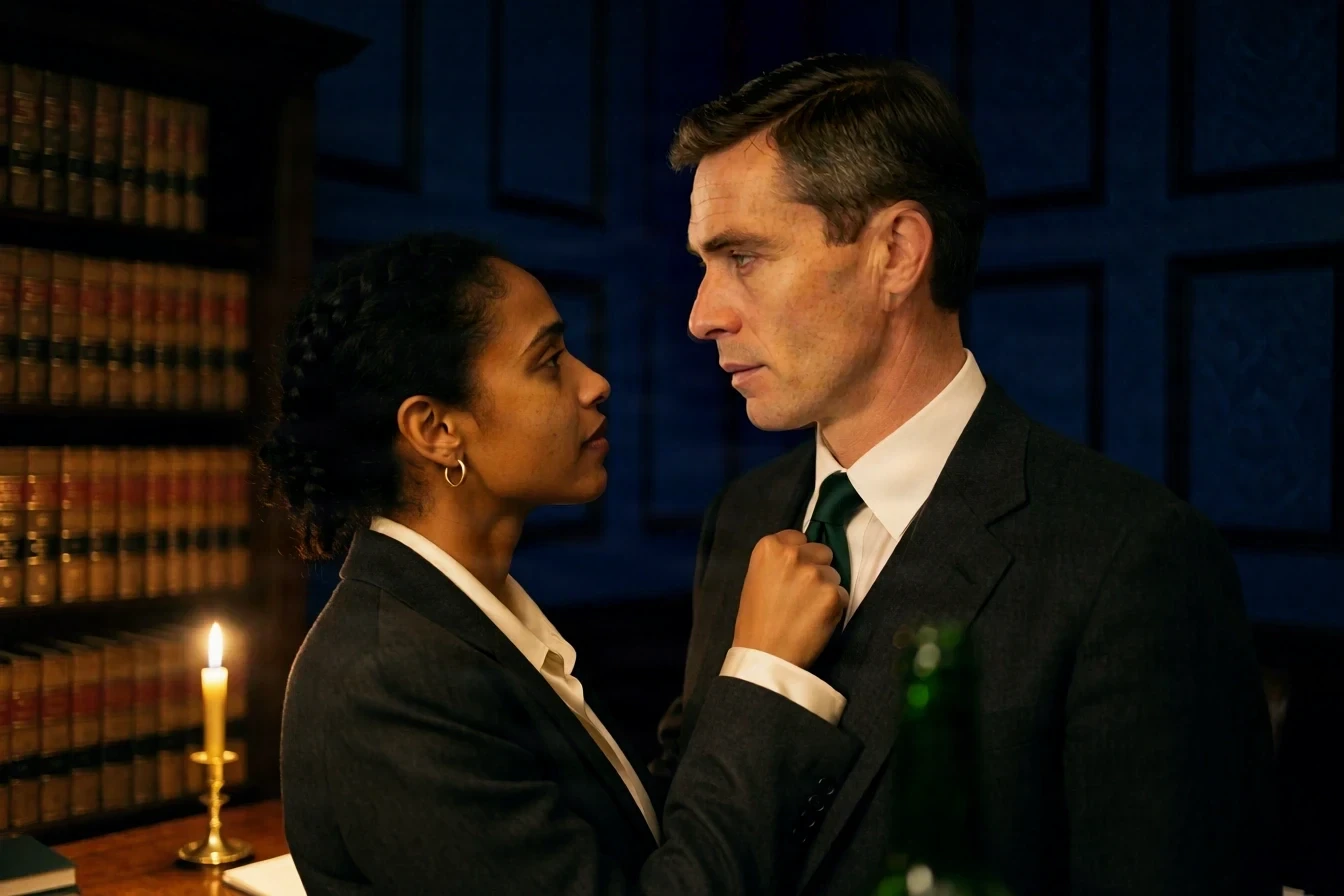
He doesn't move. Both his hands go into his trouser pockets at once, as if he's putting them somewhere safe. His eyes close.
"Ms Natarajan," he says, to the dark above my head, like a man reading a warning into the minutes.
"Your tie was crooked."
"It's been crooked for years. Nobody's dared."
"I dare. It's in my contract."
"It isn't."
"Then you should have drafted it better."
He opens his eyes. Up close they're grey, the clear cold grey of a window before dawn, and they look at me as if I'm the only lit thing in London. Tonight I might be.
"Why do you keep your hands in your pockets?" I ask.
"Because they want to be somewhere else."
"Since when?"
"For a long time," he says. "Longer than you'd believe. I was waiting for someone to read the definitions."
My hands are still on his tie. I don't take them away. The candle leans towards me and away from him.
"You can take them out," I say. "Your hands."
"No," he says, very gently. "I can't. Not tonight."
"Your copy of your contract." He takes an envelope from his waistcoat without looking away from me. "Countersigned. I should have given it to you on night one."
I take it. This time I'm careful not to touch him, and I watch him notice that I'm careful.
"The Fleet's upset," he says, and steps back. "I'll go and talk to it."
He takes no light with him. I listen to him go down the stairs in the pitch dark, and he doesn't miss a step.
I open the 1903 file first. Evidence in the order it was obtained.
It's a draft charterparty in brown ink gone soft with age. And in the margin of page four, in a narrow slanting copperplate I've been staring at all night:
Good. Better. This is a crime.
The ink is black. It's had a hundred and twenty-one years to get there.
My grandfather kept his shop ledgers in iron gall ink. It goes on pale blue and turns black over the hours. You'd have to be very old-fashioned to use it now, or very sure you'd outlast the paper.
House style, I tell myself. I know the difference between evidence and proof, and tonight I'm standing on the narrow dry strip between them.
So I read my contract instead. I know it already. Clause 1 even defines "return", at length and oddly tender, which I assumed was about laptops.
The signature page is last. My name, and his signature under mine. I hold it up to the candle to look at the watermark, because I'm the kind of woman who looks at watermarks.
Through the paper, backwards, there's writing on the other side.
I have never, in eleven years of practice, signed a page without turning it over. Then a man with good hands passed me his pen, and I watched his hands instead.
I turn it over now.
One typed clause. I read it aloud, because a clause said out loud can't pretend it isn't there.
"Nineteen. On the Associate's leaving, the Associate's memory of the Firm returns to the Firm."
And under it, in ink so fresh it hasn't begun to darken, still the pale blue of the last hour, in his hand:
Not this one.
I uncap my own pen. Under his three words I write three of mine: Define "this one".
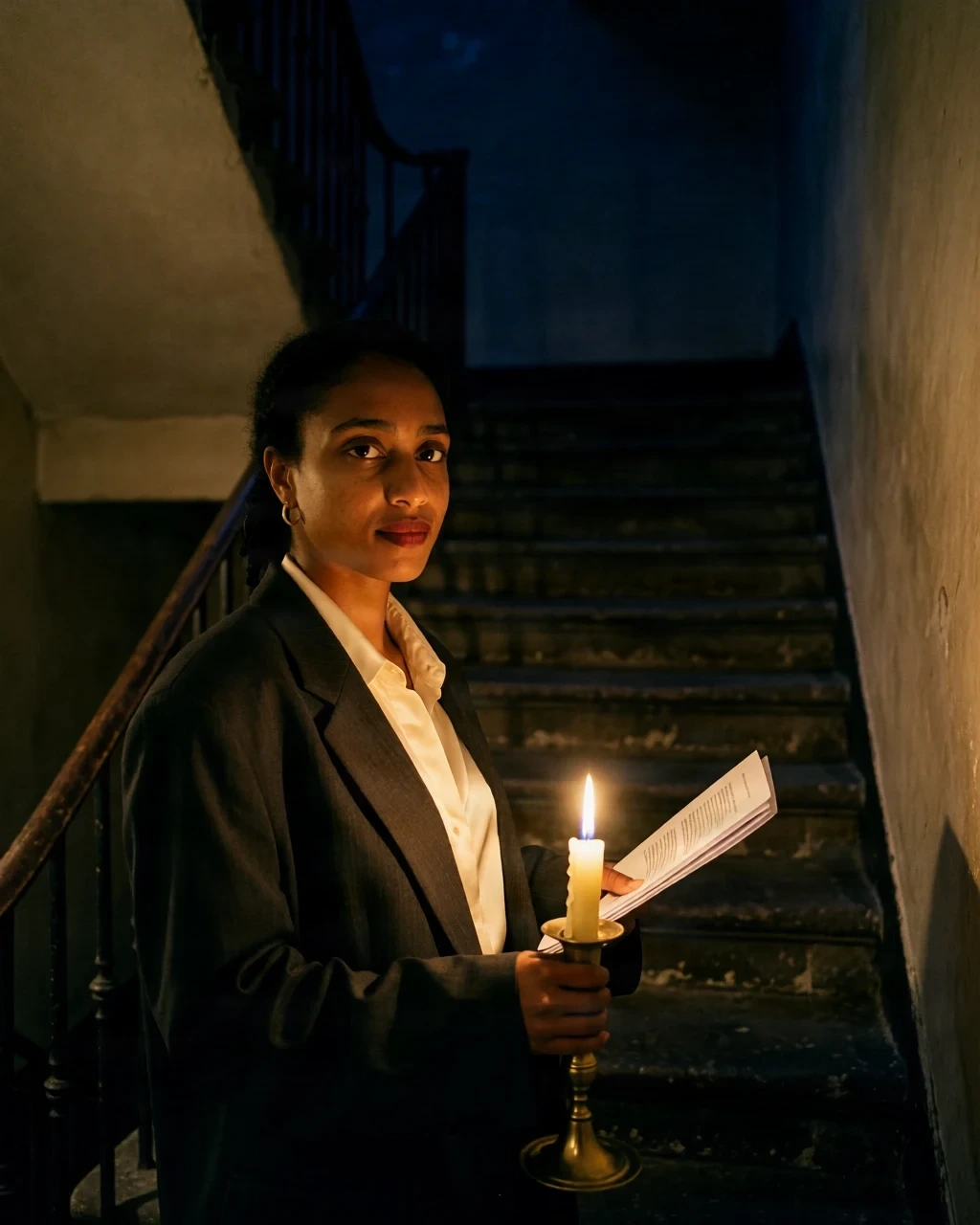
Then I pick up the candle, and the page, and go down into the dark after him.
Fine del capitolo 1
Prossimo · capitolo 2 · Lui · Elliot
The Clause
I have had eleven associates and forgotten none of them.
Con un account il capitolo 2 è gratis.
Reclami: support@teasing.me, risolti entro 5 giorni lavorativi. Politica dei reclami · Politica contro la tratta